Is curing salt bad for you? Not when you use it as directed. At the label rate, pink curing salt (Curing Salt #1, Prague Powder #1) is a regulated ingredient that makes cured meat safer by helping protect against botulism. It's harmful when it's eaten straight from the bottle, mistaken for table salt or overused.
That's why it needs to be measured, labeled and stored with care. Health agencies also advise limiting processed meat in general, which we cover below. This guide applies to any Cure #1, including Prague Curing Salt #1 from SPQR Seasonings.
Is the Older Pink Bottle Still Safe to Use?
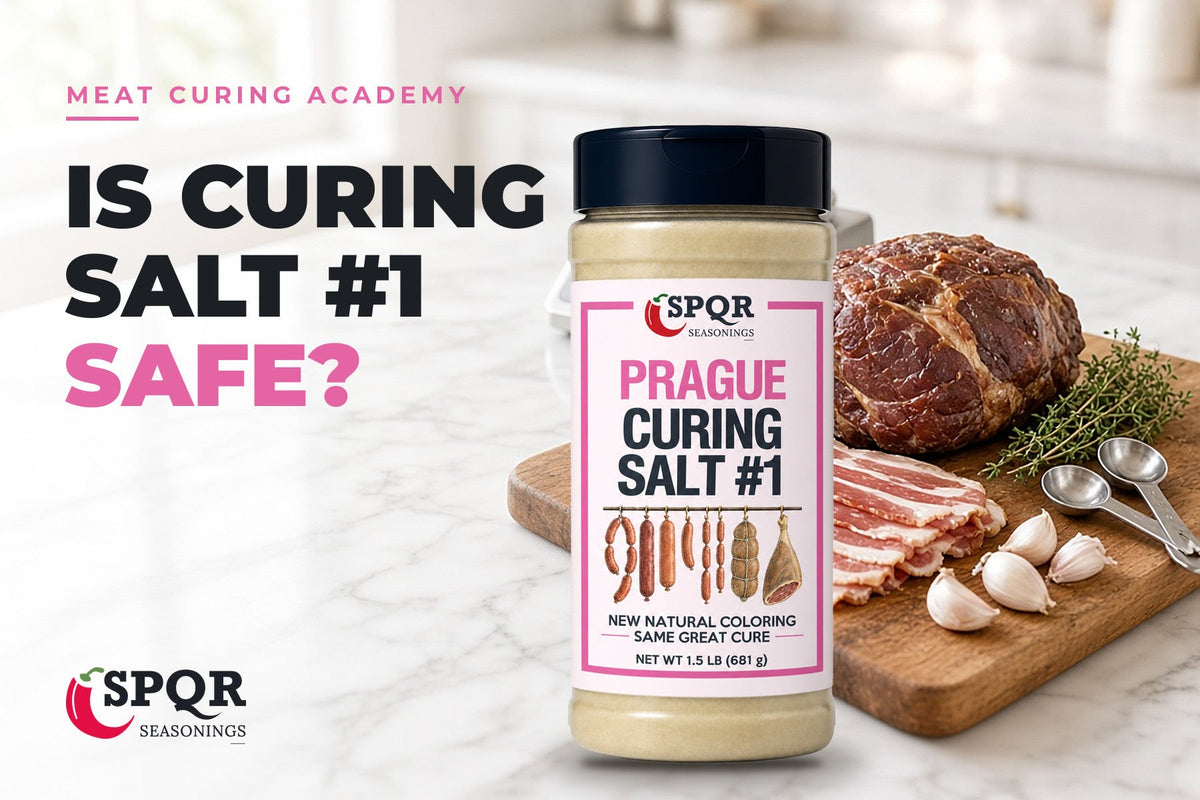
Yes. For a while you may get either a yellow or a pink bottle of our Curing Salt #1, whether you buy from SPQR Seasonings directly or on Amazon. New bottles say Prague Curing Salt #1 and are colored yellow with annatto extract. Older bottles were labeled "Pink Curing Salt #1" and colored with FD&C Red No. 3.
If you've bought pink curing salt from SPQR Seasonings before, this is the same product: the same 6.25% sodium nitrite, used at the same rate. The color is only there so you can identify the cure. It doesn't tint your meat, and older pink bottles are fine to use.
We changed the color because FDA has revoked FD&C Red No. 3 for food, with a January 15, 2027 deadline. Here's the full story on why it's yellow.
What's in Curing Salt #1?
Curing Salt #1, also called Prague Powder #1 or Cure #1, is 6.25% sodium nitrite blended into salt, plus a color so you can recognize it. The Prague Curing Salt #1 label from SPQR Seasonings lists Salt, Sodium Nitrite (6.25%), Propylene Glycol, Annatto Extract (Natural Coloring).
The salt does a safety job of its own: it dilutes the nitrite, so a normal, measurable amount of cure delivers a small, controlled amount of nitrite.
Why Use Curing Salt at All?
- Botulism protection. USDA's Food Safety and Inspection Service (FSIS) says nitrite "greatly delays the development of the Clostridium botulinum toxin." Oregon State University Extension calls curing salts "an important safety measure" because nitrite is "an effective inhibitor of Clostridium botulinum growth and toxin production." This matters most for meat that's smoked low and slow or held for days during a cure.
- Color and flavor. Nitrite produces the rosy color and cured flavor of bacon and ham, and it slows rancidity.
Curing salt is one safety layer. Refrigeration, proper cooking temperatures and tested recipes are the others.
Is Pink Curing Salt Bad for You? Can You Eat It?
In properly cured meat at the label rate, it isn't. Eaten straight from the bottle, it's harmful. At curing levels, sodium nitrite is a regulated, long-established food ingredient. In larger amounts it is harmful. Our label says it plainly: "INGESTION HAZARD: This product contains Sodium Nitrite. Eating this product directly or using it improperly may cause harm or serious illness."
- Why it's harmful in excess: too much nitrite interferes with how blood carries oxygen, a condition called methemoglobinemia. Children are more susceptible than adults.
- How much is dangerous: a University of Wisconsin hazard analysis used a conservative estimate that about 1 gram of pure sodium nitrite can be lethal for an adult (about 14 mg per kg of body weight) and about 0.2 gram for a small child.
- What that means in cure: Curing Salt #1 is 6.25% nitrite, so the adult amount is in roughly 16 grams of Cure #1, about 2¼ level teaspoons, for a 70 kg (154 lb) adult, and the child amount is in about 3.2 grams, a little under ½ teaspoon, for a 15 kg (33 lb) child. These are rough estimates that scale with body weight, and some people are harmed by less. That's why the bottle belongs out of children's reach.
- How poisonings actually happen: the same University of Wisconsin analysis notes that most reported nitrite poisonings involve sodium nitrite mistaken for table salt. In a 2002 case documented by CDC, five people in a New York household were hospitalized after food was seasoned from a bag labeled "table salt" that actually held pure sodium nitrite. All five recovered.
- Why a pre-blended cure is safer: with a 6.25% blend, adding too much to meat makes it unpleasantly salty long before nitrite reaches dangerous levels.
- Less remains in finished meat: nitrite reacts with the meat during curing, cooking and storage, so far less is left than was added.
Is Prague Powder #1 Dangerous?
Prague Powder #1 is the same 6.25% sodium nitrite cure as Curing Salt #1, so the same rules apply. It's dangerous when it's mistaken for table salt, eaten directly or overused. Measured at the label rate in a tested recipe, it's a long-established way to make cured meat safer.
How Much Nitrite Is Allowed?
| Situation | Sodium nitrite limit | Source |
|---|---|---|
| Home curing mixes (retail packages) | Directions must keep finished meat at or below 200 ppm | FDA, 21 CFR 172.175 |
| Ground or chopped products such as sausage (commercial) | 156 ppm ingoing | USDA FSIS, 9 CFR 424.21 and FSIS Table II |
| Pumped, massaged or immersion-cured products other than bacon (commercial) | 200 ppm ingoing | USDA FSIS Table II |
| Dry-cured products other than bacon (commercial) | 625 ppm ingoing | USDA FSIS Table II |
| Pumped or immersion-cured bacon (commercial) | 120 ppm ingoing | 9 CFR 424.22(b) |
| Dry-cured bacon (commercial) | 200 ppm ingoing (maximum) | 9 CFR 424.22(b) |
The USDA limits apply to inspected meat plants, but they're a useful benchmark for home curing.
How Much Pink Curing Salt per Pound of Meat?
- Label rate: use 1 level teaspoon for 5 lbs. of meat. That's the direction printed on Prague Curing Salt #1 from SPQR Seasonings, and it works out to about 1/5 teaspoon per pound.
- What that means in the meat: we weighed 10 level teaspoons of our Prague Curing Salt #1 three times (73 g, 68 g and 71 g), so a level teaspoon is about 7.07 g. That's roughly 0.31% of the meat's weight and delivers about 195 ppm of sodium nitrite going into the meat. FDA's limit for home curing mixes is 200 ppm in the finished meat. Our tested recipes weigh the cure to about the same level, 193 to 195 ppm, and never over 200 ppm. Ground meat like sausage has a lower 156 ppm limit, so it gets a little less than the label rate: about 2.4 g per kilogram, or 1.1 g per pound.
- Prefer to weigh? Use the rate for what you're curing. For whole cuts (whole muscle), like pork belly, brisket, ham or a pork loin, use about 1.4 g per lb (3.1 g per kg). That's the same as 1 level teaspoon per 5 lb, about 0.31% of the meat's weight, or about 195 ppm. For ground meat like sausage, use about 1.1 g per lb (2.4 g per kg), roughly 0.25% of the meat's weight, or about 156 ppm, the USDA ingoing limit for ground and chopped products. Use a scale that reads to 0.1 g, and round down, never up.
- Brines and injections: follow a tested cure recipe. Cure time depends on the size and type of the cut.
- Never add extra. More cure is not safer.
To scale that dose to your own piece of meat, calculate your exact cure amount from the weight, whether it's a whole cut (whole muscle), ground meat or a brine.
Cure #1 vs Cure #2
- Cure #1 (Prague Powder #1): salt plus 6.25% sodium nitrite. Use it for meats that will be cooked or smoked before you eat them: bacon, ham, jerky, corned beef, smoked and semi-dry sausage, and snack sticks. It's ideal for wet curing in a brine, and it also works in a dry rub. Prague Curing Salt #1 from SPQR Seasonings is a Cure #1.
- Cure #2 (Prague Powder #2): sodium nitrite plus sodium nitrate, which breaks down slowly over a long cure. Use it for long dry-cured meats that are eaten without cooking, such as dry salami and prosciutto. It isn't recommended for bacon. Curing Salt #2 from SPQR Seasonings is coming soon.
OSU Extension advises against Cure #2, or other nitrate blends, for bacon because nitrate is more likely to form nitrosamines when bacon is fried at high heat.
What the Label Tells You
Our label's caution panel spells out the rules:
- NOT TABLE SALT. KEEP OUT OF REACH OF CHILDREN.
- DO NOT USE AS TABLE SALT: This is not a table salt substitute or general seasoning. Avoid accidental ingestion.
- USE ONLY AS DIRECTED: For curing meat.
How to Identify and Store Curing Salt #1
- Read the label. Look for "Curing Salt #1" and "Sodium Nitrite (6.25%)." New yellow bottles say "Prague Curing Salt #1." Older pink bottles say "Pink Curing Salt #1." Don't go by color alone: brands use different colors, and SPQR Seasonings bottles may be either color right now.
- Keep it in the original labeled bottle. Never pour it into a shaker, salt cellar, grinder or unmarked jar.
- Store it in a cool, dry place away from direct sunlight, apart from your everyday salts, and out of reach of children.
- It's not table salt. Never use it as table salt or as a general seasoning.
If someone swallows curing salt (beyond the tiny amount in properly cured meat), call Poison Help at 1-800-222-1222 right away, or 911 if they're having trouble breathing, turn bluish or collapse.
Does Curing Salt Cause Cancer?
The World Health Organization and other health agencies advise limiting processed meats, because regular, long-term consumption is linked to a higher cancer risk. Oregon State University Extension explains that part of that risk comes from nitrosamines. They form when nitrite combines with amines from the natural breakdown of protein in meat, and high cooking temperatures form more of them.
That's why USDA caps nitrite in commercial bacon, with a 200 ppm limit for dry-cured bacon, and why the label rate on Curing Salt #1 matters. The label rate is a general guide, and our tested recipes weigh the cure to about 195 ppm. Going over the limit for the product (200 ppm for dry-cured bacon, 120 ppm for brined or injected bacon, 156 ppm for ground meat) adds nitrite without adding safety.
What About "Uncured" or "No Nitrite Added" Bacon?
Products labeled uncured, natural or "no nitrates or nitrites added" are usually cured with plant ingredients that are naturally high in nitrate, such as celery juice powder. OSU Extension notes that their nitrosamine risk is similar to traditionally cured bacon. The nitrite still comes from somewhere. Curing Salt #1 gives you a measured amount.
How to Reduce Nitrosamines When You Cook
FSIS and OSU Extension suggest:
- Don't burn your bacon. Well-done and burned bacon contains more nitrosamines.
- Microwaved bacon forms fewer nitrosamines than fried bacon.
- Use Cure #1, not Cure #2, for bacon.
Common Mistakes to Avoid
- Using too much. Stick to the label rate or a tested recipe. If you already added too much to a batch, here's what to do if you used too much curing salt.
- Mixing up Cure #1 and Cure #2. Check the label, and see Curing Salt #1 vs #2 for which one your recipe needs.
- Using Himalayan pink salt instead. It has no nitrite and won't cure meat. Here's the difference.
- Unlabeled containers. Always keep cure in its labeled bottle.
- Skipping temperature control. Cure in the refrigerator at 40°F or below, and cook to the temperature in your tested recipe. OSU's bacon guide uses 160°F internal.
Curing your first batch? Shop Prague Curing Salt #1, which prints the dose right on the label, and start with What Is Pink Curing Salt? for the basics.
Keep Learning
- What Is Pink Curing Salt? Curing Salt #1, Prague Powder #1 and Cure #1 explained
- Why Is Curing Salt Pink? And why Curing Salt #1 is now yellow
- Is Pink Himalayan Salt the Same as Curing Salt? Why you can't swap them
- Curing Salt #1 vs #2: What's the Difference? Which cure to use, and why #2 never goes in bacon
- The SPQR Seasonings Meat Curing Academy: every guide in one place
- Shop Prague Curing Salt #1 from SPQR Seasonings
Frequently Asked Questions
Is pink curing salt bad for you?
Not when it's used as directed. At the label rate, Curing Salt #1 is a regulated curing ingredient that helps protect cured meat against botulism. It's harmful if eaten directly, mistaken for table salt or overused, so measure it and keep it in its labeled bottle.
Is pink curing salt safe?
Yes, when it's used as directed for curing meat. At the label rate, Curing Salt #1 helps protect cured meat against botulism. It's harmful in larger amounts, so measure it, keep it in its labeled bottle and never use it as table salt.
Can you eat curing salt?
Not on its own. It contains sodium nitrite. Eating it directly or using it improperly may cause harm or serious illness. Use it only, measured, in curing recipes.
Is Prague Powder #1 dangerous?
Only when it's misused. Prague Powder #1 is 6.25% sodium nitrite in salt, the same as Curing Salt #1. Used at the label rate in a tested recipe it's safe. Eaten directly, mistaken for table salt or overused, it can cause serious illness.
Does curing salt cause cancer?
Health agencies including the World Health Organization advise limiting processed meats, because regular, long-term consumption is linked to higher cancer risk, partly from nitrosamines. Use Curing Salt #1 at the label rate and don't burn cured meat.
Is uncured bacon safer than bacon cured with curing salt?
Not necessarily. Uncured bacon is usually cured with plant sources of nitrate such as celery juice powder, and OSU Extension notes its nitrosamine risk is similar to traditionally cured bacon.
What happens if you eat curing salt?
The tiny amount in properly cured meat is expected and allowed. Eating curing salt straight, or using it like table salt, can cause nitrite poisoning. Call Poison Help at 1-800-222-1222, or 911 for severe symptoms such as trouble breathing, bluish skin or collapse.
Do you need curing salt to cure meat?
For bacon, ham and sausage that are smoked low and slow or cured for days, yes. OSU Extension says bacon can be made without nitrite, but then temperature control is critical and it must be kept below 40°F.
How much curing salt is toxic?
A University of Wisconsin hazard analysis used a conservative estimate that about 1 gram of pure sodium nitrite can be lethal for an adult and about 0.2 gram for a small child. That's roughly 16 grams of Cure #1, about 2¼ level teaspoons, for a 70 kg (154 lb) adult and about 3.2 grams, a little under ½ teaspoon, for a 15 kg (33 lb) child; these are rough estimates that scale with body weight, and some people are harmed by less. Keep it out of reach of children.
How much curing salt per pound of meat?
For whole cuts (whole muscle) like pork belly, brisket and ham, the Prague Curing Salt #1 label rate is 1 level teaspoon for 5 lbs. of meat, about 1/5 teaspoon or 1.4 g per pound (about 195 ppm). Ground meat like sausage has a lower limit, so use about 1.1 g per pound (about 0.25% of the meat's weight, or 156 ppm). For brines, follow a tested recipe.
Is the new yellow Prague Curing Salt #1 as safe as the older pink bottles?
Yes. It's the same 6.25% sodium nitrite cure. Only the coloring changed, from Red No. 3 to annatto. You may receive either color for a while, and both are fine to use.
Is Curing Salt #1 safe for bacon?
Yes. Cure #1 (Prague Powder #1) is the cure OSU Extension recommends for home bacon. Use the label rate or a tested recipe, and cook bacon before eating.
Does curing salt prevent botulism?
Nitrite strongly inhibits Clostridium botulinum growth and toxin production. It works together with salt, refrigeration and proper cooking.
How should I store curing salt?
In its original labeled bottle, in a cool, dry place away from direct sunlight, apart from everyday salts and out of reach of children.
What if a child swallows curing salt?
Call Poison Help at 1-800-222-1222 right away, or 911 for severe symptoms such as trouble breathing, bluish skin or collapse.
Safety note: Curing Salt #1 contains sodium nitrite. It is not table salt. Eating it directly or using it improperly can cause serious illness. Use it only as directed for curing meat, follow a tested recipe, keep it in its labeled bottle out of reach of children, and never use it as a seasoning. This article is general information, not a substitute for the product label.
Sources
- Prague Curing Salt #1 label, SPQR Seasonings: ingredients, directions, caution, storage, serving size
- USDA FSIS, Bacon and Food Safety
- Oregon State University Extension, Making Cured Bacon at Home (PNW 784)
- USDA FSIS, Sausage and Cured Operations Quick Reference (Table II nitrite limits)
- USDA FSIS Directive 7620.3, Processing Inspectors' Calculations Handbook
- 21 CFR 172.175, Sodium nitrite (home curing preparations and label requirements)
- 9 CFR 424.21 (curing agents, nitrite limits, handling of nitrite supplies)
- 9 CFR 424.22(b) (bacon nitrite limits)
- Borchert and Cassens, University of Wisconsin, Chemical Hazard Analysis for Sodium Nitrite in Meat Curing (1998)
- CDC MMWR, Methemoglobinemia Following Unintentional Ingestion of Sodium Nitrite, New York, 2002
- FDA, FD&C Red No. 3 (page current as of Oct 5, 2026)
- HRSA Poison Help line, 1-800-222-1222


