Why is curing salt pink? Because it's dyed on purpose, so nobody mistakes it for table salt. Curing salt contains sodium nitrite, which is harmful in larger amounts, and without a tint it looks just like the salt you cook with. The pink does nothing to the cure or to the meat.
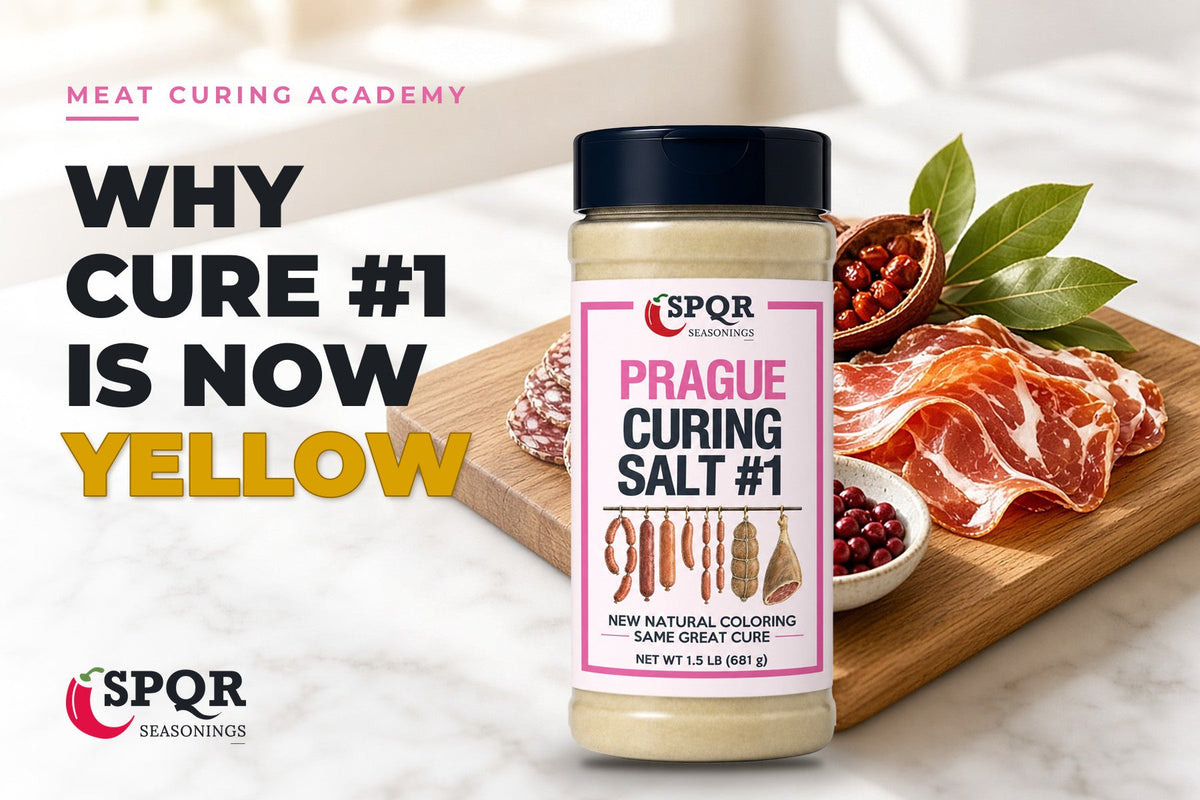
For decades most brands, SPQR Seasonings included, used FD&C Red No. 3 for that pink. FDA has revoked Red No. 3 for food, and food makers have until January 15, 2027 to stop using it. So Prague Curing Salt #1 from SPQR Seasonings is now yellow, colored with annatto extract. If you just opened a yellow bottle, nothing is wrong with it. It's the same cure.
What the Color Does and Doesn't Do
Curing Salt #1 (Prague Powder #1, Cure #1) is salt mixed with 6.25% sodium nitrite. Both are white, so manufacturers color the blend to make it stand out in the kitchen. For decades the usual color was pink, which is how it got the name pink curing salt.
The color doesn't:
- make the cure stronger or weaker
- change the flavor
- extend shelf life
- tint the meat (the cured color of bacon and ham comes from the nitrite, not the dye)
Why Is Curing Salt Pink? A Short History
People have cured meat with salt and saltpeter (potassium nitrate) for centuries. By the end of the 1800s, scientists understood that nitrate has to turn into nitrite before it can cure meat. In the 1920s, the U.S. Department of Agriculture set rules allowing meat processors to use sodium nitrite directly, with a maximum level. Those limits are still the basis of today's rules.
That created a safety problem. Pure sodium nitrite is toxic in small amounts, and it looks like salt. Meat scientists at the University of Wisconsin note that most reported nitrite poisonings happen when sodium nitrite is mistaken for ordinary table salt. CDC documented exactly that in 2002, when five members of a New York household were hospitalized after a meal seasoned from a bag labeled "table salt."
It actually held pure sodium nitrite that a former tenant had used for curing meat. All five recovered.
The industry answered in two ways:
- Dilute it. Pre-blended curing salts mix nitrite into ordinary salt (6.25% for Cure #1), so the right dose comes from a normal, measurable amount of cure.
- Color it. A tinted blend looks nothing like table salt.
Pink became the usual color, which is why curing salt is so often called "pink salt." We couldn't find a documented record of exactly when, or by whom, pink was chosen. It was likely a practical choice: pink is easy to spot against white salts and goes with the color of cured meat. The nickname is also why beginners sometimes confuse pink curing salt with Himalayan pink salt.
Is Coloring Curing Salt Required by Law?
Coloring is an established industry practice. Oregon State University Extension puts it simply: "Most forms of curing salts are dyed a pink color so they are distinguishable from table salt." We didn't find a federal rule requiring a particular color, or any color. What U.S. rules do require is clear identification:
- FDA requires a retail curing mix containing sodium nitrite to name the additive and its concentration, include directions that keep the finished meat at or below 200 ppm nitrite, and carry the statement "Keep out of the reach of children" (21 CFR 172.175).
- USDA FSIS requires meat plants to keep nitrite supplies under the care of a responsible employee, with the nitrite content "known and clearly marked" (9 CFR 424.21).
Pink Curing Salt Without Red Dye: Why We Switched to Annatto
Many pink curing salts, including our earlier pink bottles, have been colored with FD&C Red No. 3 (erythrosine). Here's what happened, according to FDA:
- January 2025: FDA announced it was revoking authorization for Red No. 3 in food and ingested drugs. It acted under the Delaney Clause, a 1960 law that bars FDA from authorizing any color additive found to cause cancer in humans or animals.
- The finding: studies showed cancer in male laboratory rats exposed to high levels of Red No. 3, through a hormonal mechanism specific to rats. Studies in other animals and in humans didn't show the same effect, and FDA says there's no evidence Red No. 3 causes cancer in humans.
- August 2026: after reviewing objections, FDA confirmed its order and the deadlines.
- The deadlines: food manufacturers must reformulate by January 15, 2027 (ingested drugs by January 18, 2028). Products made before the deadline may stay on the market after it.
Our earlier pink curing salt was not unsafe. Red No. 3 was an authorized color when we used it. We switched because the dye is on its way out of the U.S. food supply, and we wanted to make the change ahead of the deadline rather than at the last minute. At the same time we gave the product its full name, Prague Curing Salt #1.
What Is Annatto?
Annatto is a color made from the seeds of the achiote tree (Bixa orellana). FDA lists annatto extract as a color additive exempt from certification that may be used to color foods generally.
You've probably eaten it before: it gives many orange cheeses their color. In Curing Salt #1 it does exactly what the red dye did. It makes the cure easy to recognize. It doesn't tint your meat and plays no part in the curing itself.
Annatto comes from a plant, so the shade can vary a little from batch to batch. Our label notes that natural color variation may occur and doesn't affect product quality.
Why We Kept a Color Instead of Going White
With Red No. 3 on its way out, some curing salt makers are dropping the dye altogether, so their cure will look white, just like table salt. We think that undoes the reason cure was colored in the first place. We switched to annatto so Curing Salt #1 from SPQR Seasonings still looks different from every other salt in your kitchen.
It also means color is no longer a reliable guide when you shop. Depending on the brand and the age of the bottle, Curing Salt #1 may now be pink, yellow or white. Always read the label for the cure number and "Sodium Nitrite (6.25%)."
Will I Get a Yellow or a Pink Bottle?
For a while you may get either a yellow or a pink bottle of our Curing Salt #1, whether you buy from SPQR Seasonings directly or on Amazon. New bottles say Prague Curing Salt #1 and are colored yellow with annatto extract. Older bottles were labeled "Pink Curing Salt #1" and colored with FD&C Red No. 3.
If you've bought pink curing salt from SPQR Seasonings before, this is the same product: the same 6.25% sodium nitrite, used at the same rate. The color is only there so you can identify the cure. It doesn't tint your meat, and older pink bottles are fine to use. FDA has said products made before its Red No. 3 deadline may remain on the market after that date.
Does the Color Change How I Use It?
No. Curing Salt #1 is still 6.25% sodium nitrite in salt, and the label direction hasn't changed: use 1 level teaspoon for 5 lbs. of meat, or follow a tested cure recipe. For dosing details, see Is Pink Curing Salt Bad for You? Ready to cure? Shop Prague Curing Salt #1 in the new yellow bottle.
If your cut isn't 5 lbs., the curing salt calculator will give you the grams and the level-teaspoon amount for that weight.
Cure #1 vs Cure #2
- Cure #1 (Prague Powder #1): salt plus 6.25% sodium nitrite. Use it for meats that will be cooked or smoked before you eat them: bacon, ham, jerky, corned beef, smoked and semi-dry sausage, and snack sticks. It's ideal for wet curing in a brine, and it also works in a dry rub. Prague Curing Salt #1 from SPQR Seasonings is a Cure #1.
- Cure #2 (Prague Powder #2): sodium nitrite plus sodium nitrate, which breaks down slowly over a long cure. Use it for long dry-cured meats that are eaten without cooking, such as dry salami and prosciutto. It isn't recommended for bacon. Curing Salt #2 from SPQR Seasonings is coming soon.
How to Identify and Store Curing Salt #1
- Read the label. Look for "Curing Salt #1" and "Sodium Nitrite (6.25%)." New yellow bottles say "Prague Curing Salt #1." Older pink bottles say "Pink Curing Salt #1." Don't go by color alone: brands use different colors, and SPQR Seasonings bottles may be either color right now.
- Keep it in the original labeled bottle. Never pour it into a shaker, salt cellar, grinder or unmarked jar.
- Store it in a cool, dry place away from direct sunlight, apart from your everyday salts, and out of reach of children.
- It's not table salt. Never use it as table salt or as a general seasoning.
Keep Learning
- What Is Pink Curing Salt? Curing Salt #1, Prague Powder #1 and Cure #1 explained
- Is Pink Curing Salt Bad for You? Dosing, nitrite limits and storage
- Is Pink Himalayan Salt the Same as Curing Salt? Why you can't swap them
- Curing Salt #1 vs #2: What's the Difference? Which cure to use, and why #2 never goes in bacon
- The SPQR Seasonings Meat Curing Academy: every guide in one place
- Shop Prague Curing Salt #1 from SPQR Seasonings
Frequently Asked Questions
Why is curing salt pink?
So it can't be mistaken for table salt. Curing salt contains sodium nitrite, which is harmful in larger amounts, so most brands have dyed it pink as a visual warning. The pink color is only a marker. It isn't part of the cure.
Why is Curing Salt #1 from SPQR Seasonings yellow now?
We replaced FD&C Red No. 3, which gave our earlier bottles their pink color, with annatto extract. FDA has revoked Red No. 3 for food, and manufacturers must reformulate by January 15, 2027. It's the same 6.25% sodium nitrite cure, now called Prague Curing Salt #1.
Is there pink curing salt without red dye?
SPQR Seasonings Curing Salt #1 no longer uses red dye. New bottles are colored yellow with annatto extract instead of FD&C Red No. 3. The cure itself, 6.25% sodium nitrite in salt, hasn't changed.
Is Red No. 3 banned?
FDA has revoked its authorization for FD&C Red No. 3 in food and ingested drugs. Food manufacturers have until January 15, 2027 to reformulate, and products made before that date may remain on the market.
Was the earlier pink curing salt from SPQR Seasonings unsafe?
No. Red No. 3 was an authorized color when we used it. FDA acted under the Delaney Clause after high-dose studies in male rats, and FDA says there's no evidence it causes cancer in humans.
Is curing salt still pink?
Some still is. Older stock colored with Red No. 3 can stay on sale, some brands have switched to other colors such as yellow annatto, and some are dropping the dye so their cure is white. Check the label, not the color.
Is pink curing salt the same as Himalayan pink salt?
No. Curing salt was dyed pink, while Himalayan salt is naturally pink from trace minerals and has no nitrite. It can't cure meat, and the two should never be swapped.
Can I still use a pink bottle?
Yes. Older pink bottles are the same cure, used at the same rate, and they're fine to use. FDA allows products made before its Red No. 3 deadline to stay on the market.
Why is my curing salt a slightly different shade of yellow?
Annatto comes from a plant, and as our label notes, natural color variation may occur and does not affect product quality. A lighter or deeper yellow is the same cure.
Does the color affect the cure or the meat?
No. The color is only a safety marker and doesn't tint your meat. The cured color and flavor come from the sodium nitrite.
Is yellow curing salt the same as Prague Powder #1?
SPQR Seasonings Prague Curing Salt #1 is a Prague Powder #1 (Cure #1) with 6.25% sodium nitrite. Other brands may use other colors, so always check the label for the cure number and nitrite percentage.
Safety note: Curing Salt #1 contains sodium nitrite. It is not table salt. Eating it directly or using it improperly can cause serious illness. Use it only as directed for curing meat, follow a tested recipe, keep it in its labeled bottle out of reach of children, and never use it as a seasoning. This article is general information, not a substitute for the product label.
Sources
- Prague Curing Salt #1 label, SPQR Seasonings: ingredients, directions, caution, storage, serving size
- FDA, FD&C Red No. 3 (page current as of Oct 5, 2026)
- FDA constituent update, FDA to Revoke Authorization for the Use of Red No. 3 in Food and Ingested Drugs (Jan 15, 2025)
- Federal Register, 90 FR 4628 (Jan 16, 2025)
- Federal Register, Aug 5, 2026 order (objections denied, effective dates confirmed)
- 21 CFR 73.30, Annatto extract (color additive exempt from certification)
- 21 CFR 172.175, Sodium nitrite (home curing preparations and label requirements)
- 9 CFR 424.21 (curing agents, nitrite limits, handling of nitrite supplies)
- Oregon State University Extension, Making Cured Bacon at Home (PNW 784)
- Borchert and Cassens, University of Wisconsin, Chemical Hazard Analysis for Sodium Nitrite in Meat Curing (1998)
- CDC MMWR, Methemoglobinemia Following Unintentional Ingestion of Sodium Nitrite, New York, 2002


