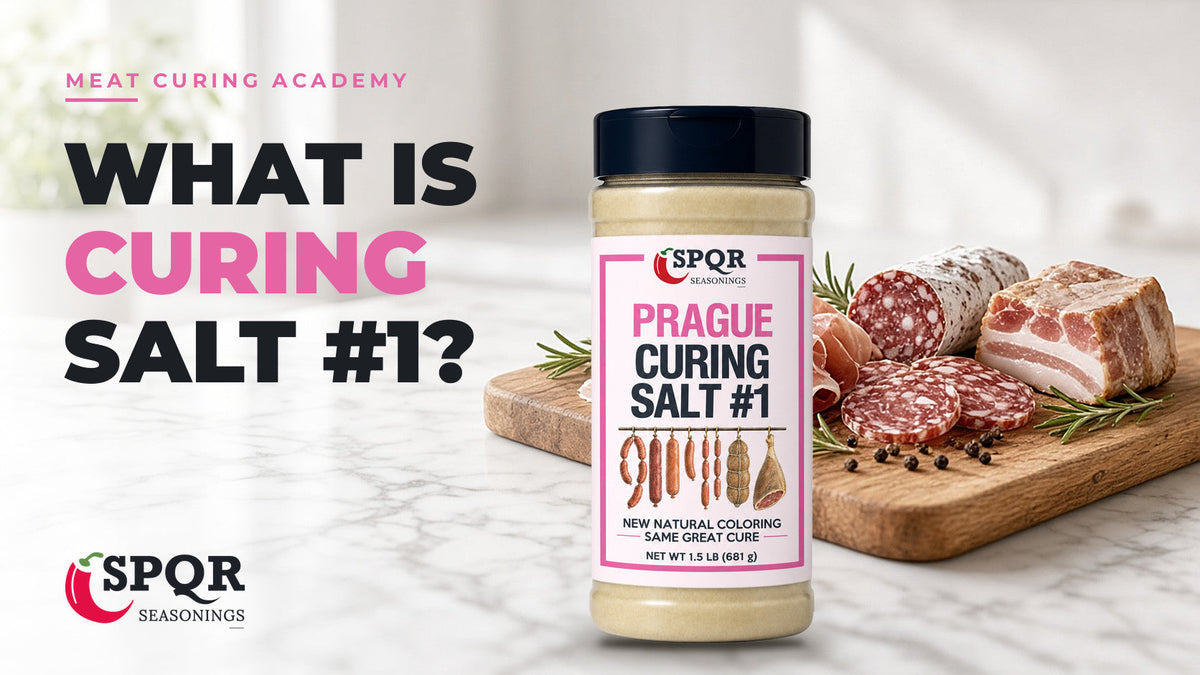
What is pink curing salt? It's salt blended with a small, measured amount of sodium nitrite (6.25%), used to cure meat such as bacon, ham, jerky and sausage. You'll also see it sold as Curing Salt #1, Prague Powder #1, Cure #1 and Instacure #1. Most brands dye it pink so nobody mistakes it for table salt.
At SPQR Seasonings we call ours Prague Curing Salt #1, and new bottles are yellow instead of pink. It's the same cure in a new color. Why is curing salt pink, and why is ours yellow now?
What Is Curing Salt, and Is Pink Curing Salt the Same as Curing Salt #1?
Curing salt is salt blended with nitrite (and, in Cure #2, nitrate), used in measured amounts to cure meat. "Pink curing salt" is the everyday name for Curing Salt #1, the 6.25% sodium nitrite cure that has traditionally been dyed pink. The pink was never part of the cure. It's a color added so nobody mistakes the cure for table salt.
For a while you may get either a yellow or a pink bottle of our Curing Salt #1, whether you buy from SPQR Seasonings directly or on Amazon. New bottles say Prague Curing Salt #1 and are colored yellow with annatto extract. Older bottles were labeled "Pink Curing Salt #1" and colored with FD&C Red No. 3.
If you've bought pink curing salt from SPQR Seasonings before, this is the same product: the same 6.25% sodium nitrite, used at the same rate. The color is only there so you can identify the cure. It doesn't tint your meat, and older pink bottles are fine to use.
Other Names for Curing Salt #1
You'll find the same basic cure under several names:
- Prague Curing Salt #1, the SPQR Seasonings name
- Prague Powder #1
- Cure #1
- Instacure #1 (also written Instacure No. 1) and other brand names
- Pink curing salt or pink salt, after the traditional color
- Tinted cure or quick cure
Whatever the name, check the label for sodium nitrite (6.25%) before you follow a recipe. Not everything called "pink salt" is a cure. Himalayan pink salt is a seasoning with no nitrite.
What about saltpeter (salt peter)? Some people search for "saltpeter" or "salt peter" when they're looking for curing salt. Saltpeter is potassium nitrate, an old-fashioned curing ingredient. Curing Salt #1 contains sodium nitrite, the cure most modern recipes are written for. If an old recipe calls for saltpeter, don't swap in Curing Salt #1 one for one. Find a recipe written for Cure #1.
What Is Pink Curing Salt Made Of?
Here's the ingredient line straight from our label: Salt, Sodium Nitrite (6.25%), Propylene Glycol, Annatto Extract (Natural Coloring).
- Salt carries and dilutes the nitrite, so a normal, measurable spoonful delivers the right amount.
- Sodium nitrite (6.25%) does the curing.
- Propylene glycol is a food-grade ingredient that FDA recognizes as safe (GRAS), including as a solvent and carrier.
- Annatto extract gives the yellow color. It's a safety marker only and doesn't tint your meat. In our older pink bottles, FD&C Red No. 3 did the same job.
The rest of our label is just as plain. It calls the cure "ideal for wet-curing of semi-dry and meats that will be smoked or cooked," gives the dose as 1 level tsp per 5 lbs. of meat, and carries two warnings: "Keep out of reach of children" and "Not table salt."
The label also notes that natural color variation may occur, so one yellow bottle can look a shade different from the next.
What Does Curing Salt Do?
Curing Salt #1 does three jobs.
It makes cured meat safer. Nitrite inhibits Clostridium botulinum, the bacterium that causes botulism. USDA's Food Safety and Inspection Service (FSIS) says nitrite "greatly delays the development of the Clostridium botulinum toxin." That protection matters most for meats that are smoked low and slow or held for days while they cure.
It gives cured meat its color. The sodium nitrite, not the dye, creates the rosy color of bacon and ham. Without it, they cook up gray-brown.
It gives cured flavor. Nitrite creates that familiar "cured" taste and slows rancidity during storage.
Typical uses are bacon, ham, jerky, corned beef, smoked sausage and snack sticks.
Curing Salt vs Regular Salt
Table salt, kosher salt and sea salt are sodium chloride. They season meat, but they contain no nitrite. Curing salt is salt with 6.25% sodium nitrite blended in, so it adds the botulism protection, cured color and cured flavor that plain salt can't.
That's also why you use so little of it: 1 level teaspoon of Curing Salt #1 for 5 lbs. of meat, measured, never to taste. Many recipes use both, regular salt for seasoning and a measured amount of curing salt for the cure.
Cure #1 vs Cure #2 (Prague Powder #1 vs #2)
If you've seen pink curing salt #1 and #2 on the shelf, here's the short version. Our full guide, Curing Salt #1 vs #2: What's the Difference?, covers which cure to use and how much.
- Cure #1 (Prague Powder #1): salt plus 6.25% sodium nitrite. Use it for meats that will be cooked or smoked before you eat them: bacon, ham, jerky, corned beef, smoked and semi-dry sausage, and snack sticks. It's ideal for wet curing in a brine, and it also works in a dry rub. Prague Curing Salt #1 from SPQR Seasonings is a Cure #1.
- Cure #2 (Prague Powder #2): sodium nitrite plus sodium nitrate, which breaks down slowly over a long cure. Use it for long dry-cured meats that are eaten without cooking, such as dry salami and prosciutto. It isn't recommended for bacon. Curing Salt #2 from SPQR Seasonings is coming soon.
How Much Curing Salt #1 per Pound of Meat?
- Label rate: use 1 level teaspoon for 5 lbs. of meat. That's the direction printed on Prague Curing Salt #1 from SPQR Seasonings, and it works out to about 1/5 teaspoon per pound.
- What that means in the meat: we weighed 10 level teaspoons of our Prague Curing Salt #1 three times (73 g, 68 g and 71 g), so a level teaspoon is about 7.07 g. That's roughly 0.31% of the meat's weight and delivers about 195 ppm of sodium nitrite going into the meat. FDA's limit for home curing mixes is 200 ppm in the finished meat. Our tested recipes weigh the cure to about the same level, 193 to 195 ppm, and never over 200 ppm. Ground meat like sausage has a lower 156 ppm limit, so it gets a little less than the label rate: about 2.4 g per kilogram, or 1.1 g per pound.
- Prefer to weigh? Use the rate for what you're curing. For whole cuts (whole muscle), like pork belly, brisket, ham or a pork loin, use about 1.4 g per lb (3.1 g per kg). That's the same as 1 level teaspoon per 5 lb, about 0.31% of the meat's weight, or about 195 ppm. For ground meat like sausage, use about 1.1 g per lb (2.4 g per kg), roughly 0.25% of the meat's weight, or about 156 ppm, the USDA ingoing limit for ground and chopped products. Use a scale that reads to 0.1 g, and round down, never up.
- Brines and injections: follow a tested cure recipe. Cure time depends on the size and type of the cut.
- Never add extra. More cure is not safer.
For a cut that isn't 5 lbs., use our curing salt calculator to get the exact grams and spoon amount for whole cuts (whole muscle), ground meat or a brine.
For nitrite limits and more on safe dosing, read Is Pink Curing Salt Bad for You?
Is There a Substitute for Pink Curing Salt?
Not a simple one. Table salt, kosher salt, sea salt and Himalayan pink salt contain no nitrite, so they can't cure meat or protect against botulism the way Curing Salt #1 does. Other cures, such as Cure #2 or curing blends, are used at different rates, so switch to a recipe written for that cure. No curing salt at all? Choose a recipe meant to be cooked and eaten fresh.
How to Identify and Store Curing Salt #1
- Read the label. Look for "Curing Salt #1" and "Sodium Nitrite (6.25%)." New yellow bottles say "Prague Curing Salt #1." Older pink bottles say "Pink Curing Salt #1." Don't go by color alone: brands use different colors, and SPQR Seasonings bottles may be either color right now.
- Keep it in the original labeled bottle. Never pour it into a shaker, salt cellar, grinder or unmarked jar.
- Store it in a cool, dry place away from direct sunlight, apart from your everyday salts, and out of reach of children.
- It's not table salt. Never use it as table salt or as a general seasoning.
Is Curing Salt #1 the Same as Himalayan Pink Salt?
No. Himalayan pink salt is a mined rock salt that gets its color from trace minerals. It contains no nitrite and can't cure meat. Curing Salt #1 is a measured nitrite blend and should never be used as a seasoning. The full comparison is in Curing Salt #1 vs Himalayan Salt.
Prague Curing Salt #1 from SPQR Seasonings
Prague Curing Salt #1 comes in an XL 1.5 lb bottle with a dual-action cap, so you can pour it into a brine or measure by the teaspoon without a mess. The dose, 1 level teaspoon for 5 lbs. of meat, is printed right on the label. Yellow bottle or older pink one, the cure inside is the same.
Ready to start? Shop Prague Curing Salt #1, then read Is Pink Curing Salt Bad for You? before your first batch.
Keep Learning
- Why Is Curing Salt Pink? And why Curing Salt #1 is now yellow
- Is Pink Curing Salt Bad for You? Dosing, nitrite limits and storage
- Is Pink Himalayan Salt the Same as Curing Salt? Why you can't swap them
- Curing Salt #1 vs #2: What's the Difference? Which cure to use, and why #2 never goes in bacon
- The SPQR Seasonings Meat Curing Academy: every guide in one place
- Shop Prague Curing Salt #1 from SPQR Seasonings
Frequently Asked Questions
What is pink curing salt?
Pink curing salt is the common name for Curing Salt #1 (Prague Powder #1, Cure #1): salt blended with 6.25% sodium nitrite for curing meat, traditionally dyed pink so it isn't mistaken for table salt. SPQR Seasonings Curing Salt #1 is now colored yellow with annatto. The cure is the same.
What is pink curing salt made of?
Salt and 6.25% sodium nitrite, plus a color. The Prague Curing Salt #1 label from SPQR Seasonings lists salt, sodium nitrite (6.25%), propylene glycol and annatto extract.
What is pink curing salt used for?
Curing meats that will be cooked or smoked before eating, such as bacon, ham, jerky, corned beef, smoked sausage and snack sticks. It helps protect against botulism and gives cured meat its color and flavor.
What does curing salt do?
It cures meat. The sodium nitrite in curing salt helps protect against botulism, gives bacon and ham their rosy cured color and cured flavor, and slows rancidity.
What's the difference between curing salt and regular salt?
Regular salt is sodium chloride with no nitrite. Curing salt adds 6.25% sodium nitrite, which protects against botulism and gives cured color and flavor. Use curing salt only in measured amounts, never as a seasoning.
Is Prague Powder #1 the same as pink curing salt?
Yes. Prague Powder #1, Cure #1 and Instacure #1 are names for the same type of cure: salt with 6.25% sodium nitrite. Prague Curing Salt #1 is the SPQR Seasonings version.
I ordered Curing Salt #1 from SPQR Seasonings and got a pink bottle. Is that OK?
Yes. Older pink bottles (labeled Pink Curing Salt #1) and new yellow bottles (Prague Curing Salt #1) will both be around for a while, including on Amazon. They're the same cure with the same 6.25% sodium nitrite. Only the coloring differs, and pink bottles are fine to use.
How much Curing Salt #1 do I use per pound of meat?
For whole cuts (whole muscle) like pork belly, brisket and ham, the label rate is 1 level teaspoon for 5 lbs. of meat, about 1/5 teaspoon or 1.4 g per pound (about 195 ppm). Ground meat like sausage has a lower limit, so use about 1.1 g per pound (about 0.25% of the meat's weight, or 156 ppm). For brines, follow a tested recipe.
Is Morton Tender Quick the same as Curing Salt #1?
No. Tender Quick is a different curing blend with its own formula and usage rate. Follow its label, and don't swap it one for one with Curing Salt #1 in a recipe.
Is pink curing salt the same as sodium nitrite?
No. Pink curing salt is mostly salt, with 6.25% sodium nitrite blended in. Pure sodium nitrite is far more concentrated and toxic in small amounts, so never use it in place of Curing Salt #1. It's also different from sodium nitrate, which is part of Cure #2.
Is saltpeter the same as curing salt?
No. Saltpeter (salt peter) is potassium nitrate. Curing Salt #1 contains sodium nitrite. Use a recipe written for the cure you have.
What can I use instead of curing salt?
There's no simple swap. Regular, kosher and Himalayan salt contain no nitrite and won't cure meat. Other cures are used at different rates, so use a recipe written for the cure you have.
Is curing salt the same as Himalayan pink salt?
No. Himalayan pink salt is a seasoning with no nitrite and can't cure meat. Curing salt should never be used as a seasoning. Never swap one for the other.
Safety note: Curing Salt #1 contains sodium nitrite. It is not table salt. Eating it directly or using it improperly can cause serious illness. Use it only as directed for curing meat, follow a tested recipe, keep it in its labeled bottle out of reach of children, and never use it as a seasoning. This article is general information, not a substitute for the product label.
Sources
- Prague Curing Salt #1 label, SPQR Seasonings: ingredients, directions, caution, storage, serving size
- Oregon State University Extension, Making Cured Bacon at Home (PNW 784)
- USDA FSIS, Bacon and Food Safety
- USDA FSIS, Sausage and Cured Operations Quick Reference (Table II nitrite limits)
- 21 CFR 172.175, Sodium nitrite (home curing preparations and label requirements)
- 21 CFR 184.1666, Propylene glycol (GRAS)
- 21 CFR 73.30, Annatto extract (color additive exempt from certification)
- FDA, FD&C Red No. 3 (page current as of Oct 5, 2026)
- Wikipedia, Curing salt (saltpeter is potassium nitrate)


