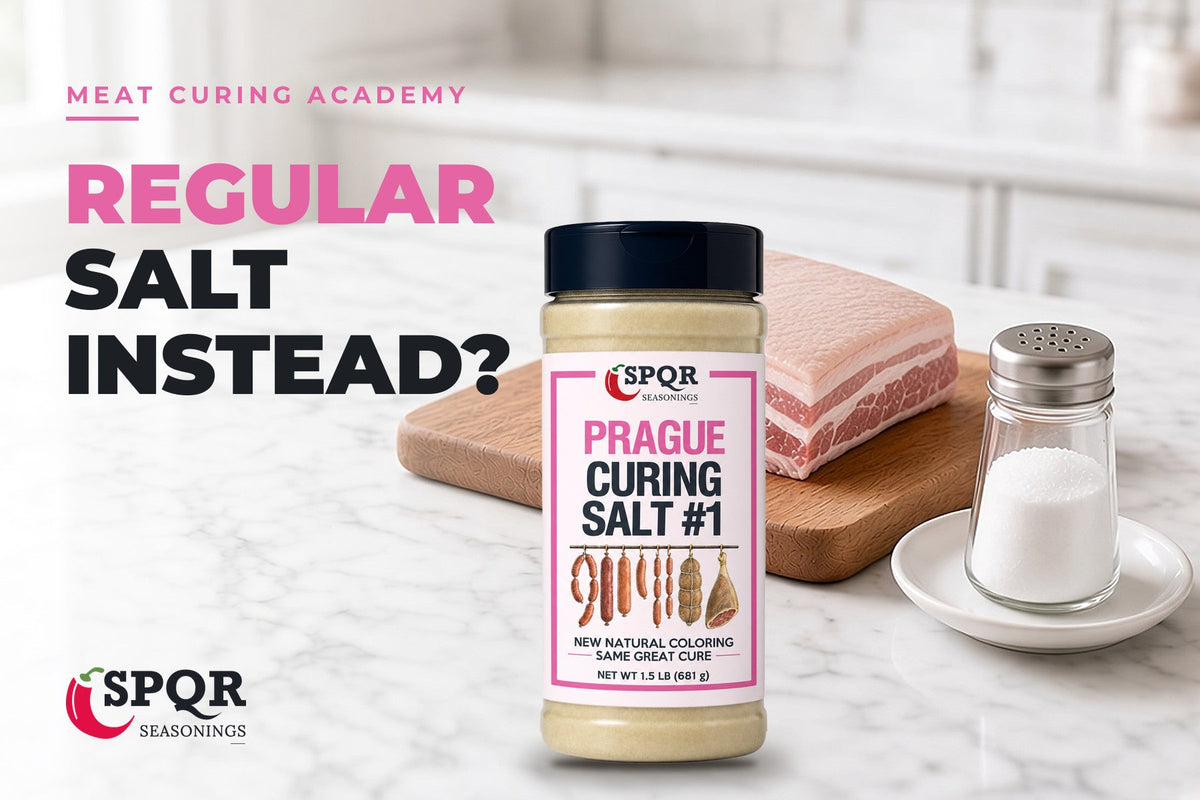
No, not if the recipe calls for curing salt. Regular salt (table, kosher, sea or Himalayan) is sodium chloride and nothing else. Curing salt is salt with a measured amount of sodium nitrite, and the nitrite is what protects slow-smoked and cured meat against botulism and gives it its pink color and cured flavor. If you're going to cook the meat soon and keep it cold until then, like a fresh sausage, a brined pork chop or a dry-brined turkey, regular salt is all you need.
The quick rule: if the meat will be smoked low and slow, cured for days, dried or kept for weeks, use a measured amount of curing salt such as Prague Curing Salt #1 from SPQR Seasonings. More regular salt can't take its place.
Curing Salt vs Regular Salt
| Curing Salt #1 | Regular salt (table, kosher, sea, Himalayan) | |
|---|---|---|
| What's in it | 93.75% salt plus 6.25% sodium nitrite | Sodium chloride (sometimes iodine or anti-caking agents) |
| What it does | Cures: botulism protection, cured color and flavor, slower rancidity | Seasons, draws out moisture, firms texture |
| How much | Measured by weight: about 1.4 g per pound of whole cuts | Often 1.5 to 3% of the meat's weight, or to taste |
| Color | Dyed so it isn't mistaken for table salt. Most brands are pink, ours is yellow (annatto) | White, or naturally pink for Himalayan salt |
| Used as a seasoning? | Never | Yes |
Most cure recipes use both: regular salt for the main salting and flavor, plus a small, measured amount of curing salt for the nitrite. Oregon State University Extension says standard table salt, kosher salt or canning and pickling salt can supply the salt in a bacon cure, while a Cure #1 supplies the nitrite (OSU Extension, PNW 784).
What Curing Salt Does That Regular Salt Can't
Salt alone does preserve meat by pulling out water. But nitrite does several jobs salt can't. USDA's Food Safety and Inspection Service lists them for bacon: sodium nitrite produces the pink cured color, "greatly delays the development of the Clostridium botulinum toxin (botulism)," develops the cured-meat flavor, and slows rancidity and off-flavors in storage (FSIS: Bacon and Food Safety).
Kansas State University meat scientists add that a main reason nitrite is used is to stop food poisoning and spoilage bacteria, "especially the bacteria that causes botulism, in case cured meat is mishandled and stored at temperatures above 40F" (KSU, Use of Nitrite to Cure Meat).
Botulism bacteria grow without oxygen. That's exactly the condition inside a thick ham, a sealed cure bag or a sausage that's smoked slowly at low temperatures. Salt slows them down, but nitrite at the right dose is the safeguard.
You can see the difference on the plate, too. A cooked fresh pork chop turns brownish. A cooked ham, which is cured, stays reddish-pink and tastes "cured." That's the nitrite, not the salt. More on that in What Is Cured Meat?
Is Curing Salt Necessary?
It depends on what you're making and how you'll keep it.
You need curing salt for:
- Bacon, ham, corned beef and pastrami. They cure for days in the fridge and are often smoked, so they get a measured dose of Curing Salt #1. Without nitrite you don't get the pink color or cured flavor, and the meat loses its main protection if it gets warm.
- Smoked sausage, summer sausage, snack sticks and hot dogs. Ground meat that sits in a smoker at low temperatures is a classic botulism risk.
- Jerky you'll store. In University of Georgia research cited by FSIS, ground beef jerky made with a salt and sodium nitrite curing mix had more bacteria destroyed than jerky made without it (FSIS: Jerky and Food Safety).
- Cold-smoked meat, and anything dried or hung for weeks, like salami, pepperoni, coppa and country ham. Long dry cures usually call for Curing Salt #2. Prague Curing Salt #2 from SPQR Seasonings is coming soon.
Regular salt is fine for:
- Fresh sausage, meatballs and burgers you'll cook within a day or two. FSIS says fresh sausages "must be kept refrigerated and thoroughly cooked before eating," to 160 °F for pork or beef and 165 °F for poultry (FSIS: Sausages and Food Safety).
- Brining or dry-brining a turkey, chicken, pork chop or roast you'll cook right away.
- Barbecue you'll eat fresh, like a smoked brisket or pork shoulder cooked to a safe internal temperature and refrigerated promptly afterward.
In between are cases like "uncured" bacon. Oregon State University Extension says bacon can be made without nitrite, but "temperature control is critical in such products and they must be constantly stored below 40° F." FSIS requires bacon made without nitrite to carry the words "Not Preserved, Keep Refrigerated Below 40 degrees At All Times," unless it's dried or salted to specific levels. For more on those labels, see What Does "Uncured" Mean? and Cured vs Uncured Bacon.
What Happens If You Cure Meat With Only Regular Salt?
- Color: it cooks up gray-brown, like a roast, instead of pink.
- Flavor: it tastes like salted pork or beef, not ham or bacon.
- Safety: it can be perfectly safe if you keep it at 40 °F or below the whole time, cook it fully and eat it soon. It isn't safe to cold-smoke it, slow-smoke it at low temperatures, or hang it to dry without a tested method.
Some famous hams are made with salt alone. Prosciutto di Parma, for example, is made from pork and sea salt only, cured and aged for months in tightly controlled conditions (Consorzio del Prosciutto di Parma). FSIS notes that dry-cured hams are safe at room temperature because they hold so little water that bacteria can't multiply (FSIS: Hams and Food Safety). That kind of salt-only curing depends on large amounts of salt, long drying and careful temperature and humidity control. It isn't a shortcut for a weekend bacon or ham. For home curing, follow a tested recipe that includes curing salt.
Kosher Salt, Sea Salt, Himalayan Salt and Iodized Salt
None of them contain nitrite, so none of them can replace curing salt. Any of them can supply the regular-salt part of a cure:
- Kosher salt is popular because it's pure salt and easy to spread. Crystal size varies a lot by brand, so weigh it instead of measuring by the cup or spoon.
- Sea salt works the same way by weight.
- Himalayan pink salt is pink from trace minerals, not nitrite. It is not pink curing salt. See Curing Salt #1 vs Himalayan Salt.
- Table salt, iodized or not, can be used. OSU Extension lists standard table salt as an option for the salt in a bacon cure.
Can You Use Curing Salt Instead of Regular Salt?
No. Curing salt is never a seasoning. Our label says it plainly: "NOT TABLE SALT. KEEP OUT OF REACH OF CHILDREN." It's dosed by the weight of the meat, not by taste. Use the regular salt in a recipe for seasoning, and add the cure only in the measured amount.
It does count toward the salt in a recipe a little, because Curing Salt #1 is 93.75% salt. In a 5-lb pork belly, 7.0 g of cure adds about 6.6 g of salt. Our curing salt calculator subtracts that from the regular salt for you when you enter a salt percentage.
How Much Curing Salt Do You Need?
Very little. For whole cuts (whole muscle) like pork belly, brisket, ham, loin or a roast, it's about 1.4 g of Curing Salt #1 per pound, or 1 level teaspoon per 5 pounds (about 195 ppm). Ground meat and sausage get less: about 1.1 g per pound, or ¾ teaspoon per 5 pounds, to stay under the 156 ppm limit (9 CFR 424.21(c)). The full charts and the math are in How Much Curing Salt Per Pound?, and the curing salt calculator does it for you.
Never add "extra to be safe." More nitrite doesn't add safety, and the FDA caps nitrite from home curing mixes at 200 ppm in the finished meat (21 CFR 172.175). If you think you've overdone it, see I Used Too Much Curing Salt. What Now?
What About Saltpeter?
Saltpeter (salt peter, potassium nitrate) is the old-fashioned cure. FSIS still lists it in its definition of curing. But it works slowly and unevenly, because the nitrate has to be turned into nitrite by bacteria in the meat first. Today home curers use Curing Salt #1, which delivers a measured amount of nitrite right away, or Curing Salt #2 for long dry cures. For more, read Curing Salt #1 vs #2.
The Bottom Line
Regular salt seasons meat and preserves it a little. Curing salt cures it. If your recipe calls for curing salt, use it, measured by weight. If you don't have any, make the recipe as fresh meat: keep it cold and cook it fully. Then pick up a bottle of Prague Curing Salt #1 from SPQR Seasonings for next time. It's dyed yellow with natural annatto so it never gets mixed up with your table salt, and one 1.5-lb bottle cures hundreds of pounds of meat.
Safety note: Curing Salt #1 contains sodium nitrite. It is not table salt. Measure it, use it only as directed for curing meat, keep it in its labeled bottle out of reach of children, and never use it as a seasoning. If someone swallows curing salt, call Poison Help at 1-800-222-1222, or 911 for trouble breathing, bluish skin or collapse.
Keep Learning
- What Is Curing Salt #1?
- How Much Curing Salt Per Pound?
- Is Curing Salt #1 Safe?
- What Is Cured Meat?
- Curing Salt Calculator
Frequently Asked Questions
Can I use regular salt instead of curing salt?
Not when a recipe calls for curing salt. Regular salt has no nitrite, so it can't give cured color and flavor or the botulism protection that slow-smoked and cured meats need. If you have no curing salt, make the recipe as fresh meat: keep it cold and cook it fully.
What is the difference between curing salt and regular salt?
Regular salt is sodium chloride. Curing Salt #1 is 93.75% salt and 6.25% sodium nitrite, dyed so it isn't mistaken for table salt. It's used in small measured amounts to cure meat, never as a seasoning.
Is curing salt necessary?
For bacon, ham, corned beef, pastrami, jerky, smoked sausage and anything smoked low and slow, dried or cold-smoked, yes. For fresh sausage, brined poultry or meat you'll cook right away, no. Regular salt is fine.
Is curing salt necessary for jerky?
It's strongly recommended for jerky you plan to store. FSIS cites research where ground beef jerky made with a nitrite curing mix had more bacteria destroyed than jerky made without it. Also heat the meat to 160 °F before or during drying.
Is curing salt necessary for bacon?
For real cured bacon, yes. Bacon made without nitrite must be kept below 40 °F at all times and won't have the usual color or flavor. Use about 1.4 g of Curing Salt #1 per pound of belly for a dry cure.
Is curing salt necessary for sausage?
For fresh sausage you'll cook soon, no. For smoked, summer or dry sausage, yes: use about 1.1 g of Curing Salt #1 per pound of meat, or the Cure #2 a tested dry-sausage recipe calls for.
Can you cure meat with kosher salt or sea salt?
They can supply the salt part of a cure, but they contain no nitrite, so they can't replace curing salt in bacon, ham, smoked sausage or jerky. Weigh kosher salt, because crystal sizes vary by brand.
Can you cure meat with Himalayan salt?
No. Himalayan pink salt is colored by trace minerals and has no nitrite. It isn't the same as pink curing salt.
Can I use curing salt instead of regular salt?
No. Curing salt is never a seasoning. Use it only in the measured amount for the weight of meat, and use regular salt for flavor.
Does curing salt make meat saltier?
Only slightly. Curing Salt #1 is 93.75% salt, so 7 g in a 5-lb pork belly adds about 6.6 g of salt. Our curing salt calculator subtracts that from the regular salt.
Can I make bacon or ham with just salt?
You can salt pork and keep it cold, but it won't taste or look like bacon or ham, and it must stay below 40 °F and be cooked fully. Traditional salt-only hams rely on heavy salting, months of drying and controlled conditions. For home curing, use a tested recipe with curing salt.
Is saltpeter the same as curing salt?
No. Saltpeter is potassium nitrate, an old-fashioned cure that works slowly. Modern Curing Salt #1 delivers a measured amount of sodium nitrite instead.
Sources
- USDA FSIS, Bacon and Food Safety (what nitrite does; uncured bacon labeling)
- Kansas State University, Use of Nitrite to Cure Meat (nitrite and botulism; cured color)
- Oregon State University Extension, Making cured bacon at home (PNW 784) (salts for cures; bacon without nitrite below 40 °F)
- USDA FSIS, Jerky and Food Safety (University of Georgia jerky study with curing mix)
- USDA FSIS, Sausages and Food Safety (fresh sausage handling and cooking temperatures)
- USDA FSIS, Hams and Food Safety (curing definition incl. saltpeter; dry-cured hams)
- Consorzio del Prosciutto di Parma, Making Parma Ham (pork and sea salt only)
- 21 CFR 172.175 and 9 CFR 424.21(c) (nitrite limits)


