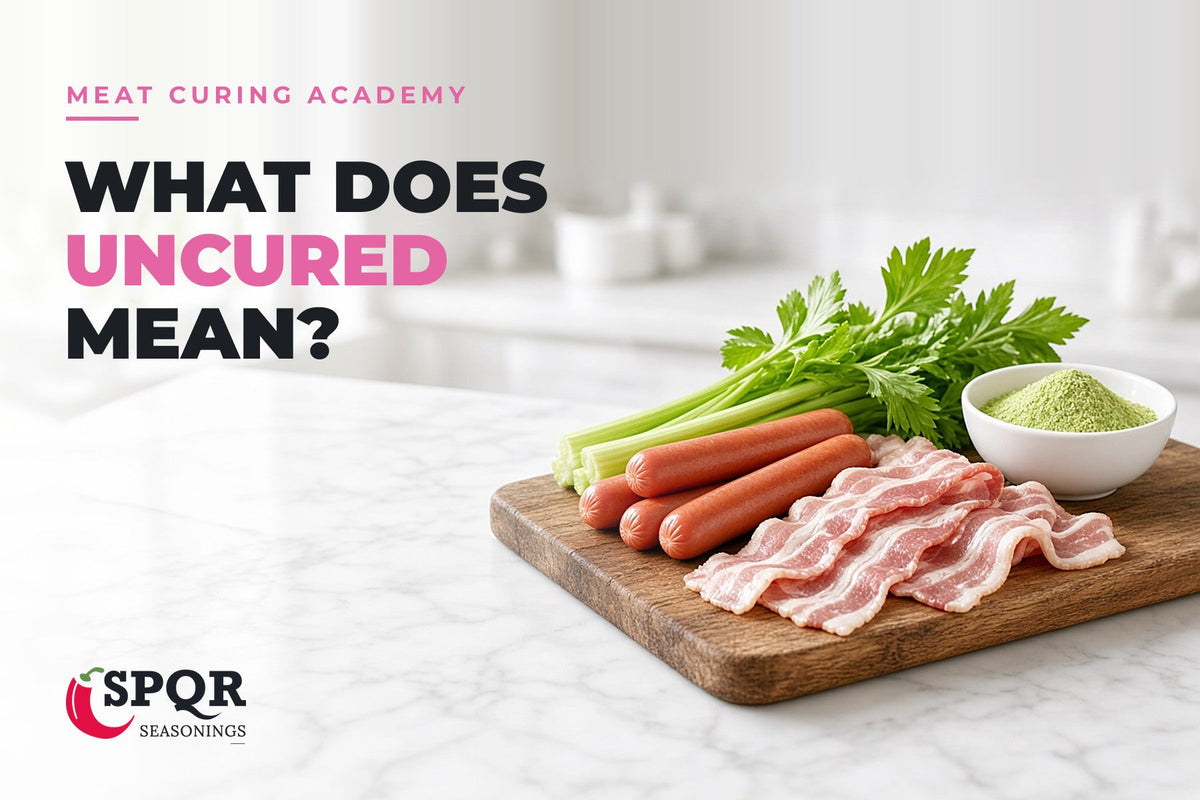
"Uncured" on a meat label means no sodium nitrite or sodium nitrate was added directly. It doesn't mean the meat wasn't cured. Most uncured bacon, ham and hot dogs are cured with celery powder, which is naturally rich in nitrate. That nitrate turns into nitrite, the same compound that cures conventional meat. "Uncured" is a USDA labeling term, and the rule behind it, 9 CFR 317.17, requires the word on any product made without added nitrite or nitrate.
At SPQR Seasonings we make Prague Curing Salt #1, a measured cure of salt and 6.25% sodium nitrite, so we get this question a lot. Here's the honest version: what the label rule says, how celery curing works, and what "uncured" means for the bacon, ham, hot dogs and salami in your cart.
"Uncured" Meaning at a Glance
| The label says | What it actually means |
|---|---|
| Uncured | No sodium nitrite or nitrate was added as an ingredient. The meat is usually still cured with a vegetable source of nitrate. |
| No Nitrates or Nitrites Added | Required wording on uncured products. FSIS adds a qualifier such as "except for those naturally occurring in celery powder." |
| Not Preserved, Keep Refrigerated Below 40 °F At All Times | Required on uncured products unless they're heat processed, acidified, dried or salted past set limits. |
| Natural | Minimally processed with no artificial ingredients. Synthetic sodium nitrite isn't allowed, so natural cured meats use celery or similar powders. |
| Cured | Cured with salt plus sodium nitrite (and, in some products, nitrate), measured and capped by federal rules. |
What the USDA "Uncured" Rule Actually Says
The rule is short, and it's worth reading in its own words. Under 9 CFR 317.17(b), a product such as bacon or pepperoni that normally contains nitrite or nitrate "may be prepared without nitrate or nitrite" and keep its usual name, as long as the name is "immediately preceded with the term 'Uncured'" in the same size and style of lettering. A sister rule, 9 CFR 319.2, does the same for standardized products like frankfurters and corned beef.
Three label requirements follow from that:
- "Uncured" in front of the name. Same size and style as the product name, so "Uncured Bacon," not "Bacon (uncured)."
- "No Nitrate or Nitrite Added." Next to the product name, at least half the size of the name (317.17(c)(1)).
- "Not Preserved, Keep Refrigerated Below 40 °F At All Times." Required unless the product has been heat processed to F0 3 or more, fermented or pickled to pH 4.6 or lower, or dried to a water activity of 0.92 or lower (317.17(c)(2)). Products salty enough to reach a 10% brine concentration skip these rules entirely (317.17(c)(3)).
Here's the catch. The rule was written in the 1970s for meat made with no nitrite at all. Today almost every uncured product is cured with a natural nitrite source, so FSIS has it add a qualifier. Its Bacon and Food Safety page says these products "must be labeled with the explanatory statement 'no nitrates or nitrites added except for those naturally occurring in ingredients such as celery juice powder, parsley, cherry powder, beet powder, spinach, sea salt etc.'"
So the word "uncured" tells you where the nitrite came from, not whether it's there.
How Celery Powder Cures "Uncured" Meat
Celery, beets, spinach and lettuce are naturally high in nitrate. Celery juice powder is the favorite in meat plants because it's concentrated and mild-tasting. A 2007 American Meat Science Association white paper by Iowa State meat scientists Joseph Sebranek and James Bacus found commercial celery juice powder held about 2.75% nitrate.
Nitrate on its own doesn't cure meat. It has to be turned into nitrite first. In uncured products that happens one of two ways:
- A starter culture. Nitrate-reducing bacteria are mixed into the meat with the celery powder, and the product is held warm (often around 100 to 110 °F) for an hour or more so they can work.
- Pre-converted celery powder. The supplier ferments the celery juice before drying it, so the powder already contains nitrite.
Many makers also add cherry powder or acerola, which is rich in vitamin C. It does the same job that sodium erythorbate or ascorbate does in conventional cures: it speeds the reaction and helps fix the cured color.
Is nitrite from celery different from sodium nitrite?
Chemically, no. Nitrite is nitrite. The AMSA white paper notes that natural ingredients often contain "naturally occurring chemicals virtually identical in chemical nature to those chemicals synthetically produced." That's exactly why FSIS said in 2020 that it intends to treat celery powder and other non-synthetic sources as curing agents (more on that below).
The real difference is control. The same white paper says the true amount of nitrite formed in these products "is unknown and impossible to measure because nitrite reacts quickly with meat components." When retail natural and organic bacon, ham and hot dogs were tested, all but one sample held residual nitrite (0.9 to 9.2 ppm) and every sample held residual nitrate (6.8 to 44.4 ppm). Levels were usually lower than in conventional products, but they varied a lot more.
Is the USDA Changing the "Uncured" Label?
It has said it wants to. In 2019 the Center for Science in the Public Interest filed Petition 19-03, asking FSIS to stop allowing "Uncured" and "No Nitrate or Nitrite Added" on meats cured with celery powder. On December 10, 2020, FSIS partially granted it. The agency said it "intends to conduct rulemaking to propose to prohibit the statements" on products processed with any source of nitrate or nitrite, to approve non-synthetic sources as curing agents, and to write new definitions for "Cured" and "Uncured." It gave a tentative publication date of May 2021.
That proposal hasn't appeared. As of November 22, 2026, the text of 9 CFR 317.17 is unchanged, and we found no proposed or final rule on it in the Federal Register. So today's "uncured" labels are still legal. If FSIS publishes a rule, we'll update this page.
Cured vs Uncured: What's Actually Different
| Cured | Uncured | |
|---|---|---|
| Nitrite source | Sodium nitrite (sometimes nitrate) added as an ingredient | Nitrate from celery or other vegetable powders, converted to nitrite |
| How much nitrite | Measured and capped (for example, 120 ppm in pumped bacon, 200 ppm in dry-cured bacon, 9 CFR 424.22) | Not capped the same way, and it varies by batch |
| Contains nitrite? | Yes | Usually yes, often at lower residual levels |
| Label | "Cured" or simply the product name | "Uncured," "No Nitrates or Nitrites Added*," often "Natural" |
| Color and flavor | Rosy pink, classic cured flavor | Usually similar; wider swings in color and flavor |
| Processed meat? | Yes | Yes |
If you want the bacon-specific version, with the federal limits and what happens in the pan, read Cured vs Uncured Bacon.
Uncured Ham, Bacon, Hot Dogs and Salami
Uncured ham
"Uncured ham" can mean two very different things, so read the package:
- Fresh ham. A raw pork leg that was never cured. It cooks up like a pork roast, gray-white and not pink. Cook it to 145 °F and rest it 3 minutes, per the USDA safe temperature chart.
- Uncured deli or spiral ham. A ham cured with celery powder, labeled "uncured" under 317.17. It's pink and tastes like ham, and it's usually fully cooked. Look for "fully cooked" or "cook before eating" on the label.
A home-cured ham made with Curing Salt #1 is a cured ham. Our home-cured holiday ham recipe shows the brine and the math.
Uncured bacon
Uncured bacon is pork belly cured with celery powder instead of added sodium nitrite. It's still raw. FSIS says pork bacon without other descriptors "is raw or uncooked, and must be cooked before eating." Full comparison: Cured vs Uncured Bacon.
Uncured hot dogs
Frankfurters have a federal standard, so 9 CFR 319.2 lets them be sold as "Uncured Frankfurters" or "Uncured Hot Dogs" when no nitrite is added directly. Most use celery powder. Hot dogs are fully cooked, but the CDC advises people at higher risk of Listeria (pregnant women, adults 65 and older, people with weakened immune systems) to heat hot dogs to 165 °F or until steaming hot, cured or uncured.
Uncured salami and pepperoni
Dry and fermented sausages are where "uncured" gets most confusing. Traditional salami is cured with nitrate and nitrite over weeks of drying, the job saltpeter (salt peter) did for centuries. Uncured salami uses celery powder for the same reason. Because these sausages are fermented and dried, they're often exempt from the "keep refrigerated" statement under 317.17(c)(2). Follow the package's storage directions.
For home dry curing, the measured cure is Curing Salt #2 from SPQR Seasonings (coming soon), which adds nitrate for long cures. See Curing Salt #1 vs #2 for which one to use.
Is Uncured Meat Healthier?
Not in any proven way. The World Health Organization's cancer agency, IARC, defines processed meat as meat "transformed through salting, curing, fermentation, smoking, or other processes." That definition doesn't depend on where the nitrite came from, so uncured bacon and hot dogs are processed meat too. They're usually just as salty, and most still contain nitrite.
That's not a reason to panic about either one. It's a reason to choose uncured products for taste, ingredients or price, not because the label sounds healthier. We go through the evidence in Is Cured Meat Bad for You?.
Why We Cure With Measured Nitrite at Home
Commercial plants can test and control celery curing. A home kitchen can't. The nitrate in celery powder varies, and how much of it becomes nitrite depends on the culture, the temperature and the time. Too little nitrite leaves meat open to Clostridium botulinum, the bacteria that cause botulism. FSIS notes that nitrite "greatly delays the development of the Clostridium botulinum toxin."
A weighed cure takes the guesswork out. Prague Curing Salt #1 from SPQR Seasonings is 6.25% sodium nitrite, so you can calculate exactly how much nitrite goes in:
- Whole cuts (whole muscle). A solid piece of meat, like brisket, pork belly, ham, loin or a roast, not ground. 1 level teaspoon (7.07 g) per 5 lb (2,268 g) is about 195 ppm: 7.07 × 62,500 ÷ 2,268 = 194.8 ppm. Federal rules cap it at 200 ppm (21 CFR 172.175; 9 CFR 424.21).
- Ground meat. The cap is 156 ppm. For 5 lb, that's 5.6 g (154 ppm), or ¾ level teaspoon (5.30 g, 146 ppm) if you're using spoons.
- Bacon. 120 ppm for brined or pumped bacon, 200 ppm for dry-cured bacon (9 CFR 424.22).
Weigh it in grams when you can. Spoon amounts in our recipes round down to the nearest ⅛ teaspoon, so they never go over. The curing salt calculator does the math for any weight, and How Much Curing Salt Per Pound? has a full chart. Plain salt can't stand in for cure; here's why.
Curing salt should never be mistaken for table salt. Most brands dye it pink for that reason; ours is tinted yellow with annatto (here's why). Keep it in its labeled bottle, out of reach of children, and measure it every time.
How to Read an Uncured Label
- Find the asterisk. "No nitrates or nitrites added*" almost always ends with "except those naturally occurring in celery powder" or similar.
- Read the ingredients. Celery powder, celery juice powder, cultured celery, beet powder, spinach or Swiss chard powder are nitrite sources. Cherry or acerola powder is the vitamin C helper.
- Check "fully cooked" vs "cook before eating." Uncured bacon and fresh ham are raw. Uncured deli ham and hot dogs are usually cooked.
- Look for "Keep Refrigerated." Uncured products without heat treatment, acid or drying have to say it. Keep them at 40 °F or below.
- Compare sodium. The Nutrition Facts panel tells you more about health than the word "uncured" does.
Make Real Cured Meat at Home
If you've read this far, you know the secret: nearly everything good in the deli case is cured, whatever the label says. Making it yourself means you know exactly what's in it. Start with our homemade bacon recipe, the homemade corned beef recipe or the homemade pastrami recipe, and a bottle of Prague Curing Salt #1 from SPQR Seasonings.
Frequently Asked Questions
What does uncured mean on meat?
It means no sodium nitrite or sodium nitrate was added directly. Under USDA rule 9 CFR 317.17, a product like bacon or ham made without added nitrite or nitrate must put the word "Uncured" in front of its name and say "No Nitrate or Nitrite Added." Most uncured meats are still cured with celery powder or another vegetable source of nitrite.
Is uncured meat still cured?
Usually, yes. Most uncured bacon, ham and hot dogs are cured with celery juice powder, which is naturally high in nitrate. Bacteria or a pre-conversion step turn that nitrate into nitrite, the same compound that cures conventional meat. That is why the label adds "except for those naturally occurring in celery powder."
Does uncured meat have nitrates or nitrites?
Most does. Meat scientists who tested retail natural and organic bacon, ham and hot dogs found residual nitrite in all but one sample (0.9 to 9.2 ppm) and residual nitrate in all of them (6.8 to 44.4 ppm), according to a 2007 American Meat Science Association white paper.
Is uncured ham raw or fully cooked?
It depends on the package. A "fresh ham" is raw, uncured pork leg and must be cooked to 145 °F with a 3-minute rest. Most "uncured ham" in the deli case is a celery-cured ham that is already fully cooked. Check the label for "fully cooked" or "cook before eating."
Is uncured meat healthier than cured meat?
Not in any proven way. The World Health Organization's cancer agency defines processed meat as meat transformed by salting, curing, fermentation or smoking, and it doesn't separate celery-cured from conventionally cured meat. Uncured products still contain nitrite and are usually just as salty.
Why does uncured meat say "Not Preserved, Keep Refrigerated"?
USDA rules require that statement on uncured products unless they have been heat processed to a set level, fermented or pickled to pH 4.6 or below, dried to a water activity of 0.92 or below, or salted to a brine concentration of 10% or more. It is a labeling rule tied to the "no added nitrite" claim.
Is the USDA changing the "uncured" label?
FSIS said in December 2020 that it intends to propose banning "Uncured" and "No Nitrate or Nitrite Added" on meat made with any source of nitrate or nitrite, including celery powder. As of November 22, 2026, the regulation text is unchanged and we found no proposed rule in the Federal Register.
Can I make uncured meat at home?
You can, but it is hard to do safely. The nitrate in celery powder varies, and how much becomes nitrite depends on a starter culture, time and temperature. At home, a weighed dose of Curing Salt #1 gives you a known amount of nitrite every time.
Keep Learning
- What Is Curing Salt #1?
- Is Curing Salt #1 Safe?
- Cured vs Uncured Bacon
- Is Cured Meat Bad for You?
- What Is Cured Meat?
- Curing Salt #1 vs #2
- Back to the Meat Curing Academy
Sources
- 9 CFR 317.17, eCFR (read Nov 22, 2026)
- 9 CFR 319.2, eCFR
- 9 CFR 424.22, eCFR
- 21 CFR 172.175, eCFR
- USDA FSIS, Bacon and Food Safety
- USDA FSIS, Petition 19-03 and final response (Dec 10, 2020)
- Sebranek and Bacus, Natural and Organic Cured Meat Products, American Meat Science Association white paper, 2007
- IARC Monographs Vol. 114 Q&A, 2015
- CDC, Preventing Listeria Infection
By SPQR Seasonings. Last reviewed November 2026. Regulations quoted are current as of November 22, 2026.


