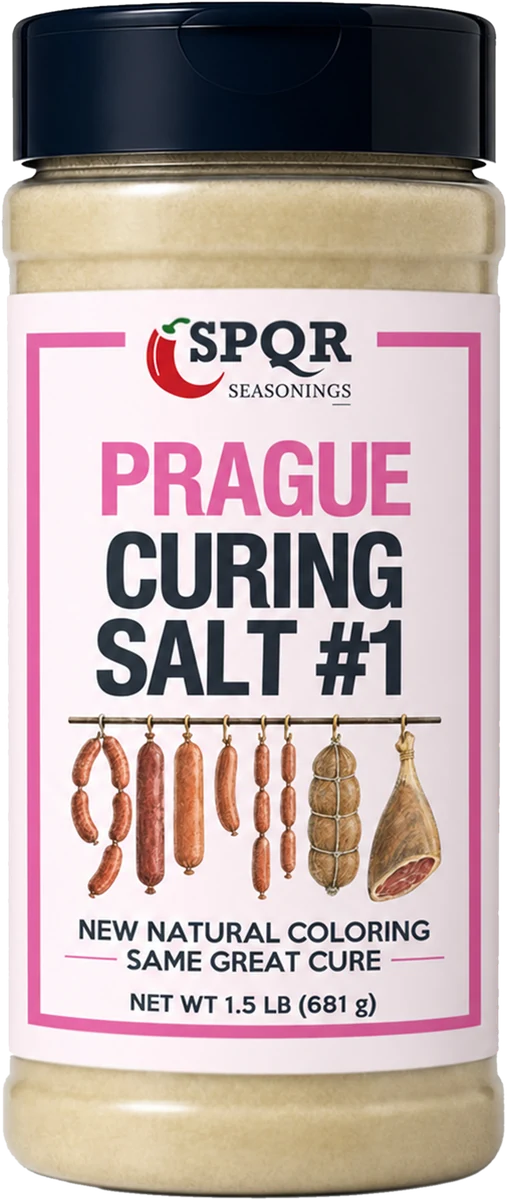

A home-cured holiday ham starts as a fresh, uncured pork leg. You inject it with a seasoned brine and soak it in the rest of the brine in the fridge for 7 days, then roast it to 145 °F with a brown sugar glaze. The cure is Prague Curing Salt #1 from SPQR Seasonings. It's the part that turns roast pork into real ham: rosy all the way through, with that cured, smoky-sweet flavor.
It takes about 45 minutes of hands-on work and a week of waiting. Every amount below is by weight, so you know exactly how much cure goes in. This is the same dose a professional would calculate.
Home-Cured Holiday Ham
- Total time
- 8 daysmostly hands-off
- Prep time
- 45 minactive, plus chilling the brine
- Cure time
- 7 daysin the fridge
- Cook time
- 4 to 4½ hrat 325 °F, then glaze
- Yield
- 12 to 14 servingsone 7-lb ham
- Difficulty
- Intermediateeasy steps; need a scale and thermometer
- Meat weight
- 7 lbbone-in half ham
You'll need
Written for a 7-lb fresh ham and 1 gallon of water. For a different size, use the scaling table below the recipe.
For the ham
- 7 lbs. (3,175 g) fresh (uncured, raw) ham, bone-in shank or butt half, skin off, with about ¼ inch of fat left on. Ask the butcher for a "fresh ham."
For the brine
- 1 gallon (3,785 g) cold water, divided
- 21.7 g SPQR Seasonings Prague Curing Salt #1, measured level. Weigh it if you can, and don't round up.
- 154 g fine salt (a generous ½ cup), such as SPQR Seasonings Himalayan Pink Salt, Fine Grain or any non-iodized salt. This is the plain salt, not the cure.
- 105 g brown sugar (½ cup packed) or SPQR Seasonings Monk Fruit Sweetener, cup for cup
- 4 bay leaves
- 1 tablespoon black peppercorns
- 1 teaspoon whole cloves
- 1 teaspoon allspice berries
- 1 cinnamon stick
- 4 garlic cloves, smashed
For the glaze
- ½ cup (100 g) packed brown sugar
- ¼ cup (85 g) honey or maple syrup
- 2 tablespoons Dijon mustard
- 1 tablespoon apple cider vinegar
- ½ teaspoon SPQR Seasonings Smoked Spanish Paprika
- ¼ teaspoon ground cloves
- Optional: 4.9 g (about 1 tsp) SPQR Seasonings MSG for a savory boost. Stir it into the glaze, not the brine.
Cure dose
Measure level, never heaped
- Prague Curing Salt #1
- 21.7 g per gallon for 7 lb
- Nitrite level
- about 195 ppm
Storage: Keep the bottle sealed, labeled and out of reach of children. Curing salt is not table salt. Store it away from your regular salt.
Equipment
- Digital kitchen scale that reads in grams
- Food-safe container or 2-gallon brining bag (set in a bowl) that holds the ham and brine and fits in your fridge
- Meat injector (a marinade injector works)
- A plate or zip-top bag of water to keep the ham under the brine
- Fridge thermometer (the fridge must stay at 36 to 40 °F)
- Roasting pan, foil and an instant-read or probe meat thermometer
Steps
-
Weigh the ham
Write the weight down in grams. If it isn't close to 7 lbs., use the scaling table below to adjust the brine.
-
Make the brine base
In a pot, warm 1 quart of the water with the 154 g salt, the brown sugar, bay leaves, peppercorns, cloves, allspice, cinnamon and garlic. Stir until the salt and sugar dissolve, then turn off the heat. Add the other 3 quarts of cold water.
-
Chill it completely
Refrigerate the brine until it's 40 °F or colder. Never put raw pork into warm brine.
-
Add the cure
Stir 21.7 g of Prague Curing Salt #1 into the cold brine until it dissolves. Weigh it if you can, and don't round up.
-
Inject the ham
Strain about 1⅓ cups (318 g) of brine into a cup for the injector. That's 10% of the ham's weight, which is the standard pump amount. Set the ham on the scale and inject every inch or so, going deep along the bone and into the thickest parts, until it weighs about 318 g more. Injecting cures the center and the meat around the bone, which a soak alone takes weeks to reach.
-
Submerge
Put the ham in the container and pour all the remaining brine over it, including anything that leaked out while injecting. Weigh it down so every part stays under.
-
Cure for 7 days at 36 to 40 °F
Plan on about 1 day per pound after injecting, and turn the ham every day or two. A few extra days won't make it saltier, because the brine is mixed to the final salt level.
-
Rinse and dry
Lift the ham out, throw the brine away, rinse the ham under cold water and pat it dry. If you plan to smoke it, leave it uncovered on a rack in the fridge overnight so the surface gets tacky.
-
Roast
Heat the oven to 325 °F. Set the ham fat side up in a roasting pan with 1 cup of water, tent it with foil and roast. For an uncooked bone-in half ham at 325 °F, USDA lists 35 to 40 minutes per pound, so plan on about 4 to 4½ hours. A boneless ham finishes sooner, so start checking at 2½ hours.
-
Make the glaze
While the ham roasts, simmer the glaze ingredients, including the MSG if you're using it, in a small pan for 2 to 3 minutes until glossy.
-
Glaze and finish
When the thickest part reads 130 °F, take off the foil, turn the oven up to 400 °F and brush on half the glaze. Roast 10 minutes, brush on the rest, and roast until the thickest part (not touching bone) reads 145 °F, usually 10 to 15 minutes more.
-
Rest and slice
USDA asks for at least a 3-minute rest at 145 °F. Give a big ham 15 to 20 minutes so it slices cleanly, then carve across the grain. Cured ham stays pink when it's fully cooked. That's the cure at work, so go by the thermometer.
Storage
- Cured but not yet cooked: keep it in the fridge and cook it within 5 to 7 days, the USDA window for an uncooked cook-before-eating ham.
- Cooked ham: refrigerate within 2 hours. It keeps 3 to 5 days in the fridge, or 1 to 2 months in the freezer for best quality.
- Reheating: USDA says to reheat hams that weren't packaged in an inspected plant, which includes this one, to 165 °F.
- The bone: freeze it for split pea soup or beans.
Scaling the brine to your ham
The cure is figured on the total weight of meat plus water: 3.1 g of Prague Curing Salt #1 for every kilogram of meat and water combined, which comes to about 195 ppm. Never go over 3.2 g per kilogram, which is 200 ppm. Amounts below are by weight. Don't round up.
| Ham | g | Water | g | Cure #1 | Salt | Sugar | Inject |
|---|---|---|---|---|---|---|---|
| 5 lb | 2,268 | 1 gal | 3,785 | 18.9 g | 134 g | 91 g | 227 g |
| 6 lb | 2,722 | 1 gal | 3,785 | 20.3 g | 144 g | 98 g | 272 g |
| 7 lb | 3,175 | 1 gal | 3,785 | 21.7 g | 154 g | 105 g | 318 g |
| 8 lb | 3,629 | 1 gal | 3,785 | 23.1 g | 164 g | 111 g | 363 g |
| 9 lb | 4,082 | 1¼ gal | 4,732 | 27.5 g | 195 g | 132 g | 408 g |
| 10 lb | 4,536 | 1¼ gal | 4,732 | 28.9 g | 205 g | 139 g | 454 g |
If you need more water to cover the ham, add these for each extra quart (946 g): 2.9 g Prague Curing Salt #1, 21 g fine salt and 14 g brown sugar.
How much cure is in this ham?
Prague Curing Salt #1 from SPQR Seasonings is salt with 6.25% sodium nitrite, tinted yellow so nobody mistakes it for table salt. We weighed 10 level teaspoons of it three times (73 g, 68 g and 71 g), so a level teaspoon weighs about 7.07 g. Spoon amounts in this recipe are rounded down to the nearest ⅛ teaspoon at that weight, so the spoon dose is never more than the weighed dose. A scale is more accurate.
- The math: 21.7 g of cure × 6.25% = 1.36 g of sodium nitrite. The ham and water together weigh 6,960 g, so that's 1.36 ÷ 6,960 = about 195 ppm. If you measure by spoon instead of weighing, 3 level teaspoons is about 21.2 g at 7.07 g per teaspoon, or about 190 ppm. Never round up.
- The limit: Federal rules cap nitrite in a cured product like this at 200 ppm, calculated as sodium nitrite (21 CFR 172.175, 9 CFR 424.21). USDA FSIS lists 200 ppm as the most for immersion-cured and pumped products other than bacon (FSIS quick reference, Table II).
- The injection doesn't add any nitrite. The brine you inject comes out of the same batch, so the total stays the same. Measured the way FSIS figures a pump, a 10% injection of this brine adds only about 33 ppm to the ham.
- Why this is more than the bottle's 1 level tsp per 5 lbs. (about 195 ppm on meat alone): In a brine, the cure spreads through the meat and the water, so the recipe counts both. That's how this ham gets close to the 200 ppm limit while staying under it. Measure carefully, use level spoons or a scale, and don't add extra.
- Use Curing Salt #1, not #2. Ham you'll cook within a few weeks needs #1. Curing Salt #2 is for long dry cures. See Curing Salt #1 vs #2.
- Keep it cold. Cure in a fridge at 36 to 40 °F (USDA FSIS says a fridge should hold 40 °F or below), and cook to 145 °F with a 3-minute rest.
For a ham that isn't 7 lbs., or a different amount of water, calculate the brine for your ham by entering both the meat and the water.
Wondering whether nitrite is safe to eat at these levels? Our Meat Curing Academy guide Is Curing Salt #1 Safe? walks through it. Store the bottle away from children and your regular salt.
Tips and swaps
- Boneless works too. A boneless fresh ham or pork leg roast cures and cooks faster. Inject it the same way.
- Want it smoked? After the overnight air-dry, smoke the ham at 225 to 250 °F until it reads 145 °F inside. Glaze it during the last 30 minutes.
- Less sugar: You can swap the brown sugar in the brine for SPQR Seasonings Monk Fruit Sweetener, cup for cup. Sugar in the brine is there for flavor, not safety.
- Optional MSG boost: Stir 4.9 g (about 1 tsp) of SPQR Seasonings MSG into the glaze, not the brine (it does more good on the surface). It adds flavor only and doesn't affect the cure. Don't cut the curing salt; you can use a little less regular salt if you like.
- Don't swap the cure. Himalayan pink salt is plain salt with no nitrite, so it can't cure ham. Here's how the two differ.
- No room in the fridge? Use a smaller ham or a boneless half. Never brine at room temperature.
- Curing other holiday meats? Our General Holiday Cure covers turkey breast, pork loin and more.
Frequently asked questions
How long does it take to cure a ham at home?
About 1 day per pound in the brine after you inject it, so a 7-lb ham takes 7 days. Without injecting, the brine has to soak in from the outside, and a big bone-in ham can take weeks. That's why this recipe injects.
Do I need curing salt to make ham?
Yes, if you want ham and not roast pork. Curing salt (often sold as pink curing salt or Prague Powder #1; ours is the same cure tinted yellow) contains sodium nitrite, which gives ham its pink color, cured flavor and protection against botulism. Without it, a brined pork leg cooks up gray and tastes like a pork roast.
How much Prague Curing Salt #1 goes in a ham brine?
Figure it on the meat plus the water: 3.1 g per kilogram of the two combined, which is about 195 ppm. A 7-lb ham in 1 gallon of water needs 21.7 g, about 195 ppm. Never go over 3.2 g per kilogram (200 ppm).
Why does this recipe use more cure than 1 teaspoon per 5 pounds?
In a brine, the cure spreads through both the meat and the water, so the recipe counts both. Even so, it works out to about 195 ppm, under the 200 ppm federal limit. (The bottle's 1 level teaspoon per 5 lbs. is also about 195 ppm, on meat alone.)
What temperature should a home-cured ham be cooked to?
USDA says to cook an uncooked ham, fresh or cured, to 145 °F in the thickest part, then let it rest at least 3 minutes. Reheat leftovers to 165 °F.
Why is my ham still pink after cooking?
That's the cure. Nitrite locks in a rosy color that stays pink even when the ham is fully cooked. Trust the thermometer, not the color.
Can I use Himalayan pink salt instead of curing salt?
No. Himalayan pink salt has no nitrite, so it can't cure ham. Use it as the plain salt in the brine if you like, and use Prague Curing Salt #1 as the cure.
Ready to cure your first ham? One bottle of Prague Curing Salt #1 from SPQR Seasonings (1.5 lb.) will cure a lot of holiday hams, plus bacon, corned beef and jerky the rest of the year. Next up, try our homemade cured and smoked bacon, or learn the basics in What Is Curing Salt #1?
Sources
- eCFR, 21 CFR 172.175, Sodium nitrite
- eCFR, 9 CFR 424.21, Use of food ingredients (nitrite not more than 200 ppm in the finished product)
- USDA FSIS, Cured Meat and Poultry Product Operations: Calculation Quick Reference (ppm and pump equations; Table II limits)
- USDA FSIS, Safe Minimum Internal Temperature Chart
- USDA FSIS, Refrigeration and Food Safety
- USDA FSIS, Ham and Food Safety fact sheet (cooking times and storage chart), as published by Utah State University Extension
- Oklahoma State University Extension, Meat Curing (ANSI-3994) (pump hams at 10% of their weight; cure at 36 to 40 °F)
- Optional MSG: about 0.25% of the meat weight (about ¼ tsp per lb) when mixed into a dry cure, rub, sausage or marinade; a smaller amount in a glaze, because it sits on the surface. Ajinomoto cites a formulation range of 0.1 to 0.8% and a kitchen tip of ½ tsp per lb of meat, including jerky and sausage (Ajinomoto Health & Nutrition); NDSU Extension uses 2 tsp per 5 lbs. in a beef jerky formula (The Art and Practice of Sausage Making). A level teaspoon of MSG weighs about 4.9 g (Modernist Pantry, average of 3 weighings, volume-to-weight sheet). The FDA considers added MSG “generally recognized as safe” (FDA MSG Q&A). MSG is for flavor only; it does not replace curing salt, and it is not a salt substitute for curing.