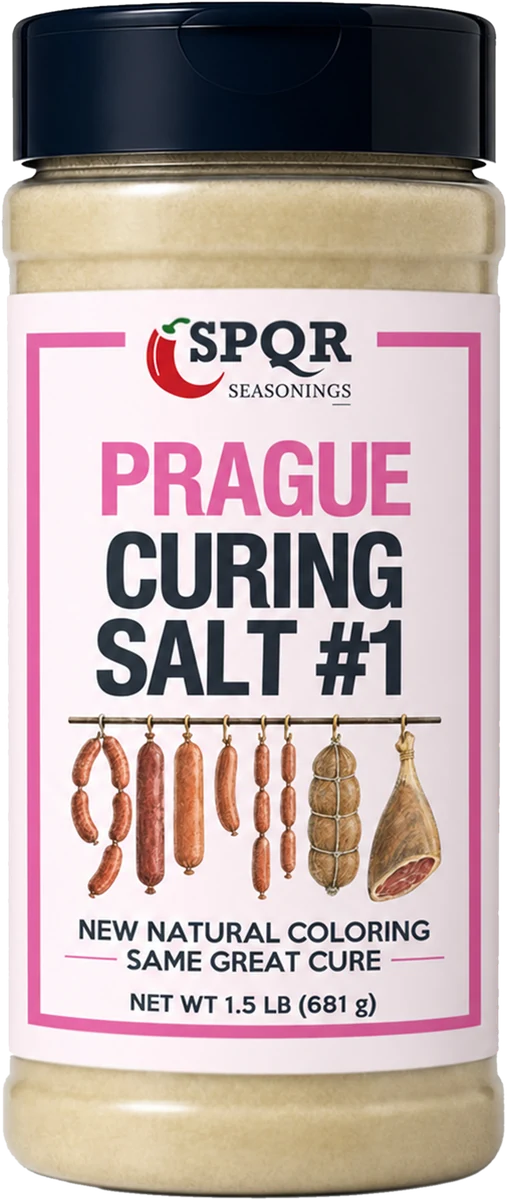
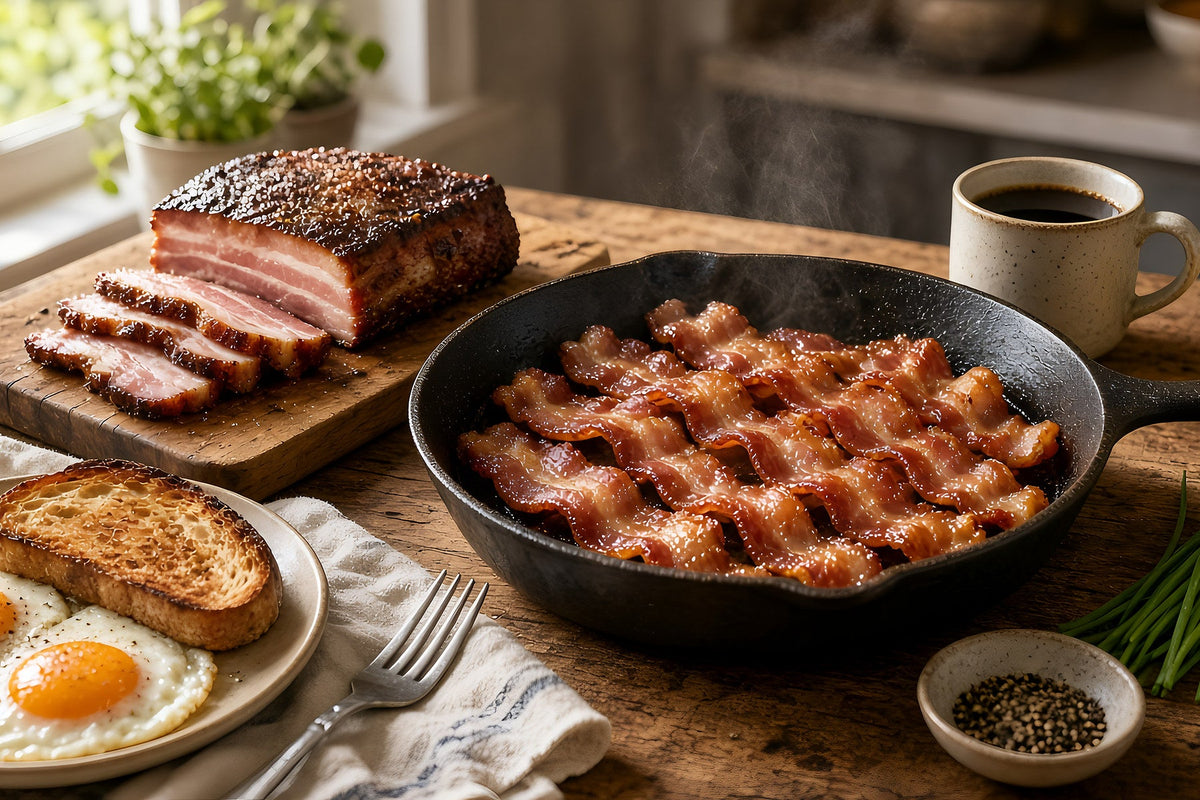
Homemade bacon is pork belly rubbed with salt, sugar and curing salt, cured in the fridge for 7 days, then smoked or slow-roasted to 160 °F. That's the whole recipe. The only part you have to get exactly right is the cure: 3.1 g per kilogram (7.0 g for a 5-lb belly) of Prague Curing Salt #1 from SPQR Seasonings by skinless weight. That gives your bacon its rosy color, real bacon flavor and protection against botulism.
You need about 20 minutes of hands-on work, a zip-top bag and some patience. Once you've tasted your own thick-cut, smoky slab, store-bought bacon is hard to go back to.
Why make your own bacon?
You pick the pork, the thickness and the flavor: sweet with maple, peppery, or smoky with apple or cherry wood. And you know exactly what's in it. This recipe uses a dry cure measured by weight, so the salt and nitrite come out right every time instead of depending on how heavy-handed you were with a scoop.
Homemade Smoked Bacon
- Total time
- 8 daysmostly hands-off
- Prep time
- 20 minactive
- Cure time
- 7 daysin the fridge, plus an overnight dry
- Cook time
- 2 to 3 hrsmoker at 225 °F or oven at 200 °F
- Yield
- About 4 lbs.of sliced bacon
- Difficulty
- Easyyou need a kitchen scale
- Meat weight
- 5 lbskinless pork belly
You'll need
Written for a 5-lb skinless pork belly. For other sizes, see the scaling table below the recipe.
For the belly
- 5 lbs. (2,268 g) pork belly, skin removed. Weigh it after the skin comes off.
For the dry cure
- 7.0 g SPQR Seasonings Prague Curing Salt #1. Weigh it on a 0.1 g scale.
- 50 g fine salt (about 3 tablespoons), such as SPQR Seasonings Himalayan Pink Salt, Fine Grain. This is the plain salt, not the cure.
- 50 g (¼ cup packed) brown sugar, light or dark or SPQR Seasonings Monk Fruit Sweetener, measure for measure
- 1½ tablespoons coarsely ground black pepper
- 1 tablespoon SPQR Seasonings Smoked Spanish Paprika
- 2 tablespoons maple syrup or honey (optional, for a sweeter cure)
- 1 teaspoon each garlic powder and onion powder (optional)
- Optional: 5.7 g (about 1⅛ tsp) SPQR Seasonings MSG for a savory boost. Mix it into the dry cure.
For smoking
- Apple, cherry or hickory wood chunks or chips (skip if you're using the oven)
Cure dose
Measure level, never heaped
- Prague Curing Salt #1
- 7.0 g for 5 lb of skinless belly
- Nitrite level
- about 193 ppm
Storage: Keep the bottle sealed, labeled and out of reach of children. Curing salt is not table salt. Store it away from your regular salt.
Equipment
- Digital kitchen scale that reads in grams
- 2-gallon zip-top bag or a vacuum-seal bag
- Fridge thermometer (the fridge must stay at 40 °F or below)
- Wire rack and sheet pan
- Smoker, or an oven that holds 200 °F
- Probe or instant-read meat thermometer
- Long sharp knife or a meat slicer
Steps
-
Weigh the belly
Trim off the skin and any ragged edges, then weigh the belly in grams. The cure is measured for this exact weight. If it isn't 5 lbs., see the scaling table below the recipe.
-
Mix the cure
In a bowl, whisk the Prague Curing Salt #1, salt, brown sugar, pepper and smoked paprika, plus the garlic and onion powder and the MSG if you're using them. Whisk 30 seconds so the cure is even. Stir in the maple or honey last.
-
Rub it on
Set the belly on a tray and pat it dry. Rub half the mix over one side and the edges, then flip and use the rest. Use every bit; the amount is set for this belly.
-
Bag it and cure for 7 days
Slide the belly into the bag with any loose cure, press out the air and seal. Lay it flat in the fridge at 40 °F or below. Flip it daily and massage the liquid that forms around the meat. A 1- to 1½-inch belly takes about 7 days; give a thicker one a day or two more.
-
Check, rinse and dry
The cured belly should feel firm all the way through, like a flexed muscle. Rinse it under cold water and pat it dry. Set it on a rack over a sheet pan and leave it uncovered in the fridge overnight, up to 24 hours. The tacky surface helps smoke stick.
-
Smoke it (or use the oven)
Smoker: Heat it to 225 °F with apple, cherry or hickory wood. USDA FSIS says to keep the air in the smoker between 225 and 300 °F the whole time (FSIS, Smoking Meat and Poultry). Smoke the belly until the thickest part reads 160 °F, usually 2 to 3 hours. Oven: Roast on the rack at 200 °F to the same 160 °F, about 2 hours.
-
Chill, then slice
Let the slab cool, then refrigerate it overnight. Cold bacon slices far more cleanly. Slice and fry like store-bought bacon.
Storage
- Fridge: wrap the slab or slices airtight and keep them at 40 °F or below for up to 7 days, cutting and cooking as you go (if you don't eat it all at once!).
- Freezer: vacuum-seal or wrap tightly and freeze. USDA suggests using frozen bacon within about 4 months for best quality. It stays safe longer, but the flavor fades.
- It isn't shelf-stable. Home-cured bacon must stay refrigerated or frozen.
Scaling the cure to your belly
The rule: 3.1 g of Prague Curing Salt #1 per kilogram of skinless belly (about 193 ppm), never more than 3.2 g per kilogram (200 ppm). Grams are rounded down. Spoon amounts are rounded down to the nearest ⅛ teaspoon at 7.07 g per level teaspoon (our own weigh test) (1 level teaspoon per 5 lbs. is the one exception, at about 195 ppm).
| Skinless belly | Prague Curing Salt #1 | Nitrite (weighed) | Fine salt | Brown sugar |
|---|---|---|---|---|
| 2 lbs. (907 g) | 2.8 g (⅜ level tsp) | 193 ppm | 20 g | 20 g |
| 3 lbs. (1,361 g) | 4.2 g (½ level tsp) | 193 ppm | 30 g | 30 g |
| 4 lbs. (1,814 g) | 5.6 g (¾ level tsp) | 193 ppm | 40 g | 40 g |
| 5 lbs. (2,268 g) | 7.0 g (1 level tsp) | 193 ppm | 50 g | 50 g |
| 6 lbs. (2,722 g) | 8.4 g (1⅛ level tsp) | 193 ppm | 60 g | 60 g |
| 7 lbs. (3,175 g) | 9.8 g (1⅜ level tsp) | 193 ppm | 70 g | 70 g |
| 8 lbs. (3,629 g) | 11.2 g (1½ level tsp) | 193 ppm | 80 g | 80 g |
Scale the pepper, paprika and other flavorings by eye. They don't affect safety.
How much cure is in this bacon?
Prague Curing Salt #1 from SPQR Seasonings is salt with 6.25% sodium nitrite, tinted yellow so nobody mistakes it for table salt. We weighed 10 level teaspoons of it three times (73 g, 68 g and 71 g), so a level teaspoon weighs about 7.07 g. Spoon amounts in this recipe are rounded down to the nearest ⅛ teaspoon at that weight, so the spoon dose stays at or under the weighed dose. The one exception is the label rate: 1 level teaspoon per 5 lbs. (7.07 g) comes out about 195 ppm, a hair over the weighed 193 ppm and still under 200. A scale is more accurate.
- The math: 7.0 g of cure × 6.25% = 0.44 g of sodium nitrite. Divided by 2,268 g of belly, that's about 193 ppm. By spoon, 1 level teaspoon (about 7.07 g, the bottle's label rate) gives about 195 ppm, still under 200.
- The limit: USDA caps dry-cured bacon at 200 ppm ingoing sodium nitrite, based on the skin-free weight of the belly (9 CFR 424.22(b)). The FDA's limit on nitrite in cured meat is also 200 ppm (21 CFR 172.175).
- Why there's no wet-brine version: USDA holds bacon that's soaked in brine or injected to a much lower 120 ppm, so a brine at our ham or corned beef strength would be too strong for bacon. A dry cure is simpler and fits the rules.
- About the bottle's 1 level tsp per 5 lbs.: That's a general guide, and at 7.07 g per teaspoon it works out to about 195 ppm. This recipe weighs the cure to about 193 ppm, just under the guide and under the 200 ppm limit for dry-cured bacon. Don't add extra.
- Use Curing Salt #1, never #2, for bacon. See Curing Salt #1 vs #2.
If your belly isn't 5 lbs., calculate the cure for your belly from its skinless weight. Use the dry-cured bacon setting, not a brine.
Curious whether nitrite in bacon is safe? Our Meat Curing Academy guide Is Curing Salt #1 Safe? walks through it.
Tips and swaps
- Skin on? Take it off before curing. The skin slows the cure, and the dose is figured on the skinless weight. If you buy a skin-on belly, weigh it after trimming.
- Less sugar: Swap the brown sugar for SPQR Seasonings Monk Fruit Sweetener, measure for measure, and skip the maple. Sugar is there for flavor, not safety.
- Optional MSG boost: Mix 5.7 g (about 1⅛ tsp) of SPQR Seasonings MSG into the dry cure for a savory boost. It adds flavor only and doesn't affect the cure. Don't cut the curing salt; you can use a little less regular salt if you like.
- Peppered bacon: Press extra cracked pepper onto the belly right after you rinse and dry it.
- Don't swap the cure. Himalayan pink salt is plain salt with no nitrite. Here's how the two differ.
Frequently asked questions
How much curing salt do I need for bacon?
Use 3.1 g of Prague Curing Salt #1 per kilogram of skinless pork belly: 7.0 g for 5 lbs. That's about 193 ppm sodium nitrite, under USDA's 200 ppm limit for dry-cured bacon.
How long does it take to cure bacon?
About 7 days in the fridge for a belly 1 to 1½ inches thick, flipping the bag every day. A thicker belly needs a day or two more. It's done when it feels firm all the way through.
What temperature should homemade bacon be cooked to?
Smoke or roast the cured belly until the thickest part reads 160 °F, the target Oregon State University Extension uses for home-cured bacon. Then chill, slice and fry.
Can I make bacon without a smoker?
Yes. Roast the cured belly on a rack in a 200 °F oven to 160 °F inside, about 2 hours. Smoked paprika in the cure adds a smoky flavor without the smoker.
Can I cure bacon in a wet brine?
Not with this recipe. USDA limits brined or injected bacon to 120 ppm nitrite, compared with 200 ppm for dry-cured bacon. That's why we use a dry cure measured by weight.
Do I need curing salt to make bacon?
For real bacon, yes. Curing salt (often called pink curing salt or Prague Powder #1; ours is the same cure tinted yellow) adds the nitrite that gives bacon its color, flavor and protection against botulism. Without it, you get salted pork belly that cooks up gray.
Can I use Himalayan pink salt instead of curing salt?
No. Himalayan pink salt has no nitrite. Use it as the plain salt in the cure if you like, and use Prague Curing Salt #1 as the cure.
Ready to make your first slab? One 1.5-lb. bottle of Prague Curing Salt #1 from SPQR Seasonings cures a lot of bacon, plus ham, corned beef and jerky. Next, try our home-cured holiday ham or homemade corned beef, or learn the basics in What Is Curing Salt #1?
Sources
- eCFR, 9 CFR 424.22, Certain other permitted uses (bacon: 200 ppm dry-cured; 120 ppm immersion-cured or pumped)
- eCFR, 21 CFR 172.175, Sodium nitrite
- USDA FSIS, Bacon and Food Safety (bacon is raw until cooked; storage chart: 7 days refrigerated, 4 months frozen)
- USDA FSIS, Smoking Meat and Poultry (keep smoker air between 225 and 300 °F)
- USDA FSIS, Refrigeration and Food Safety (keep the fridge at 40 °F or below)
- Oregon State University Extension, Making Cured Bacon at Home (PNW 784) (cure 5 to 7 days in the fridge, cook to 160 °F, refrigerate up to 7 days or freeze)
- Optional MSG: about 0.25% of the meat weight (about ¼ tsp per lb) when mixed into a dry cure, rub, sausage or marinade; a smaller amount in a glaze, because it sits on the surface. Ajinomoto cites a formulation range of 0.1 to 0.8% and a kitchen tip of ½ tsp per lb of meat, including jerky and sausage (Ajinomoto Health & Nutrition); NDSU Extension uses 2 tsp per 5 lbs. in a beef jerky formula (The Art and Practice of Sausage Making). A level teaspoon of MSG weighs about 4.9 g (Modernist Pantry, average of 3 weighings, volume-to-weight sheet). The FDA considers added MSG “generally recognized as safe” (FDA MSG Q&A). MSG is for flavor only; it does not replace curing salt, and it is not a salt substitute for curing.