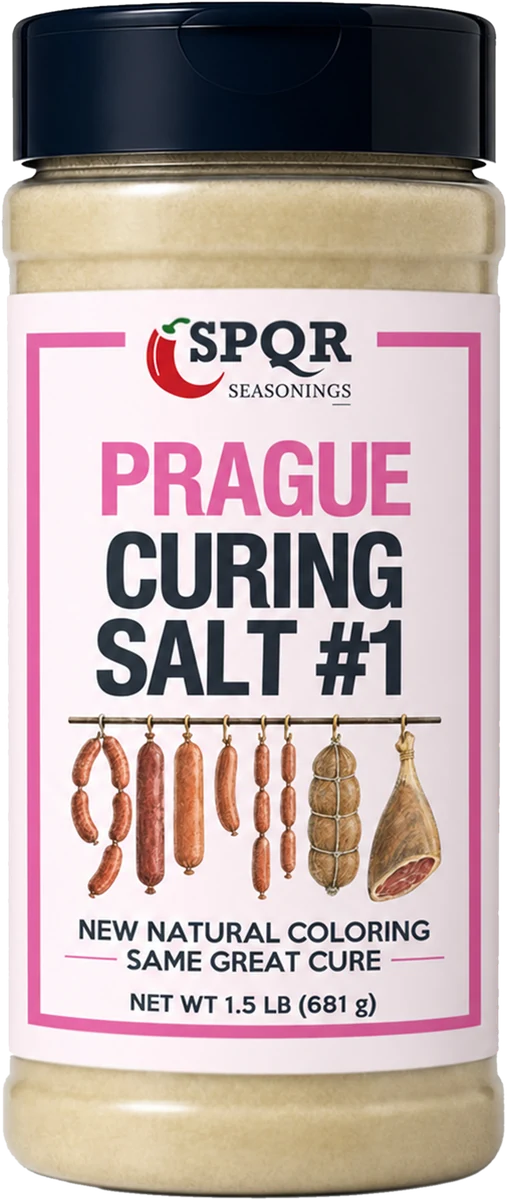
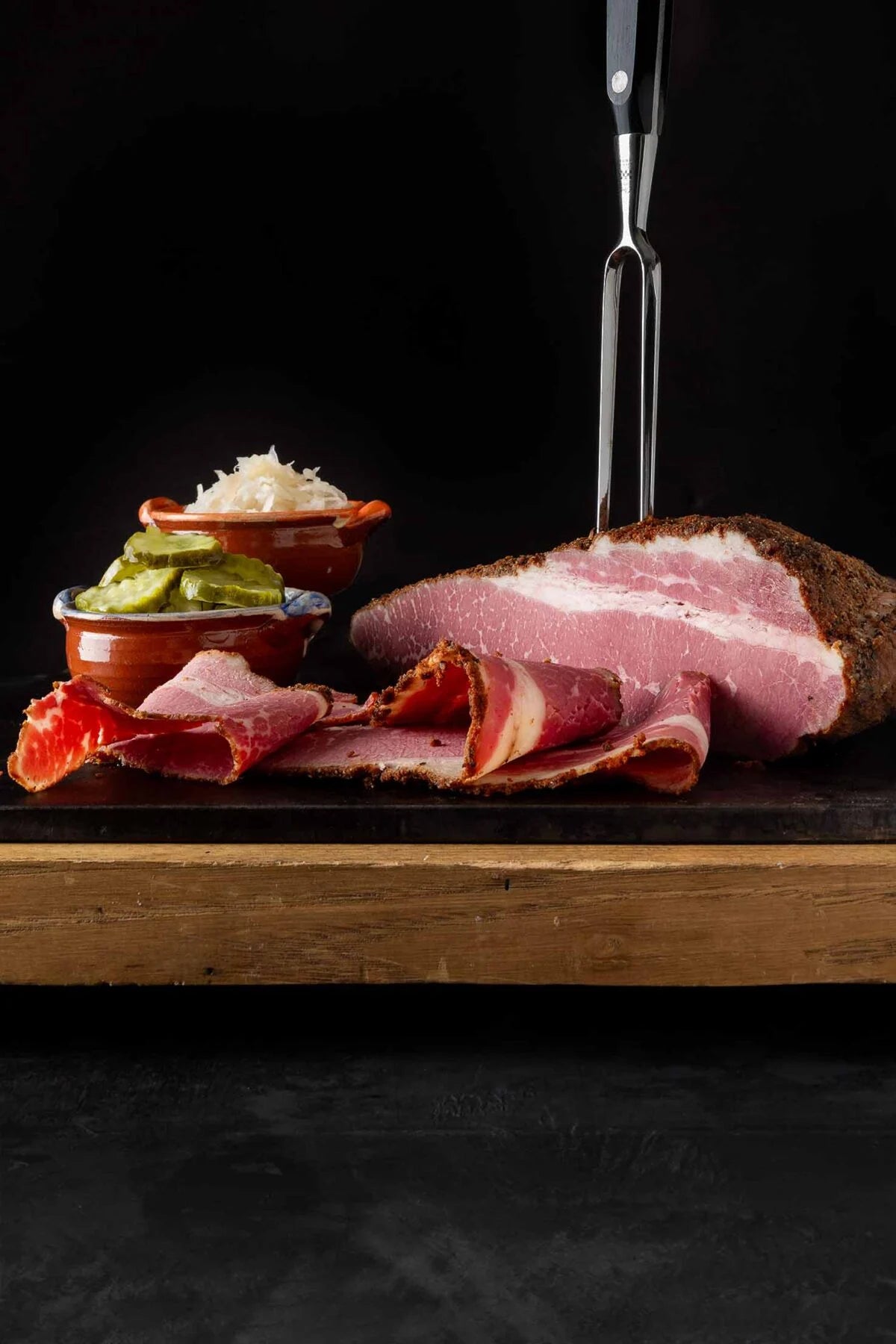
To make pastrami, you cure a beef brisket in a salt-and-sugar brine with curing salt for about 7 days, coat it in cracked black pepper and coriander, smoke it, then steam it until it's tender enough to pull apart. The cure, Prague Curing Salt #1 from SPQR Seasonings, is what makes it pastrami instead of smoked brisket: rosy all the way through, with that deli flavor.
It takes a week, but only about an hour and a half of actual work. Pastrami is corned beef's smoky cousin. It starts with the same brine as our homemade corned beef, then picks up a peppery crust and a few hours of smoke. New to it? Read What Is Pastrami? in our Meat Curing Academy first.
Why make your own pastrami?
Good deli pastrami is expensive, and most supermarket pastrami is thin-sliced and steamed in a pouch. At home you pick the brisket, toast your own spices and control the salt. This recipe gives every amount in grams, including the cure, so you know exactly how much nitrite goes into the meat.
Homemade Pastrami
- Total time
- 8 daysmostly hands-off
- Prep time
- 1 hr 30 minactive, over several days
- Cure time
- 7 daysin the fridge, plus an overnight rest
- Cook time
- 6 to 9 hrsmoke, then steam
- Yield
- 10 to 12 servingsabout 3 lbs. cooked
- Difficulty
- Moderateyou need a scale and a thermometer
- Meat weight
- 5 lbflat-cut brisket
You'll need
Written for a 5-lb brisket and 1 gallon of water. For other sizes, see the scaling table below the recipe.
For the brisket
- 5 lbs. (2,268 g) beef brisket, flat cut (or navel, if your butcher has it), fat trimmed to about ¼ inch
For the brine
- 1 gallon (3,785 g) cold water, divided
- 18.8 g SPQR Seasonings Prague Curing Salt #1. Weigh it on a 0.1 g scale.
- 164 g fine salt (about ½ cup plus 1 tablespoon), such as SPQR Seasonings Himalayan Pink Salt, Fine Grain or any non-iodized salt. This is the plain salt, not the cure.
- 91 g (a scant ½ cup) sugar or SPQR Seasonings Monk Fruit Sweetener, cup for cup
- 3 tablespoons pickling spice, store-bought or the homemade mix in our corned beef recipe
- 4 bay leaves
- 4 garlic cloves, smashed
For the pastrami rub
No salt in the rub; the brine already seasoned the meat. Toast the whole spices in a dry pan for a minute or two, then crack them coarsely.
- 3 tablespoons (about 20 g) whole black peppercorns
- 2 tablespoons (about 10 g) coriander seeds
- 2 teaspoons (about 7 g) yellow mustard seeds
- 1 tablespoon (about 7 g) SPQR Seasonings Smoked Spanish Paprika
- 1 tablespoon (about 13 g) brown sugar or monk fruit sweetener, cup for cup
- 2 teaspoons (about 6 g) garlic powder
- 1 teaspoon (about 3 g) onion powder
- Optional: 5.7 g (about 1⅛ tsp) SPQR Seasonings MSG for a savory boost. It's about 0.25% of the meat's weight.
For smoking and steaming
- 2 to 3 chunks oak, hickory or cherry wood (or a handful of chips)
- 2 cups boiling water for steaming
Cure dose
Measure level, never heaped
- Prague Curing Salt #1
- 18.8 g per gallon for 5 lb
- Nitrite level
- about 194 ppm
Storage: Keep the bottle sealed, labeled and out of reach of children. Curing salt is not table salt. Store it away from your regular salt.
Equipment
- Digital kitchen scale that reads in grams (0.1 g for the cure)
- Nonreactive container (food-grade plastic, glass or stainless steel) or a 2-gallon brining bag set in a pan
- Marinade injector (recommended)
- Fridge thermometer (the fridge must stay at 40 °F or below)
- Smoker, a roasting pan with a rack, foil and a probe thermometer
Steps
-
Weigh the brisket
Trim the fat cap to about ¼ inch and weigh the brisket in grams. If it isn't close to 5 lbs., use the scaling table below the recipe.
-
Make the brine
In a large pot, warm 1 quart of the water with the 164 g salt, the sugar, 3 tablespoons of pickling spice, the bay leaves and garlic. Stir until the salt and sugar dissolve, then turn off the heat and add the other 3 quarts of cold water.
-
Chill it completely
Refrigerate the brine until it's 40 °F or colder. Never put raw beef into warm brine.
-
Add the cure
Stir the 18.8 g of Prague Curing Salt #1 into the cold brine until it dissolves. Weigh it, or measure it level, and don't round up.
-
Inject the brisket
Strain about 1 cup (227 g) of brine for the injector. That's 10% of the brisket's weight. Inject it about every inch, focusing on the thickest parts, so the center cures evenly.
-
Cure for 7 days
Put the brisket in the container, pour over the rest of the brine and weigh it down with a plate so it stays under. Cover and refrigerate at 40 °F or below for 7 days (at least 5), turning it every day or two.
-
Rinse and soak
Discard the brine and rinse the brisket. Soak it in fresh cold water in the fridge for 1 to 2 hours to pull out some surface salt. To check, fry a thin slice and taste it; if it's too salty, soak another hour.
-
Rub and dry overnight
Pat the brisket dry. Crack the peppercorns, coriander and mustard seeds coarsely, mix with the rest of the rub, and press it onto every side. Set it on a rack over a tray and refrigerate it uncovered overnight. The surface dries so smoke and rub stick.
-
Smoke
Heat the smoker to 250 °F (anywhere from 225 to 275 °F works) with oak, hickory or cherry. Smoke the brisket fat side up until the bark is set and it reads about 160 to 165 °F inside, usually 4 to 6 hours.
-
Steam until tender
Set the brisket on a rack in a roasting pan over 2 cups of boiling water, cover the pan tightly with foil and put it in a 300 °F oven. Steam until it reads 200 to 203 °F and a probe slides in like butter, about 2 to 3 hours. No oven room? Wrap it in butcher paper and finish it in the smoker. It's safe once it reaches 145 °F with a 3-minute rest; the higher temperature is for tenderness.
-
Rest and slice
Rest the pastrami, wrapped, for at least 1 hour. Slice it across the grain, about ¼ inch thick for sandwiches. It stays rosy all the way through when fully cooked; that's the cure.
Storage
- Cured but not yet cooked: keep it refrigerated and cook it within a few days.
- Cooked: refrigerate within 2 hours. It keeps 3 to 4 days in the fridge, or 2 to 3 months frozen for best quality.
- Reheating: steam slices for 5 to 10 minutes, or until hot, to 165 °F.
Scaling the brine for a bigger or smaller brisket
The cure is figured on the total weight of meat plus water: 3.1 g of Prague Curing Salt #1 for every kilogram of meat and water combined, which comes to about 194 to 195 ppm. Never go over 3.2 g per kilogram, which is 200 ppm. Grams are rounded down. Spoon amounts are rounded down to the nearest ⅛ teaspoon at 7.07 g per level teaspoon (our own weigh test), so they never go over the weighed dose. Scale the rub with the meat: about 1 tablespoon of rub per pound is plenty.
| Brisket | Water | Prague Curing Salt #1 | Fine salt | Sugar | Inject (10%) |
|---|---|---|---|---|---|
| 3 lbs. (1,361 g) | 1 gal (3,785 g) | 16.0 g (2¼ level tsp) | 139 g | 77 g | 136 g |
| 4 lbs. (1,814 g) | 1 gal (3,785 g) | 17.4 g (2⅜ level tsp) | 152 g | 84 g | 181 g |
| 5 lbs. (2,268 g) | 1 gal (3,785 g) | 18.8 g (2⅝ level tsp) | 164 g | 91 g | 227 g |
| 6 lbs. (2,722 g) | 1 gal (3,785 g) | 20.3 g (2¾ level tsp) | 176 g | 98 g | 272 g |
| 7 lbs. (3,175 g) | 1¼ gal (4,732 g) | 24.6 g (3⅜ level tsp) | 214 g | 119 g | 318 g |
If you need more water to cover the brisket, add these for each extra quart (946 g): 2.9 g (⅜ level tsp) Prague Curing Salt #1, 26 g fine salt and 14 g sugar.
How much cure is in this pastrami?
Prague Curing Salt #1 from SPQR Seasonings is salt with 6.25% sodium nitrite, tinted yellow so nobody mistakes it for table salt. We weighed 10 level teaspoons of it three times (73 g, 68 g and 71 g), so a level teaspoon weighs about 7.07 g. A scale is more accurate than a spoon.
- The math: 18.8 g of cure × 6.25% = 1.18 g of sodium nitrite. The brisket and water together weigh 6,053 g, so that's about 194 ppm (cure g × 62,500 ÷ meat-plus-water g). By spoon, 2⅝ level teaspoons (about 18.6 g) gives about 192 ppm.
- The limit: Federal rules cap nitrite in cured beef like this at 200 ppm, calculated as sodium nitrite (21 CFR 172.175, 9 CFR 424.21). USDA FSIS lists 200 ppm as the most for immersion-cured and pumped products other than bacon (FSIS quick reference, Table II).
- The injection doesn't add any nitrite. The brine you inject comes out of the same batch. Figured the way FSIS calculates a pump, a 10% injection of this brine adds only about 29 ppm to the brisket.
- Why this is more than the bottle's 1 level tsp per 5 lbs.: In a brine, the cure spreads through the meat and the water, so the recipe counts both. Measure carefully and don't add extra.
- We checked popular pastrami recipes. Of the 8 popular versions we could calculate, 4 come out around 270 to 285 ppm, well above where we cap ours, usually because the cure is measured by the heaping spoon or isn't tied to the meat's weight. Others use far less. Ours sits just under 200 ppm for a full, even cure.
- Use Curing Salt #1, not #2. Pastrami is cooked within days, so it needs #1. See Curing Salt #1 vs #2.
For a different-size brisket, or a different amount of water, calculate a brine for a different-size brisket by entering both the meat and the water.
Wondering whether nitrite is safe to eat? Our Meat Curing Academy guide Is Curing Salt #1 Safe? walks through it.
The pastrami rub
Classic deli pastrami seasoning is mostly two spices: black pepper and coriander, about two parts pepper to one part coriander, toasted and coarsely cracked. Mustard seed, garlic, a little sugar and smoked paprika round it out. There's no salt in this pastrami rub because the brine already salted the meat all the way through.
- Crack, don't grind. A coarse crack (a spice grinder on pulse, or a heavy pan) gives the crunchy, peppery bark pastrami is known for. Fine powder turns pasty.
- Make extra. The rub keeps for a month in a sealed jar and is great on smoked turkey breast or burgers.
Pastrami vs corned beef
Both start as brisket cured in the same kind of brine. Corned beef gets simmered in water. Pastrami gets a pepper and coriander rub, then it's smoked and steamed. If you can make our corned beef, you can make pastrami. Read the full comparison in What Is Pastrami?.
Tips and swaps
- Which cut? Navel (plate) is the New York deli cut: fattier and very tender, but hard to find. The brisket flat slices neatly; the point is fattier and juicier.
- No injector? Skip it and cure the full 7 days. The very center may come out less evenly colored.
- Less sugar: Swap the sugar in the brine and rub for SPQR Seasonings Monk Fruit Sweetener, cup for cup. Sugar is there for flavor, not safety.
- Optional MSG boost: Add 5.7 g (about 1⅛ tsp) of SPQR Seasonings MSG to the rub. It adds savory flavor and doesn't affect the cure. Don't cut the curing salt.
- The stall: Around 150 to 165 °F the temperature can sit still for an hour or more. That's normal. The steaming step gets you through it.
- Slice it cold for neat slices. Chill the cooked pastrami overnight, slice it thin, then steam the slices to reheat. That's how delis do it.
- Don't swap the cure. Himalayan pink salt is plain salt with no nitrite. Here's how the two differ.
Frequently asked questions
How long does it take to make pastrami?
About 8 days, almost all of it hands-off: 7 days in the brine, an overnight rest in the rub, then 6 to 9 hours of smoking and steaming.
What cut of meat is best for pastrami?
New York delis use beef navel (the plate), which is fattier and harder to find. Brisket is the easiest choice at home. The flat slices neatly; the point is richer.
How much curing salt goes in pastrami brine?
Count the meat and the water together: 3.1 g of Prague Curing Salt #1 per kilogram of the two combined. A 5-lb brisket in 1 gallon of water needs 18.8 g, about 194 ppm. Never go over 200 ppm.
Can I make pastrami from store-bought corned beef?
Yes. Store-bought raw corned beef is already cured. Soak it in cold water for a few hours to pull out salt, fry a test slice, then rub, smoke and steam it as written.
What temperature should pastrami be cooked to?
It's safe at 145 °F with a 3-minute rest, per USDA guidance for corned beef. For tender pastrami, keep cooking to 200 to 203 °F, until a probe slides in easily.
Do I have to steam pastrami?
Steaming is what makes deli pastrami so tender and juicy. Wrapping it in butcher paper and finishing in the smoker also works. Steam slices to reheat them.
How long is homemade pastrami good for in the fridge?
Cooked pastrami keeps 3 to 4 days in the fridge, based on USDA guidance for cooked corned beef. Refrigerate it within 2 hours of cooking.
Can you freeze pastrami?
Yes. Wrap cooked pastrami well and freeze it for 2 to 3 months for best quality. Thaw it in the fridge and reheat to 165 °F.
Why is my pastrami too salty?
It needed a longer soak. Next time, soak it an hour or two longer after brining and fry a test slice before you rub it.
Can I use Curing Salt #2 for pastrami?
No. Pastrami is cured for days and then cooked, which is exactly what Curing Salt #1 is for. Curing Salt #2 is for long dry cures like salami.
Can I make pastrami without a smoker?
Yes. Roast it on a rack at 275 °F until it reaches about 165 °F, then steam it as written. Double the smoked paprika in the rub for a smokier flavor.
Ready to make your first pastrami? One 1.5-lb. bottle of Prague Curing Salt #1 from SPQR Seasonings cures a lot of brisket, plus bacon, ham and jerky. Next, try our homemade bacon or home-cured holiday ham, or learn the basics in What Is Curing Salt #1?
Sources
- eCFR, 21 CFR 172.175, Sodium nitrite (home curing preparations: not more than 200 ppm nitrite in the finished meat)
- eCFR, 9 CFR 424.21, Use of food ingredients (nitrite not more than 200 ppm in the finished product)
- USDA FSIS, Cured Meat and Poultry Product Operations: Calculation Quick Reference (ppm and pump equations; Table II limits)
- USDA FSIS, Corned Beef and Food Safety (145 °F with a 3-minute rest; stays pink when cooked; 3 to 4 days refrigerated, 2 to 3 months frozen; reheat to 165 °F)
- USDA FSIS, Refrigeration and Food Safety (keep the fridge at 40 °F or below)
- Oklahoma State University Extension, Meat Curing (ANSI-3994) (pump at 10% of the meat's weight; cure at 36 to 40 °F)
- Optional MSG: about 0.25% of the meat weight when mixed into a rub. Ajinomoto cites a formulation range of 0.1 to 0.8% (Ajinomoto Health & Nutrition).