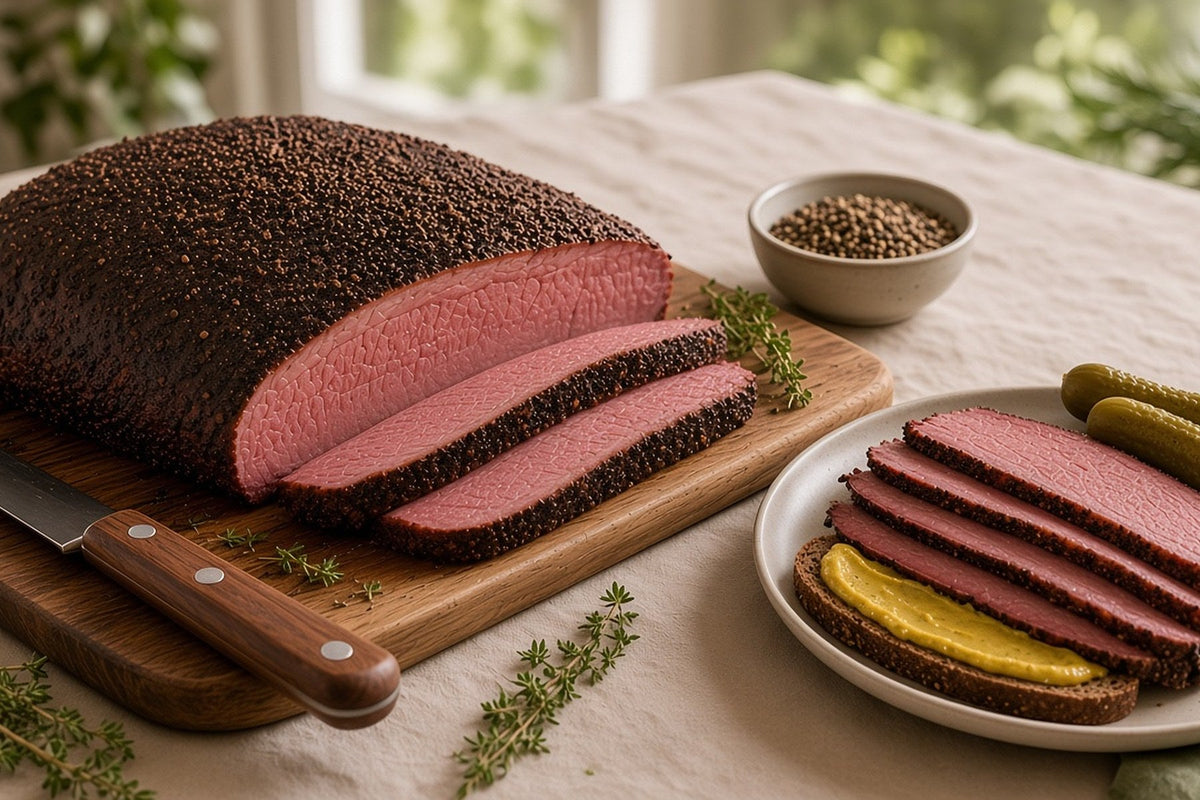
Pastrami is beef, usually brisket or navel, that's cured in a salty brine with nitrite for about a week, coated in cracked black pepper and coriander, smoked, then steamed until tender. It's the hot, peppery, rosy-red deli meat piled high on rye in New York delis. Corned beef is its closest relative; pastrami is basically corned beef that's been rubbed, smoked and steamed.
The cure is what makes pastrami pastrami. Without nitrite it's just smoked brisket: gray inside, with a pot-roast flavor. At SPQR Seasonings we cure ours with Prague Curing Salt #1, the same kind of cure many people know as pink curing salt, now tinted yellow (same cure, new color). Want to make it yourself? Here's our step-by-step homemade pastrami recipe.
Pastrami at a Glance
| Pastrami | |
|---|---|
| Meat | Beef navel (plate) or brisket; also turkey |
| Cure | Brine of water, salt, sugar, spices and sodium nitrite (Curing Salt #1), about 5 to 7 days |
| Seasoning | Cracked black pepper and coriander, often with garlic, mustard seed and paprika |
| Cooking | Smoked, then steamed until tender |
| Color | Rosy pink to red inside, with a dark peppery crust |
| Origin | Romanian Jewish immigrants in New York, late 1800s |
| Served | Hot, sliced, on rye with mustard |
What Is Pastrami Made Of?
Three things: the meat, the cure and the spice crust.
- The meat. New York pastrami is traditionally made from beef navel, the lower, fattier part of the plate, according to Gil Marks's Encyclopedia of Jewish Food. Navel is rich and well marbled but hard to buy. Most home cooks, and plenty of delis, use brisket: the flat slices neatly, and the point is fattier. You'll also find turkey pastrami and beef round pastrami at the grocery store.
- The cure. The meat sits in a brine of water, salt, sugar, pickling spices and curing salt for about a week. The curing salt supplies sodium nitrite. Prague Curing Salt #1 from SPQR Seasonings is salt with 6.25% sodium nitrite.
- The crust. After curing, the meat is coated in coarsely cracked black pepper and coriander, often with garlic, mustard seed and smoked paprika. That peppery bark is the signature of pastrami.
How Is Pastrami Made?
Pastrami takes about a week, but most of that is waiting. The traditional process has four steps:
- Cure. The brisket is injected and submerged in a cold brine with curing salt for 5 to 7 days in the fridge (at 40 °F or below). In our recipe, a 5-lb brisket gets 18.8 g of Curing Salt #1 in a gallon of brine, about 194 ppm of nitrite. Federal rules cap nitrite at 200 ppm in cured beef like this (9 CFR 424.21; 21 CFR 172.175). For a different-size brisket, calculate the cure for your brisket by entering the meat and the brine water.
- Rub. The cured meat is rinsed, soaked briefly to pull out surface salt, dried, and pressed into the pepper and coriander rub.
- Smoke. It's smoked low and slow, around 225 to 275 °F, until the crust sets.
- Steam. Finally it's steamed until the tough brisket turns tender and juicy, usually to around 200 °F inside. Delis steam it again before slicing.
The full method, with amounts for every brisket size, is in our how to make pastrami recipe.
Why Is Pastrami Pink?
Cook a plain brisket and it turns brown-gray. Cook a cured brisket and it stays reddish-pink all the way through. The difference is nitrite. During curing, nitrite reacts with myoglobin, the natural pigment in meat, and forms a cured pigment that holds its rosy color through cooking. Kansas State University meat scientists note that by the turn of the 20th century it was established that "the reddish-pink color of cured meat was due to nitrite."
So pink pastrami doesn't mean undercooked. USDA FSIS says the same about corned beef: it "may still be pink in color after cooking," because the nitrite "fixes pigment in the meat." Always go by a thermometer, not the color.
The color has nothing to do with the color of the cure. Many brands dye curing salt pink so it isn't mistaken for table salt. Our Prague Curing Salt #1 is tinted yellow with annatto, and it makes pastrami just as rosy. More on that in Why Is Curing Salt Pink?
Pastrami vs Corned Beef
Pastrami and corned beef start out almost the same: brisket cured for about a week in a spiced brine with nitrite. Corned beef is then simmered in water. Pastrami gets a thick crust of cracked pepper and coriander, then it's smoked and steamed, so it's smokier and more peppery. For the full side-by-side on cut, seasoning, cooking, taste and nutrition, read Pastrami vs Corned Beef: What's the Difference? If you've made our homemade corned beef, you've already done the hard part of pastrami.
Pastrami vs Montreal Smoked Meat
Montreal smoked meat is Canada's version. It's cured, spiced, smoked and steamed much like pastrami, but it's made from brisket, because navel is hard to find in Canada. Serious Eats describes American pastrami as more marbled and denser, and Montreal smoked meat as having a larger fat cap and a stringier texture.
Where Does Pastrami Come From?
The word comes from the Yiddish pastrame, borrowed from the Romanian pastramă, which is thought to come from the Turkish pastırma, a dried, spiced cured beef. The "pastrami" spelling probably came about in America, to rhyme with salami.
- Romania and Bessarabia. Romanian pastramă was made from mutton, goat, pork or goose, salted, seasoned and smoked to keep.
- New York, late 1800s. Jewish immigrants from Romania and Bessarabia brought it to New York starting around the 1870s. Goose was expensive in America and beef navel was cheap, so beef pastrami took over.
- The first pastrami sandwich. By family tradition, kosher butcher Sussman Volk sold the first pastrami sandwich in New York in 1887, using a Romanian friend's recipe. The story can't be fully proven, but the sandwich caught on, and pastrami on rye became a symbol of the New York deli.
From Saltpeter to Curing Salt
For centuries, cured meats like pastrami's ancestors relied on saltpeter (also spelled salt peter), which is potassium nitrate. Curers didn't know why it worked. In 1891 researchers found that bacteria on the meat turn the nitrate in saltpeter into nitrite, and that nitrite does the actual curing, according to Kansas State University.
Today pastrami is cured with sodium nitrite directly, usually as Curing Salt #1. It works right away, it's measured in exact grams, and federal rules keep it at or under 200 ppm. Saltpeter is no longer used for home pastrami. Learn more in What Is Curing Salt #1? and Curing Salt #1 vs #2.
Is Pastrami Safe to Eat?
Store-bought deli pastrami is fully cooked and ready to eat. If you cure your own, the brine has to stay at 40 °F or below, and the cure has to be measured by weight. Too little won't protect the meat; too much puts it over the legal limit. Cook it to at least 145 °F with a 3-minute rest (most cooks go to 200 °F or more for tenderness). For a closer look at nitrite safety, read Is Curing Salt #1 Safe?
How to Serve and Store Pastrami
- Serve it hot. Steam slices for 5 to 10 minutes and pile them on rye with spicy brown mustard. A spoonful of pastrami juice keeps it moist.
- Fridge: cooked pastrami keeps about 3 to 4 days, based on USDA guidance for cooked corned beef.
- Freezer: wrap it well and freeze it for 2 to 3 months for best quality.
- Reheat leftovers to 165 °F.
Make Pastrami at Home
Homemade pastrami takes a week, a scale and a smoker or oven. Our homemade pastrami recipe gives exact amounts for a 3- to 7-lb brisket, the cure math and a classic pastrami rub. All you need to start is a brisket and a bottle of Prague Curing Salt #1 from SPQR Seasonings.
Frequently Asked Questions
What is pastrami made of?
Beef, usually brisket or navel (plate), cured in a brine of salt, sugar, spices and sodium nitrite, then coated in cracked black pepper and coriander, smoked and steamed.
What cut of meat is pastrami?
New York delis use beef navel, the lower, fattier part of the plate. Most home cooks and many delis use brisket. Montreal smoked meat uses brisket too.
Is pastrami cured?
Yes. Pastrami is cured meat. The brine contains sodium nitrite, usually from Curing Salt #1, which protects against botulism and gives pastrami its rosy color and cured flavor.
Is pastrami raw?
No. Deli pastrami is fully cooked: smoked and then steamed. Homemade pastrami is safe at 145 °F with a 3-minute rest, and most cooks take it to 200 °F or more for tenderness.
What's the difference between pastrami and corned beef?
Both are brisket cured in a brine. Corned beef is simmered in water. Pastrami is coated in pepper and coriander, then smoked and steamed, so it's smokier and more peppery.
Why is pastrami pink?
The nitrite in the cure reacts with the meat's natural pigment and locks in a reddish-pink color that cooking doesn't turn gray. It's color from the cure, not a sign of undercooking.
Is pastrami beef or pork?
Almost always beef. Turkey pastrami is common too. The original Romanian pastramă was often made from mutton, goat or goose.
What is pastrami juice?
Pastrami juice is the salty, peppery, smoky liquid that collects when pastrami is steamed or rests. Delis spoon it over sliced meat, and it's great for reheating slices.
Is pastrami healthy?
Pastrami is a processed meat that's high in sodium and fat, so treat it as an occasional food. Making it at home lets you control the salt and keep the nitrite under the 200 ppm limit.
Is saltpeter used to make pastrami?
Not anymore. Saltpeter (potassium nitrate) was the old curing salt. Today pastrami is cured with sodium nitrite, usually Curing Salt #1, which works faster and is easier to measure.
Should I use Curing Salt #1 or #2 for pastrami?
Curing Salt #1. Pastrami is cured for about a week and then cooked. Curing Salt #2 is for long dry cures like salami.
Sources
- 21 CFR 172.175, Sodium nitrite (home curing preparations: not more than 200 ppm nitrite in the finished meat)
- 9 CFR 424.21, Use of food ingredients (nitrite not more than 200 ppm in the finished product; nitrate not permitted in bacon)
- USDA FSIS, Cured Meat and Poultry Product Operations: Calculation Quick Reference (Table II nitrite limits)
- USDA FSIS, Corned Beef and Food Safety (name origin, pink color after cooking, 145 °F, storage, reheating)
- Kansas State University, Department of Animal Sciences and Industry, Use of Nitrite to Cure Meat (saltpeter history; nitrite and cured color)
- Ben Jay, Serious Eats, "What's the Difference Between Pastrami and Montreal Smoked Meat?" (2022), as quoted in Wikipedia below
- Gil Marks, Encyclopedia of Jewish Food (Wiley, 2010); Ted Merwin, Pastrami on Rye: An Overstuffed History of the Jewish Deli (NYU Press, 2015); David Sax, Save the Deli (2010), as summarized in Wikipedia: Pastrami


