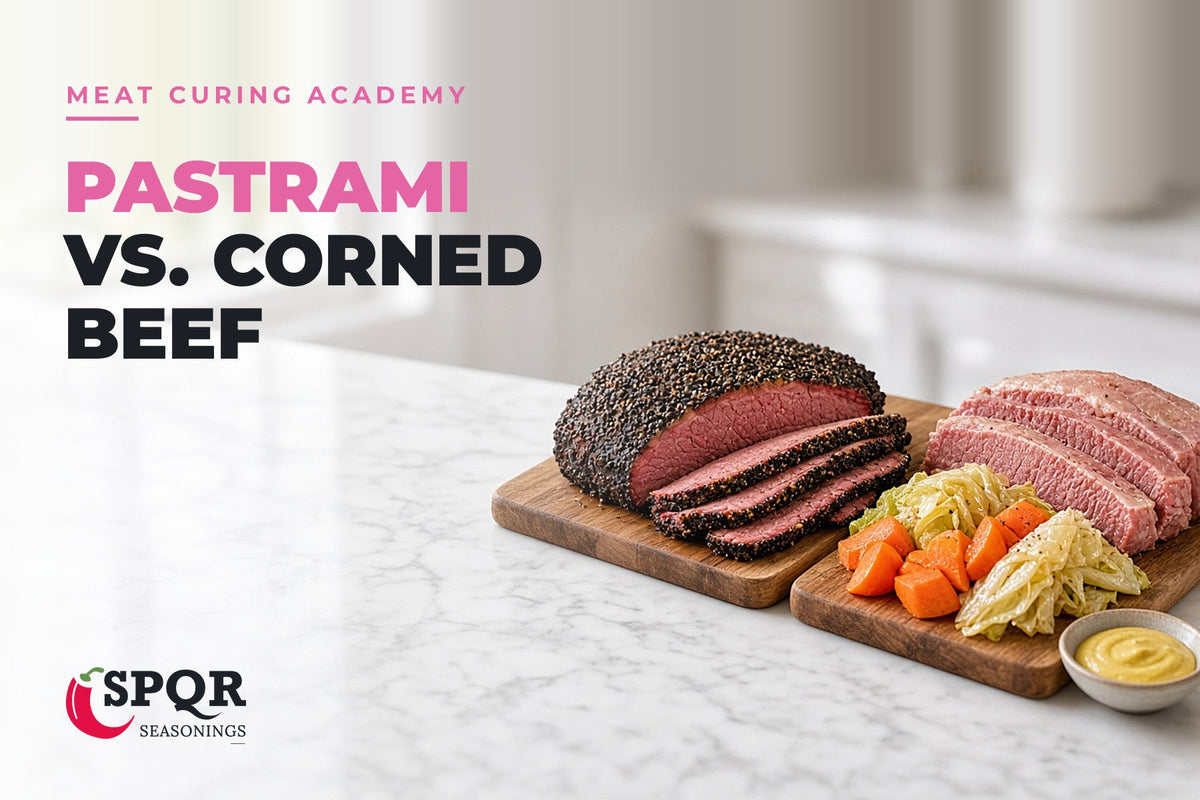
Pastrami and corned beef start out as the same thing: beef brisket cured for about a week in a salty, spiced brine with sodium nitrite. Corned beef is then simmered until tender. Pastrami is coated in cracked black pepper and coriander, smoked, and then steamed. Corned beef ends up salty, mild and tender. Pastrami ends up smoky, peppery and rich.
At SPQR Seasonings our corned beef and pastrami recipes use the exact same cure: 18.8 g of Prague Curing Salt #1 in a gallon of brine for a 5-lb brisket. Everything after the brine is where they part ways.
Pastrami vs Corned Beef at a Glance
| Pastrami | Corned beef | |
|---|---|---|
| Cut | Navel (plate) in New York delis; brisket at home | Brisket, usually the flat (also rump or round) |
| Cure | Nitrite brine, about 5 to 7 days | Nitrite brine, about 5 to 7 days |
| Seasoning | Thick crust of cracked black pepper and coriander | Pickling spices in the brine and cooking water |
| Cooking | Smoked, then steamed | Simmered (boiled gently), braised or slow-cooked |
| Flavor | Smoky, peppery, rich | Salty, mildly spiced, beefy |
| Texture | Juicy, fatty, very tender when steamed | Tender, firmer slices, especially from the flat |
| Classic dish | Hot pastrami on rye | Corned beef and cabbage; the Reuben |
| Roots | Romanian Jewish immigrants in New York, late 1800s | Salt-cured beef from long before refrigeration; Irish American St. Patrick's Day staple |
The Cut: Brisket vs Navel
Corned beef is almost always brisket. USDA FSIS lists it as made from "less tender cuts of beef like the brisket, rump, or round," which is why it "requires long, moist cooking" (FSIS, Corned Beef and Food Safety). Most supermarket corned beef is the brisket flat: lean, even and easy to slice.
Classic New York pastrami is made from beef navel, the fatty lower part of the plate. It's rich and well marbled but hard to find, so most home cooks and many delis use brisket, often the fattier point or a whole packer. That extra fat is a big part of why pastrami tastes richer. More on the cut and the history in What Is Pastrami?.
The Cure: Exactly the Same
This is the part most comparisons skip. Pastrami and corned beef are cured the same way, in a cold brine of water, salt, sugar, spices and sodium nitrite, for about a week in the fridge at 40 °F or below. The nitrite is what turns brisket into cured beef. It protects against botulism, gives the cured flavor, and keeps both meats pink after cooking. FSIS says corned beef "may still be pink in color after cooking. This does not mean it is not done."
The word "corned" has nothing to do with corn. FSIS explains it comes from the coarse "corns" of salt, "some the size of kernels of corn," once rubbed into beef to preserve it.
Here's the math behind our shared brine, using Prague Curing Salt #1 from SPQR Seasonings (6.25% sodium nitrite):
- 5-lb brisket (2,268 g) + 1 gallon of water (3,785 g) = 6,053 g total.
- 18.8 g of cure: 18.8 × 62,500 ÷ 6,053 = 194.1 ppm nitrite once the brine and meat even out.
- By spoon: 2⅝ level teaspoons (18.56 g at 7.07 g per teaspoon) = 191.6 ppm. Spoon amounts round down so they never go over.
- Limit: 200 ppm, never over (21 CFR 172.175; 9 CFR 424.21).
Brisket is a whole cut (whole muscle): a solid piece of meat, like brisket, pork belly, ham, loin or a roast, not ground. Our target for whole cuts is about 195 ppm. The curing salt calculator works out the cure for any brisket and brine, and What Is Equilibrium Curing? explains why we count the water. Never swap in plain salt; here's why.
The Seasoning: Pickling Spice vs Pepper Crust
Corned beef gets its flavor from pickling spices in the brine and the cooking water. FSIS names peppercorns and bay leaf as the classics. Most blends also add mustard seed, coriander, allspice, cloves and chile flakes.
Pastrami often uses a similar brine, but its signature is the crust. After curing, the brisket is rinsed, soaked briefly to pull out surface salt, dried, and pressed into a thick coat of coarsely cracked black pepper and coriander, often with garlic, mustard seed and smoked paprika. That bark is what you taste first.
The Cooking: Simmered vs Smoked and Steamed
Corned beef
Corned beef is cooked in liquid. FSIS's stovetop method covers the brisket with water, brings it to a boil, then simmers it about 1 hour per pound, adding vegetables in the last 20 to 30 minutes. FSIS also gives oven, microwave and slow-cooker methods. FSIS says to cook raw corned beef to at least 145 °F and rest it 3 minutes; most cooks go well past that, until it's fork-tender.
Pastrami
Pastrami is cooked twice. It's smoked low and slow, around 225 to 275 °F, until the crust sets and the meat takes on smoke. Then it's steamed until the connective tissue melts, usually to around 200 °F inside. Delis steam it again before slicing, which is why deli pastrami is so juicy.
Taste and Texture
Corned beef is salty, clean and beefy, with a gentle spice and a tender but sliceable texture. Pastrami is bolder: smoke, a peppery bite, and more fat. If you like Texas brisket, you'll probably lean pastrami. If you like a boiled dinner with cabbage and potatoes, corned beef is your meat.
Pastrami vs Corned Beef vs Brisket
All three can be the same cut. The difference is the cure:
- Brisket on its own is fresh, uncured beef. Smoked Texas-style, it's brown-gray inside with only a thin pink smoke ring.
- Corned beef is brisket cured with nitrite and simmered. Pink all the way through.
- Pastrami is cured brisket that's peppered, smoked and steamed. Pink all the way through, with a dark bark.
Which Is Healthier?
Neither is a health food, and the numbers depend a lot on the cut and how much fat is trimmed. Here's how two entries in USDA FoodData Central compare per 100 g (about 3.5 oz):
| Per 100 g | Beef pastrami, cured (FDC 170204) | Corned beef brisket, cooked (FDC 170200) |
|---|---|---|
| Calories | 147 | 251 |
| Protein | 21.8 g | 18.2 g |
| Fat | 5.8 g | 19.0 g |
| Saturated fat | 2.7 g | 6.3 g |
| Sodium | 1,080 mg | 973 mg |
The pastrami entry is a deli-style sliced product, so it's leaner than the fatty navel pastrami piled high in New York. Either way, sodium is the big number. The 2025–2030 Dietary Guidelines for Americans set a limit of less than 2,300 mg a day for people 14 and older, so 100 g of either one uses 42 to 47% of that. Both are processed meats; we cover what that means in Is Cured Meat Bad for You?.
Can You Turn Corned Beef Into Pastrami?
Yes, and it's a great shortcut. A raw, store-bought corned beef brisket is already cured. Soak it in fresh water for a few hours to pull out some salt, pat it dry, press on the pepper and coriander rub, then smoke and steam it. Don't add any more curing salt: the meat already has its cure, and adding more could push it past the limit.
How Long Do They Keep?
FSIS says uncooked corned beef in a pouch with a "sell-by" date (or no date) keeps 5 to 7 days in the fridge unopened. Cooked corned beef keeps about 3 to 4 days in the fridge and 2 to 3 months in the freezer for best quality. We use the same guideline for cooked pastrami. Reheat leftovers to 165 °F. More in How Long Does Cured Meat Last?.
Make Both at Home
If you can make one, you can make the other. Start with our homemade corned beef recipe, then try our homemade pastrami recipe with the same brine. Both give every amount in grams and include the cure math. All you need is a brisket, a scale and a bottle of Prague Curing Salt #1 from SPQR Seasonings. Keep the cure in its labeled bottle and out of reach of children; it's tinted yellow so it's never mistaken for table salt (here's why).
Frequently Asked Questions
Is pastrami the same as corned beef?
No, but they start the same way. Both are beef, usually brisket, cured for about a week in a salty brine with sodium nitrite. Corned beef is then simmered in water. Pastrami is coated in cracked black pepper and coriander, smoked, then steamed.
Is pastrami just smoked corned beef?
Pretty much. Pastrami is cured like corned beef, then soaked to pull out some salt, crusted with pepper and coriander, smoked and steamed. You can even make pastrami from a store-bought raw corned beef. Just don't add more cure, since it's already cured.
Which is healthier, pastrami or corned beef?
Neither is a health food. In USDA FoodData Central, 100 g of deli-style beef pastrami has about 147 calories, 5.8 g fat and 1,080 mg sodium, while 100 g of cooked corned beef brisket has about 251 calories, 19 g fat and 973 mg sodium. Fat depends heavily on the cut and trim, and both are salty processed meats.
Which is better for a Reuben, pastrami or corned beef?
A classic Reuben uses corned beef, with Swiss cheese, sauerkraut and Russian dressing on rye. Plenty of delis offer a pastrami version, which is smokier and more peppery. Both work; it's a matter of taste.
Why are pastrami and corned beef pink?
Both are cured with nitrite, which reacts with the meat's natural pigment and fixes a pink color that stays through cooking. USDA FSIS notes that corned beef "may still be pink in color after cooking," and that this doesn't mean it isn't done.
What cut is used for pastrami and corned beef?
Corned beef is usually made from brisket, and sometimes rump or round. New York pastrami is traditionally made from beef navel (the plate), but most home cooks and many delis use brisket.
What temperature should corned beef and pastrami be cooked to?
USDA FSIS says to cook raw corned beef to at least 145 °F, then rest it 3 minutes. For tenderness, most cooks take corned beef and pastrami much higher, often to around 200 °F, so the brisket's connective tissue breaks down.
How long do pastrami and corned beef keep?
Cooked corned beef keeps about 3 to 4 days in the fridge and 2 to 3 months in the freezer for best quality, per USDA FSIS. We use the same guideline for cooked pastrami.
Keep Learning
- What Is Pastrami?
- Homemade Corned Beef Recipe
- Homemade Pastrami Recipe
- What Is Curing Salt #1?
- What Is Equilibrium Curing?
- Is Cured Meat Bad for You?
- Back to the Meat Curing Academy
Sources
- USDA FSIS, Corned Beef and Food Safety (revised June 2011, govinfo.gov)
- 21 CFR 172.175, eCFR
- 9 CFR 424.21, eCFR
- USDA FoodData Central, SR Legacy entries 170204 and 170200
- Dietary Guidelines for Americans, 2025–2030
By SPQR Seasonings. Last reviewed November 2026. Regulations quoted are current as of November 22, 2026.


