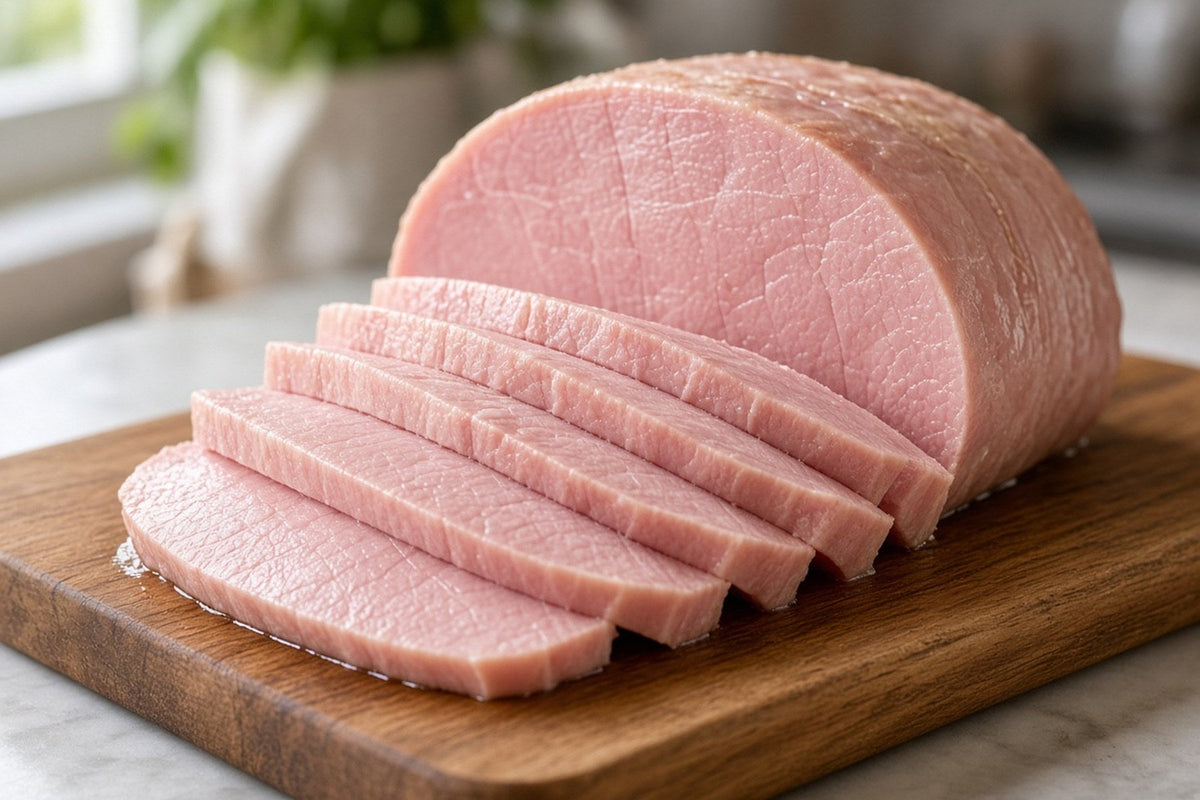
Uncured ham is ham that has been cured with a natural source of nitrite, usually celery powder or celery juice, instead of sodium nitrite. It's still cured: it has the deep rose color, the ham flavor and the nitrite chemistry of regular ham. "Uncured" is a labeling term that tells you where the nitrite came from, not whether it's there. A ham that has truly never been cured is sold as fresh ham, and it looks and tastes like roast pork.
This guide explains the USDA label rules, how uncured ham compares with cured ham and fresh ham, whether it's healthier, how to cook it, and why home curers use a measured cure like Prague Curing Salt #1 from SPQR Seasonings instead of celery powder.
What Does Uncured Ham Mean?
Ham is cured pork leg by definition. USDA says "ham is the cured leg of pork" and "fresh ham is an uncured leg of pork" that must carry the word "fresh" in its name (USDA FSIS, Hams and Food Safety). So how can a rosy, ham-flavored ham be called uncured?
The answer is a 1970s labeling rule. Under 9 CFR 317.17, a product that's normally made with nitrite or nitrate "may be prepared without nitrate or nitrite" and keep its usual name if the word "Uncured" comes right before it, in the same size and style of lettering. The label must also say "No Nitrate or Nitrite Added."
Modern uncured hams aren't made without nitrite. They're made with celery powder, which is naturally high in nitrate and is converted into nitrite, often paired with cherry powder (a natural source of vitamin C). USDA does not approve celery powder as a curing agent, only as a flavoring and antimicrobial. So a ham cured with it must be labeled "Uncured," and its "no nitrates or nitrites added" statement must be qualified with "except for those naturally occurring in" celery powder (askFSIS, Use of Celery Powder and Other Natural Sources of Nitrite).
When you see "Uncured Ham, No Nitrates or Nitrites Added Except Those Naturally Occurring in Celery Powder," read it as "ham cured with celery powder."
What the label also has to say
- "Uncured" right before "Ham," in the same lettering.
- "No Nitrate or Nitrite Added" next to the name, at least half its size, with the celery-powder qualifier.
- "Not Preserved, Keep Refrigerated Below 40 °F At All Times", unless the product has been heat-processed to F0 3, acidified to pH 4.6 or lower, or dried to a water activity of 0.92 or lower (317.17(c)(2)).
For the same rules on other meats, see What Does Uncured Mean?, Cured vs Uncured Bacon and Uncured Hot Dogs.
Uncured Ham vs Cured Ham vs Fresh Ham
| Cured ham | "Uncured" ham | Fresh ham | |
|---|---|---|---|
| Cured? | Yes | Yes | No |
| Nitrite source | Sodium nitrite (and sometimes nitrate) | Celery powder or juice, converted to nitrite | None |
| Color | Deep rose | Deep rose | Pale, like roast pork |
| Flavor | Ham | Ham | Roast pork |
| Label | "Ham" | "Uncured Ham" plus the no-added-nitrite statement and celery qualifier | "Fresh Ham" |
| Nitrite amount on label? | No | No | Not applicable |
| Usually sold | Fully cooked | Fully cooked | Raw, cook to 145 °F |
Neither label tells you how much nitrite is in the meat. For cured ham, federal rules cap nitrite at 200 ppm, calculated as sodium nitrite in the finished product (9 CFR 424.21). Celery-cured ham doesn't have a stated amount on the package, because celery powder isn't regulated as a curing agent.
Is Uncured Ham Healthier?
Not in any way the label proves. Three facts are worth knowing:
- The cure is the same chemical. Nitrite from celery powder is the same nitrite ion as nitrite from curing salt. It's what turns the meat that cured color and flavor in both cases. See Nitrites vs Nitrates.
- It's still processed meat. The World Health Organization defines processed meat as meat "transformed through salting, curing, fermentation, smoking or other processes," names ham as an example, and its cancer agency classifies processed meat as Group 1, carcinogenic to humans (WHO). That applies to uncured ham as much as cured ham.
- Salt is similar. Both are salt-cured. Compare the sodium line on the Nutrition Facts panel rather than the front label.
If you buy uncured ham because you like the producer, the pork or the flavor, that's a fine reason. Just don't assume it's nitrite-free. For the bigger picture, see Is Cured Meat Bad for You? and Is Bacon Bad for You?
Is USDA changing the "uncured" label?
It has said it intends to. In 2019 the Center for Science in the Public Interest petitioned USDA to stop allowing "Uncured" and "No Nitrate or Nitrite Added" on meats processed with natural nitrate sources. On December 10, 2020, USDA partially granted the petition (FSIS Petition 19-03). As of November 24, 2026, the text of 9 CFR 317.17 is unchanged and we found no proposed or final rule, so today's "uncured ham" labels are still legal.
Is Uncured Ham Cooked?
Most uncured hams sold whole, as halves, spiral-sliced or as lunch meat are fully cooked, just like most cured hams. The label will say "fully cooked" or "cook before eating." USDA requires hams that need cooking to carry cooking instructions and a statement like "cook thoroughly."
How to heat or cook uncured ham
Uncured ham cooks exactly like cured ham. From USDA's ham guidance (oven at 325 °F):
| Type of ham | Minutes per lb | Heat to |
|---|---|---|
| Fully cooked, whole, bone-in (10 to 14 lb) | 15 to 18 | 140 °F if packaged in a USDA-inspected plant; 165 °F otherwise |
| Fully cooked, half, bone-in (5 to 7 lb) | 18 to 24 | 140 °F (plant-packaged) or 165 °F |
| Spiral-cut, whole or half (7 to 9 lb) | 10 to 18, covered in foil | 140 °F (plant-packaged) or 165 °F |
| Cook-before-eating, whole, bone-in (10 to 14 lb) | 18 to 20 | 145 °F, then rest 3 minutes |
| Fresh ham (not cured), whole leg, bone-in (12 to 16 lb) | 22 to 26 | 145 °F, then rest 3 minutes |
USDA notes that fully cooked, vacuum-packaged hams from inspected plants can be eaten cold, and that leftover or repackaged cooked ham should be reheated to 165 °F. Cured and celery-cured ham stays rosy when cooked, so go by the thermometer, not the color.
How long does uncured ham last?
Follow the use-by date. Without one, USDA's chart gives cooked ham, store-wrapped, 3 to 5 days for slices and halves and 7 days for a whole ham; a vacuum-sealed, undated cooked ham 2 weeks unopened and 3 to 5 days after opening; and leftovers from a ham you cooked, 3 to 5 days. Freeze for 1 to 2 months for best quality. These times apply to cured and uncured ham alike. See How Long Does Cured Meat Last?
Can You Make Uncured Ham at Home?
We don't recommend it. Celery powder's nitrate has to be converted to nitrite, either by the supplier or by bacteria in the meat, and a retail jar doesn't tell you how much nitrite you'll end up with. USDA also doesn't approve it as a curing agent. At home you can't measure the result, so you can't know whether the ham has enough nitrite to protect against Clostridium botulinum, or too much.
A measured cure gives you a known, repeatable dose. Our Prague Curing Salt #1 is 6.25% sodium nitrite, the same strength as any Cure #1 or what most recipes call pink curing salt. Ours is tinted yellow with annatto, not dyed pink. In our home-cured holiday ham, 21.7 g of it in a gallon of brine cures a 7-lb ham at about 195 ppm nitrite (figured on the ham plus the water), under the federal 200 ppm cap. Use the curing salt calculator for other sizes.
Want a ham with no cure at all? Roast a fresh ham to 145 °F and rest it 3 minutes. It will taste like pork roast, not ham, and it keeps only 3 to 4 days in the fridge once cooked.
Frequently Asked Questions
What is uncured ham?
Uncured ham is ham cured with a natural nitrite source such as celery powder instead of sodium nitrite. It's still cured meat. USDA requires the "Uncured" label because celery powder isn't an approved curing agent.
Is uncured ham really uncured?
No. It's cured with nitrite that comes from celery powder or juice. A ham that has truly never been cured is sold as "fresh ham" and looks and tastes like roast pork.
Is uncured ham healthier than regular ham?
The label doesn't show that it is. The nitrite is the same compound, the salt is similar, and WHO counts all ham as processed meat. Choose it for the producer or the flavor, not as a health food.
Is uncured ham cooked?
Most uncured ham is sold fully cooked. Check the label for "fully cooked" or "cook before eating." Reheat a fully cooked ham to 140 °F, or 165 °F if it wasn't packaged at the plant.
Does uncured ham have nitrites?
Yes. The nitrite comes from celery powder, which is why the label must say "except for those naturally occurring in celery powder." The amount isn't listed on the package.
What's the difference between uncured ham and fresh ham?
Uncured ham is cured with celery powder, so it's rosy and tastes like ham. Fresh ham is raw, never-cured pork leg that cooks up pale and tastes like roast pork. Fresh ham must be cooked to 145 °F with a 3-minute rest.
Can pregnant women eat uncured ham?
The same advice applies as for any ham. CDC advises heating deli and lunch meats, including sliced ham, to 165 °F or until steaming hot.
Keep Learning
- What Does Uncured Mean?
- Can You Eat Uncured Salami?
- Country Ham: What It Is and How to Cook It
- Home-Cured Holiday Ham
- What Is Curing Salt #1?
- Meat Curing Academy
Cure your own ham and know exactly what's in it. One 1.5-lb bottle of Prague Curing Salt #1 from SPQR Seasonings holds about 96 level teaspoons, enough for many holiday hams, plus bacon, corned beef and jerky. Want it extra savory? Add SPQR Seasonings MSG to the glaze.
Sources
- USDA FSIS, Hams and Food Safety (definitions, cooking timetable, storage chart)
- USDA, 9 CFR 317.17 Labeling of cured products; nitrate and nitrite (eCFR)
- USDA, 9 CFR 319.2 Products and nitrates and nitrites (eCFR)
- USDA FSIS, askFSIS: Use of Celery Powder and Other Natural Sources of Nitrite
- USDA FSIS, Petition 19-03 (CSPI) and final response
- USDA, 9 CFR 424.21 (eCFR)
- FDA, 21 CFR 172.175 Sodium nitrite (eCFR)
- World Health Organization, Carcinogenicity of red and processed meat (Q&A)
- CDC, Safer Food Choices for Pregnant Women
By SPQR Seasonings. Last reviewed November 2026. Regulations quoted are current as of November 24, 2026.


