
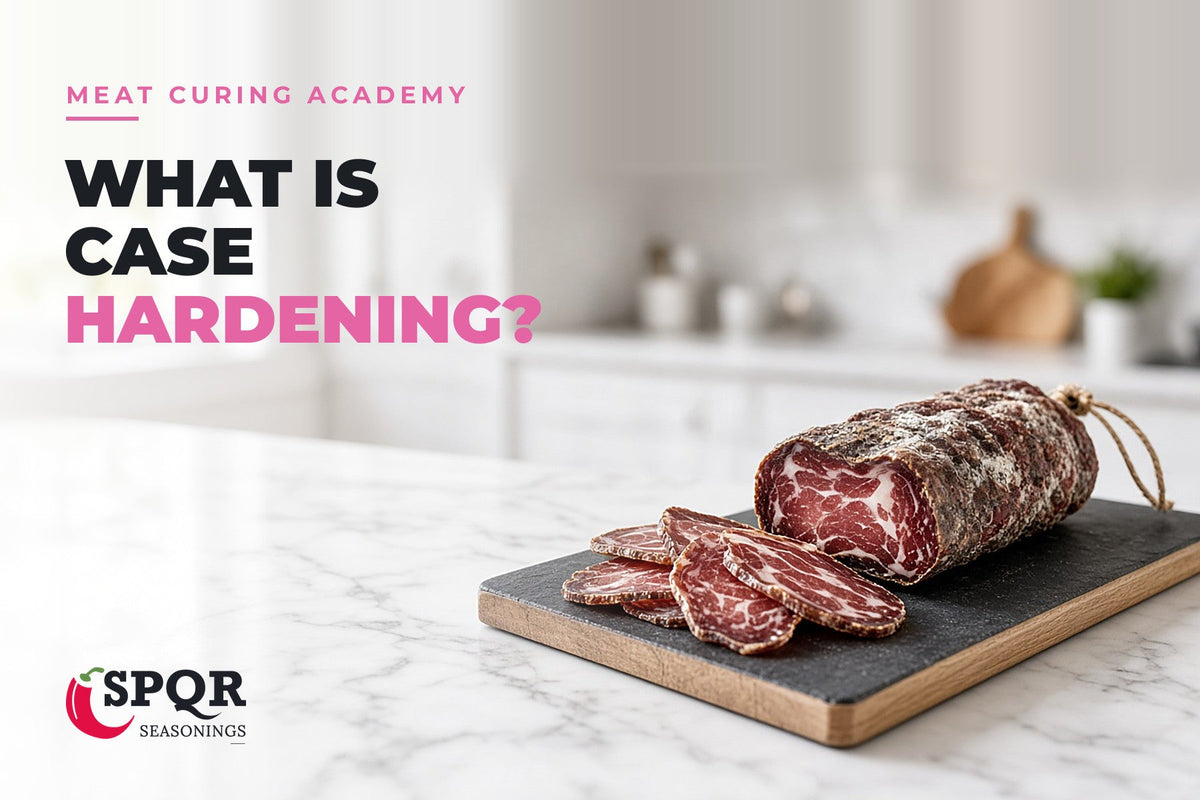
Case hardening is when the outside of a salami or dry-cured meat dries into a hard, dark crust while the inside stays soft and wet. The crust then slows the drying you still need in the middle. It happens when the air is too dry or moves too fast. Raise the humidity, slow the fan, and give the meat time to even out. If the center never dries properly, don't eat it.
(In metalworking, case hardening means hardening the surface of steel. This guide is about the meat kind.) Case hardening is a dry-curing problem, so it mostly shows up with salami, coppa, lonza, bresaola and prosciutto, the long cures that use Curing Salt #2 from SPQR Seasonings (coming soon) rather than Curing Salt #1.
How to Tell If Your Salami Is Case Hardened
- A dark, leathery ring around the outside when you slice it, with a softer, redder, wetter center.
- It feels firm outside but squishy when you press harder. A properly drying salami firms up evenly from the outside in.
- Weight loss stalls. It's been hanging for weeks, feels done on the surface, but won't reach its target weight.
- Gaps or hollows inside. A University of Molise study of salami aging rooms linked harsher, faster drying with void spaces in the sausages (Giametta et al., Sci 2024).
A slight color difference from the outside in is normal. Case hardening is a distinct hard band that feels different from the center.
What Causes Case Hardening?
Drying only works when water moves from the center to the surface as fast as it leaves the surface. If the surface dries faster, the outer layer tightens up and traps the moisture behind it.
The British Columbia Centre for Disease Control's guidance for dry sausage makers spells out the two main causes (BCCDC, Fermented Foods Guidance 3.13):
- Humidity too low. "Above 80% moulds may grow; below 65% case-hardening may occur." It also warns that "a too low humidity could cause crusting on the surface and thus harm the internal drying of the sausage meat."
- Too much air movement. Air flow should be managed "to prevent case hardening (if air flow is too great) and wild mould growth (if air flow is too low)."
Other things that make it more likely:
- A dry fridge or chamber with no humidity control. A regular refrigerator is very dry air.
- A fan blowing straight on the meat.
- Rushing it. BCCDC says "drying rates should be as low as possible to avoid the surface becoming hardened."
- Big temperature swings in the chamber.
Is Case-Hardened Salami Safe to Eat?
It depends on the center, and you should treat it with caution. Dry salami is made safe by a combination of cure, fermentation (acid) and drying. BCCDC describes dry sausages as dried "to reduce aw to 0.9 or below" (aw is water activity), which is what lets them be eaten without cooking. A crust that keeps the middle wet works against that.
- Center is soft, wet, gray or smells off: don't eat it.
- The crust is thin, the center has dried and firmed, and it reached its target weight loss: the problem was mostly texture.
- Not sure: don't take a chance with a product you'll eat raw. Home cooks can't measure water activity without a meter.
For whole cuts (whole muscle, like coppa, lonza or bresaola), the same rule applies: a wet or gray center means it isn't done and isn't protected. See gray spots or gray center after curing.
How to Fix Case Hardening
If you catch it early, you can often save it:
- Raise the humidity. Bring the chamber back into the 75 to 80% range BCCDC calls ideal at the start of drying.
- Turn the air down. Keep some air moving so mold doesn't take over, but nothing blowing directly on the meat.
- Keep it cool and steady. BCCDC's drying range is 4 to 15 °C (about 39 to 59 °F).
- Give it time to even out. Moisture needs to move back out toward the surface and soften the crust. Weigh it every few days.
Many home charcutiers also vacuum-seal a case-hardened salami or coppa and leave it in the refrigerator for a few weeks so the moisture spreads evenly through it before it goes back to drying. That's common practice rather than an agency guideline, and it only makes sense for a piece whose center is already well along.
If the center is still raw and soft after the outside has hardened badly, it's usually better to start over than to risk it.
How to Prevent Case Hardening
| Setting | Target (BCCDC dry sausage guidance) |
|---|---|
| Humidity during fermentation | Start around 95%, then keep it about 5% below the product's moisture |
| Humidity at the start of drying | 75 to 80% |
| Humidity later in drying | Can come down, but not below 60% |
| Drying temperature | 4 to 15 °C (about 39 to 59 °F) |
| Air flow | Gentle and steady; not so strong that the surface crusts, not so still that wild mold grows |
- Measure, don't guess. A digital hygrometer and a humidity controller are cheap insurance. BCCDC expects operators to "monitor relative humidity, the products, and adjust relative humidity accordingly."
- Weigh it on a schedule. Record the starting weight and weigh it every few days. BCCDC notes dry and semi-dry sausages have about 30% of their moisture removed. A steady curve is good; a fast early drop is a warning.
- Feel the casing. Early on it should be soft and slightly damp. If it's dry and stiff in the first week, raise the humidity.
- Use the right cure at the right dose. Long dry cures use Curing Salt #2, which has nitrite plus nitrate that breaks down over the long cure. See Curing Salt #1 vs #2. Follow a tested recipe for the dose. Our curing salt calculator has a Curing Salt #2 mode.
SPQR Seasonings Curing Salt #2 is coming soon. For bacon, ham, corned beef, pastrami and other meats you cook, use Prague Curing Salt #1 from SPQR Seasonings.
Case Hardening vs Mold vs Spoilage
A hard outside is a drying problem. A white powdery coat is usually good mold (see white mold on salami: good or bad?). A sour or rotten smell, slime, or fuzzy colored mold means something else has gone wrong. Our meat curing troubleshooting guide covers when to throw it out.
Keep Learning
- Meat Curing Troubleshooting Guide
- White Mold on Salami: Good or Bad?
- Curing Salt #1 vs #2: What's the Difference?
- Meat Curing Academy
Frequently Asked Questions
What is case hardening in salami?
A dry, hard outer layer that forms when the surface dries faster than moisture can move out of the center. It traps moisture inside and slows drying.
What causes case hardening?
Humidity that's too low and air that moves too fast. BC Centre for Disease Control guidance says case hardening may occur below about 65% humidity and when air flow is too great.
Can you fix case hardening?
Often, if caught early. Raise the humidity to about 75 to 80%, reduce the air flow, keep it cool, and give the moisture time to even out.
Is case-hardened salami safe to eat?
Only if the center has dried properly. If the inside is soft, wet, gray or smells off, don't eat it; dry salami relies on drying for its safety.
What humidity prevents case hardening?
BCCDC guidance: about 75 to 80% at the start of drying, coming down slowly but not below 60%.
Does case hardening happen with Curing Salt #1?
It's a drying problem, not a cure problem, so it can happen with any dry-cured meat. Long dry cures normally use Curing Salt #2; Curing Salt #1 is for meats you cook.
What is the difference between case hardening and mold?
Case hardening is a hard, dark crust from drying too fast. White powdery mold on the casing is usually the good kind; fuzzy green, black or colored mold is not.


