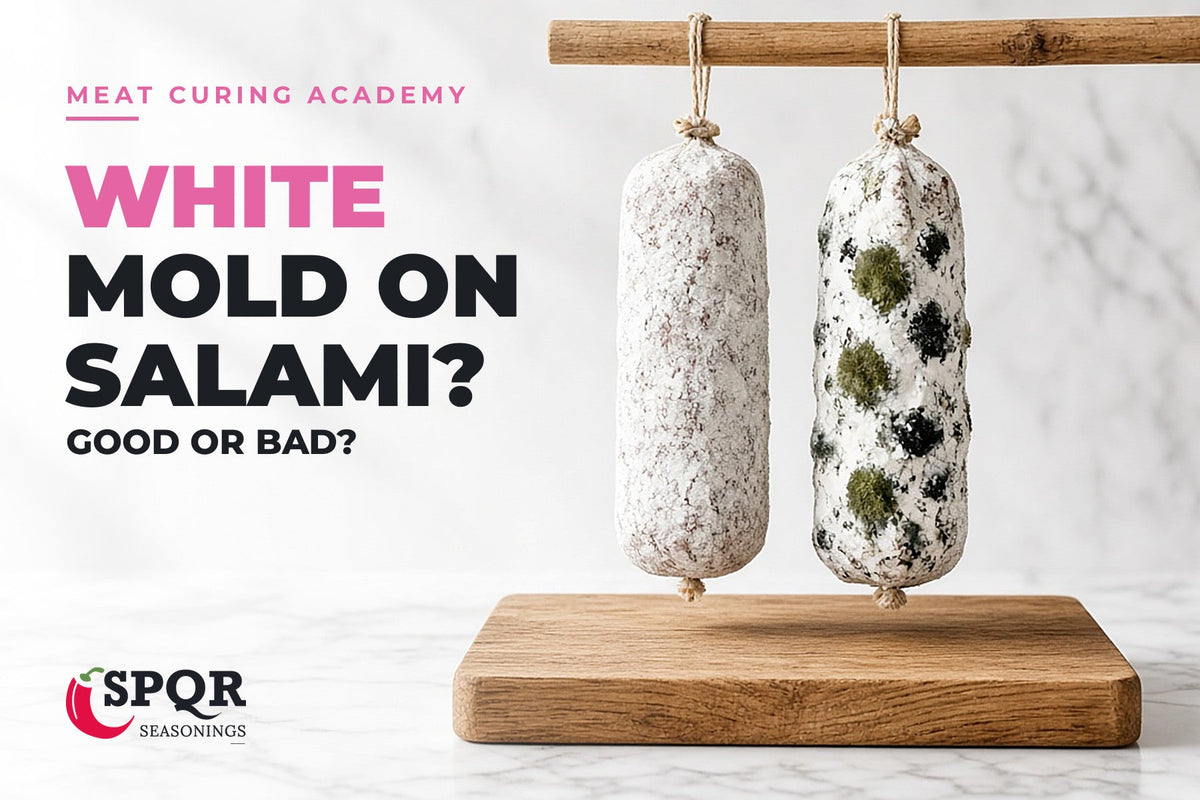
White mold on salami is usually good. A thin, even, powdery white coat is the mold salami makers want, most often Penicillium nalgiovense, and it's safe to eat. USDA FSIS says some salamis "have a characteristic thin, white mold coating which is safe to consume; however, they shouldn't show any other mold" (FSIS, Molds on Food). Fuzzy green, blue, black, yellow or orange mold is a different story. That's wild mold, and on homemade salami it usually means the batch should go.
Here's how to tell good mold from bad on salami, coppa and prosciutto, what to do about each kind, and how to set up your chamber so the right mold wins. Dry-cured salami is a Curing Salt #2 product; Curing Salt #2 from SPQR Seasonings (coming soon) is on its way.
What Is the White Stuff on Salami?
On most good salami, the white coat is a deliberate mold. Many makers spray or dip fresh salami in a mold culture so a clean white layer grows over the casing. A review of fungi in fermented sausages lists P. nalgiovense among the most common molds on salami and among the species considered non-toxin-producing, and it has been used as a starter culture for meat since the 1970s (Sidari and Tofalo, Foods 2024).
That white coat does real work. The same review says the mold layer helps prevent excessive drying, protects the fat from oxidation and rancidity, shields the color from light and oxygen, and makes the casing easier to peel. It also crowds out unwanted molds by competing for space and food.
On store-bought salami, a white, dusty casing is normal and expected. You can eat it, but most people peel the casing off.
Good Mold vs Bad Mold on Salami
| What you see | What it likely is | What to do |
|---|---|---|
| Thin, even, powdery or velvety white coat | Good mold (often P. nalgiovense) | Keep it. Normal. |
| Small white fluffy tufts early on that fill in to an even white coat | Good mold getting established | Keep an eye on it |
| Small blue-green or green spots, early in drying, that wipe off completely | Wild mold | Wipe with vinegar right away; if it comes back or spreads, discard |
| Fuzzy green, blue or gray patches that spread | Wild mold taking hold | Discard |
| Black mold, any amount | Wild mold | Discard |
| Yellow, orange, red or pink fuzz | Wild mold | Discard |
| Wet, slimy or sticky surface | Bacteria or yeast, often from too much humidity | Discard if it smells off |
| Mold under the casing or inside the meat | Mold has grown in | Discard |
Can You Just Wipe Off Bad Mold?
Sometimes, but be careful. Here's what the authorities say:
- USDA FSIS lists hard salami and dry-cured country hams as foods where you can "scrub mold off surface," because "it is normal for these shelf-stable products to have surface mold." It also says salamis "shouldn't show any other mold" besides the thin white coat (FSIS).
- The BC Centre for Disease Control, writing for sausage makers, says unwanted mold is only acceptable "if it is present in a quantity that can be easily removed by rubbing (with vinegar) regularly throughout the drying process," and "if mould cannot be wiped away with vinegar," the sausage should be tested or discarded (BCCDC 3.13).
- Researchers note that toxins some molds produce can move from the casing into the salami, so "removing the mold layer does not guarantee the safety of the product" (Sidari and Tofalo).
Our rule at SPQR Seasonings: white and powdery, keep it. A small colored spot early in drying that wipes off completely with vinegar and doesn't come back, you can keep going and watch it closely. Anything fuzzy, black, spreading, coming back, under the casing, or on a finished salami, throw it out. Don't sniff moldy food closely either; FSIS warns it can cause breathing problems.
Why Did Bad Mold Grow on My Salami?
- Humidity too high for too long. BCCDC: "above 80% moulds may grow." Fermentation starts humid, but humidity needs to come down for drying.
- Not enough air movement. Still air lets wild mold settle. BCCDC says air flow too low invites "wild mould growth."
- No good mold to compete. Without a white mold culture, whatever spores are in the air get first claim on the casing.
- A dirty chamber. Spores from an earlier batch, a wooden shelf or a damp corner reinfect new batches. FSIS says mold spores build up in fridges and cleaning cloths.
- The wrong cure or too little salt. Dry-cured sausage relies on salt, the cure, fermentation acid and drying together. See Curing Salt #1 vs #2.
How to Get the Good White Mold (and Keep Bad Mold Away)
- Use a mold culture. Mix a commercial white mold culture with water and spray or dip the salami right after stuffing.
- Control humidity. Ferment humid, then dry in the 75 to 80% range at first, coming down slowly but not below 60%, per BCCDC. Too low and you risk case hardening instead.
- Keep air gently moving. A small fan on a timer, not pointed at the meat.
- Keep it clean. Wash and sanitize the chamber between batches.
- Check every day or two. Catch stray spots while they're small.
- Weigh as you go. Mold is easier to manage when the salami is drying steadily.
Get the cure right too. Long dry cures like salami, coppa and prosciutto use Curing Salt #2, which contains nitrate that breaks down slowly over weeks. Follow a tested recipe for the amount, or use the Curing Salt #2 setting in our curing salt calculator. Curing Salt #2 from SPQR Seasonings is coming soon; for bacon, ham, corned beef and other meats you cook, use Prague Curing Salt #1 from SPQR Seasonings.
What About Mold on Prosciutto, Coppa or Country Ham?
The same color rules apply to whole cuts (whole muscle) like coppa, lonza and bresaola. Country hams are a special case: FSIS says mold "can often be found on country cured ham. Most of these are harmless," and tells you not to discard the ham but to "scrub off the mold with a stiff vegetable brush" before cooking (FSIS, Ham and Food Safety). A country ham is soaked and cooked, which is different from a salami you eat raw.
Keep Learning
- Meat Curing Troubleshooting Guide
- Case Hardening in Salami and Dry-Cured Meat
- Curing Salt #1 vs #2
- Is Curing Salt #1 Safe?
Frequently Asked Questions
Is white mold on salami safe to eat?
A thin, even, powdery white coat usually is. USDA FSIS says some salamis have a thin white mold coating that's safe to eat, but they shouldn't show any other mold.
What is the white stuff on salami?
Usually a deliberate white mold, most often Penicillium nalgiovense, grown on the casing. It protects the salami while it dries and adds flavor. Most people peel the casing off.
Is green mold on salami bad?
Fuzzy green or blue mold is wild mold. A tiny spot early in drying that wipes off with vinegar and doesn't return can be watched; if it spreads, returns or is on finished salami, throw it out.
Is black mold on salami dangerous?
Treat it as unsafe. Black mold isn't the white mold salami makers want; throw the salami out.
Can I wipe mold off salami with vinegar?
Only small spots of unwanted mold early in drying. The BC Centre for Disease Control says if mold can't be wiped away with vinegar, the sausage should be discarded or tested.
Why did my homemade salami get bad mold?
Usually humidity above 80% for too long, too little air movement, no white mold culture to compete, or a chamber that wasn't cleaned between batches.
Should I eat salami casing with white mold?
You can, but most people peel it off. Dry salami casings are often tough even when the mold is the good kind.


