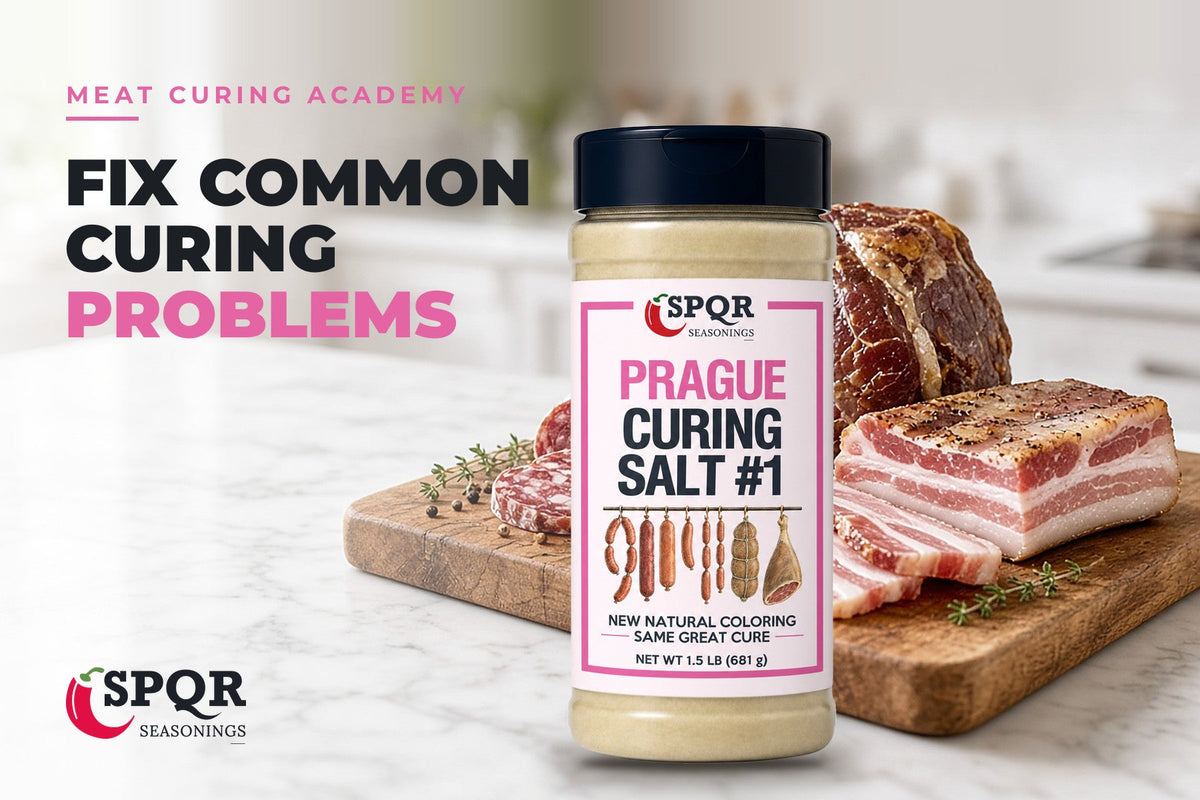
Most meat curing problems come down to four things: the amount of cure, the amount of salt, time, and temperature. Too much salt makes bacon or ham taste harsh. Too little time leaves a gray center. A warm fridge lets brine go slimy. And too much curing salt is the one mistake that's a safety problem, not just a flavor problem. This meat curing troubleshooting guide walks through the problems home curers ask about most, tells you which ones are normal, which ones you can fix, and when to throw the meat out.
We make Prague Curing Salt #1 from SPQR Seasonings, so we hear these questions every week. Each problem below has a short answer here and a full step-by-step guide of its own.
Quick Diagnosis: What's Wrong With My Cured Meat?
| What you see | What it usually means | Is it safe? | Full guide |
|---|---|---|---|
| Bacon tastes too salty | Too much plain salt, too long in a salt-box cure, or not rinsed well | Yes, if cured and cooked properly. Soak or blanch it. | Bacon Too Salty |
| Ham or corned beef too salty | Strong brine, country-style dry cure, or no soak before cooking | Yes. Soak and change the water. | Ham or Corned Beef Too Salty |
| Gray spots or a gray center | The cure didn't reach that spot | Cooked to a safe temperature, yes. Never eat it uncooked. | Gray Spots or Gray Center |
| Corned beef pink after cooking | Normal. Nitrite fixes the pink color. | Yes, go by a thermometer | Why Is My Corned Beef Pink? |
| Rainbow or green sheen on sliced meat | Light bouncing off muscle fibers (iridescence) | Yes, if it smells and feels normal | Corned Beef Pink or Rainbow |
| Hard, dark ring on salami, soft center | Case hardening: the outside dried too fast | Not if the center never dried. Don't eat a wet center. | Case Hardening |
| White powdery coating on salami | Usually good mold | Usually yes. Fuzzy green, black or other colors, no. | White Mold on Salami |
| Brine is thick, stringy or slimy | Bacteria are growing | No. Treat it as spoiled. | Slimy or Ropy Brine |
| Used too much curing salt | More nitrite than the legal limit | Depends on how much. Check the math first. | Used Too Much Curing Salt? |
When to Throw Cured Meat Out
Start here, because no fix is worth getting sick. Throw the meat out, without tasting it, if any of these are true:
- It smells sour, rotten, like ammonia or "off" in any way you wouldn't expect from raw meat, salt and spices.
- The meat itself (not just the brine) feels slimy or sticky after rinsing.
- The brine turned thick, stringy, ropy or cloudy with scum. See slimy or ropy brine.
- It sat above 40 °F for more than 2 hours while curing. USDA FSIS says bacteria multiply quickly between 40 and 140 °F (FSIS, Refrigeration and Food Safety).
- A dry-cured salami or coppa has fuzzy green, black, blue or orange mold that comes back, or mold under the casing.
- A dry-cured product that you'll eat without cooking has a soft, wet or gray center.
- Someone used curing salt in place of regular salt, or the cure amount works out far above the limit. See used too much curing salt.
If anyone feels sick after eating something cured with too much cure (dizziness, headache, bluish lips or skin, trouble breathing), call Poison Help at 1-800-222-1222 right away, or 911 for severe symptoms.
Salt Problems
Bacon Too Salty
Homemade bacon usually comes out too salty for one of three reasons: the recipe used a heavy "salt box" cure, the belly sat in it too long, or it wasn't rinsed well. Oregon State University Extension warns that if a cured belly is under-rinsed, "the final product will be too salty" (OSU Extension, PNW 784).
Fix: fry a test slice before you smoke. If it's too salty, soak the whole slab in cold water in the fridge, changing the water, and test again. Already smoked? Blanch the slices in simmering water for a minute before frying. The full method is in how to fix bacon that's too salty.
Ham or Corned Beef Too Salty
Dry-cured country hams are meant to be salty. USDA FSIS says country hams "can be soaked 4 to 12 hours or longer in the refrigerator to reduce the salt content before cooking" (FSIS, Ham and Food Safety). Corned beef that's too salty usually went straight into the pot without a rinse or soak, or was cured in a strong brine. Our step-by-step guide covers how to make ham or corned beef less salty, before and after cooking.
How to Stop Salt Problems Before They Start
Weigh your salt as a percentage of the meat. Our homemade bacon recipe uses about 2.5% total salt on the belly, and our corned beef brine works out to about 3% of the meat and water together. Because those amounts are mixed to the final level (equilibrium curing), a few extra days in the fridge won't make the meat saltier.
Color Problems
Gray Spots or a Gray Center
Cured meat turns rosy because nitrite reacts with the meat's natural pigment. Kansas State University meat scientists note it was established over a century ago that "the reddish-pink color of cured meat was due to nitrite" (K-State, Use of Nitrite to Cure Meat). A gray center or gray patches mean the cure didn't get there: not enough time for the thickness, a thick cut that wasn't injected, an air pocket in the bag, or too little cure.
If the meat was cooked to a safe temperature, the gray part is safe to eat; it just tastes like plain roast pork or beef. If it's a product you'd eat without cooking, don't. Read gray spots or gray center after curing for causes and fixes.
Why Is My Corned Beef Pink (or Rainbow)?
Pink is what you want. USDA FSIS says corned beef "may still be pink in color after cooking. This does not mean it is not done," because nitrite "fixes pigment in the meat" (FSIS, Corned Beef and Food Safety). A rainbow or greenish sheen on sliced corned beef, pastrami or ham is light reflecting off the muscle fibers, and University of Wisconsin meat scientists say it "does not correlate with spoilage" (UW-Madison Meat Science). Details in why is my corned beef pink or rainbow.
Dry-Curing Problems (Salami, Coppa, Prosciutto)
Dry-cured meats you eat without cooking are the least forgiving. They depend on the right cure, fermentation for salami, steady humidity and enough weight loss. They're also where Curing Salt #2 comes in, with nitrate that breaks down slowly over a long cure. Curing Salt #2 from SPQR Seasonings is coming soon; until then, see Curing Salt #1 vs #2 for which cure goes where.
Case Hardening
Case hardening is a dry, dark crust on the outside of a salami or whole cut while the inside stays soft and wet. The British Columbia Centre for Disease Control's dry sausage guidance says too much air flow causes it, and that below about 65% humidity "case-hardening may occur" (BCCDC, Fermented Foods Guidance 3.13). The fix is higher humidity and gentler air. See case hardening.
White Mold on Salami
A thin, even, powdery white coat is usually fine. USDA FSIS says some salamis "have a characteristic thin, white mold coating which is safe to consume; however, they shouldn't show any other mold" (FSIS, Molds on Food). Fuzzy green, black or colored mold is a different story. Our guide to white mold on salami shows how to tell them apart.
Brine Problems
Slimy or Ropy Brine
Brine should stay clear and smell like salt and spices. If it turns thick, stringy, syrupy or slimy, bacteria are growing in it. Old extension bulletins tell farm curers to watch for brine that "sours or becomes ropy" (Texas A&M Extension, Curing Meats). With today's lighter home brines, we treat a ropy brine as spoiled. See slimy or ropy brine.
How to Keep Brine Healthy
- Chill the brine completely before the meat goes in.
- Keep the meat fully under the brine, weighted down.
- Cure at 36 to 40 °F. Check your fridge with a thermometer.
- Use a clean, food-safe container and never reuse brine for a new batch.
Curing Salt Mistakes
Used Too Much Curing Salt
This is the one to take seriously. Nitrite is safe at the right dose and toxic in excess, which is why federal rules limit home-curing preparations to directions that give no more than 200 ppm sodium nitrite in the finished meat (21 CFR 172.175). Ground meat is capped lower, at 156 ppm, and brined or pumped bacon at 120 ppm (FSIS quick reference, Table II; 9 CFR 424.22(b)).
The fix depends on how much extra went in and whether the meat is still raw. A teaspoon too much on a big batch can often be fixed by adding more meat or more brine. Curing salt used in place of regular salt can't be fixed and must be thrown out. Work it out with our curing salt calculator, then follow the steps in used too much curing salt.
Used the Wrong Salt
Himalayan salt is not curing salt, even though older curing salts were dyed pink. It has no nitrite. See Curing Salt #1 vs Himalayan Salt. Curing Salt #1 is for meats you cook within days or weeks: bacon, ham, corned beef, pastrami, smoked sausage and jerky. Curing Salt #2 is for long dry cures.
Old Curing Salt
Stored sealed, dry and labeled, curing salt keeps a long time. If it's clumped or the label is gone, read does curing salt expire? before you use it.
How to Prevent Most Curing Problems
- Weigh the meat and the cure. Grams beat spoons. A level teaspoon of Prague Curing Salt #1 weighs about 7.07 g in our own weigh test, and 1 level teaspoon per 5 lb of whole cuts (whole muscle, like brisket, pork belly, ham, loin or a roast, not ground) works out to about 195 ppm. The curing salt calculator does the math for any weight, and our how much curing salt per pound chart shows the common sizes.
- Use the right limit for the product. About 195 ppm for whole cuts, never over 200. Ground meat, no more than 156. Brined or pumped bacon, no more than 120. Dry-cured bacon, no more than 200.
- Cure cold. Keep it at 36 to 40 °F the whole time.
- Give it enough time, or inject. Thick cuts like a bone-in ham or a fat brisket need injecting or a long cure. Our home-cured holiday ham injects for exactly this reason.
- Use equilibrium amounts. With equilibrium curing, when salt and cure are measured for the total weight, extra days won't oversalt the meat.
- Rinse, then test. Fry a slice of bacon or simmer a nibble of corned beef before you commit.
- Store the cure safely. Keep it in its labeled bottle, away from your table salt and out of children's reach. SPQR Seasonings tints its Curing Salt #1 yellow with natural annatto so nobody mistakes it for table salt. More in is Curing Salt #1 safe?
Ready for your next batch? Shop Prague Curing Salt #1 from SPQR Seasonings, and use the calculator to get the dose right the first time.
Keep Learning
- What Is Curing Salt #1?
- Curing Salt #1 vs #2: What's the Difference?
- Is Curing Salt #1 Safe?
- Why Is Curing Salt #1 Yellow?
- Back to the Meat Curing Academy
Frequently Asked Questions
What are the most common meat curing mistakes?
Using too much or too little cure, measuring by volume instead of weight, curing too warm, not giving thick cuts enough time or an injection, and not rinsing or testing for salt before cooking.
How do I know if my cured meat has gone bad?
A sour, rotten or ammonia smell, meat that stays slimy or sticky after rinsing, or a thick, ropy brine all mean spoilage. Throw it out without tasting it.
Why is my cured meat gray in the middle?
The cure didn't reach the center. Thick cuts need more time or an injection. If the meat was cooked to a safe temperature, the gray part is safe but tastes like plain roast; never eat it uncooked.
Is it normal for cured meat to be pink after cooking?
Yes. Nitrite in the cure fixes the pink color, so corned beef, ham and pastrami stay pink when fully cooked. Use a thermometer to check doneness, not color.
What happens if I use too much curing salt?
It depends on how much. A small overage can often be fixed by adding more meat or brine. Large amounts, or curing salt used in place of regular salt, make the meat unsafe; throw it out and call Poison Help at 1-800-222-1222 if anyone ate it.
What temperature should I cure meat at?
Keep curing meat at 36 to 40 °F in the refrigerator. Above 40 °F, bacteria grow quickly.
Can I fix meat that's too salty?
Usually. Soak uncooked bacon, ham or corned beef in cold water in the fridge, changing the water, then cook a test piece. Already-sliced bacon can be blanched in simmering water before frying.
Is white mold on salami safe?
A thin, even, powdery white coating on salami is usually safe. USDA says salamis shouldn't show any other mold. Fuzzy green, black or colored mold is a warning sign.


