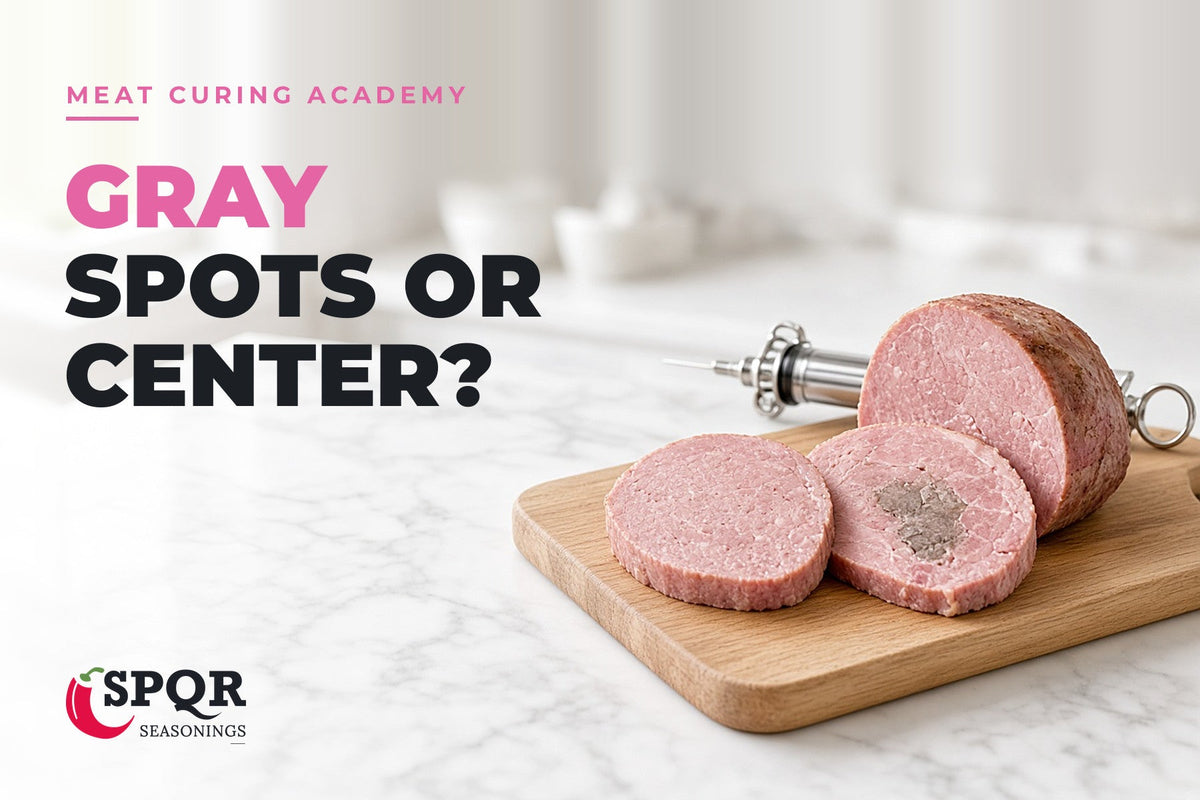
A gray center or gray spots in cooked bacon, ham or corned beef mean the cure didn't reach that part of the meat. Usually the cut was too thick for the cure time, it wasn't injected, or the cure never touched that spot. If the meat was cooked to a safe temperature, the gray part is safe to eat; it just tastes like plain roast pork or beef instead of ham. If it's something you'd eat without cooking, like a dry-cured coppa, don't eat it. And if the gray comes with a sour smell or slime, it's spoiled, not under-cured.
This guide covers how to tell a cure problem from normal color, what's safe, and how to make sure the cure goes all the way through next time with Prague Curing Salt #1 from SPQR Seasonings and the right timing.
Why Cured Meat Turns Pink, and Why Parts Stay Gray
Fresh pork and beef turn gray-brown when you cook them. Cured meat stays rosy because nitrite reacts with myoglobin, the meat's natural pigment, and the cooked cured pigment holds its color. Kansas State University meat scientists put it simply: a cooked pork chop is brownish while a cooked ham slice is pink, and the difference is nitrite (K-State, Use of Nitrite to Cure Meat).
So when a slice of homemade ham or bacon has a pink rim and a gray middle, or gray patches here and there, those parts never got enough nitrite. Some people call it "the cure didn't penetrate." It's the same problem.
Check After Cooking, Not Before
Raw cured meat doesn't always look rosy yet. USDA FSIS notes that "cured raw pork is gray, but cured cooked pork (e.g., ham) is light pink" (FSIS, The Color of Meat and Poultry). So don't judge a raw belly or ham by its color. Cut a slice from the thickest part and cook it. Cured areas turn pink; uncured areas turn gray-brown like a pork chop.
Gray Spots vs Gray Center vs Gray Surface
| What you see | Most likely cause | What to do |
|---|---|---|
| Pink rim, gray center (cooked) | Not enough cure time for the thickness, or a thick cut that wasn't injected | Safe if cooked to temperature. Next time inject or cure longer. |
| Gray patches or spots scattered through | The cure didn't touch those spots: folds, air pockets in the bag, an uneven rub | Safe if cooked to temperature. Next time rub every surface and flip daily. |
| Gray around the bone | The cure travels in from the outside and reaches the bone last | Inject along the bone next time. |
| Whole piece gray, no pink anywhere | No nitrite at all: plain salt, Himalayan salt, or the cure was left out | It's brined roast, not ham. Cook it as fresh meat. |
| Gray or green on the cut surface of sliced cured meat | Light and air fading the cured color | Normal fading. FSIS says light and oxygen break down cured pigments. Wrap it airtight. |
| Gray plus sour smell, slime or stickiness | Spoilage | Throw it out. |
Is Gray Cured Meat Safe to Eat?
Cooked to a safe temperature: yes. An uncured spot in a fully cooked ham or bacon is just cooked pork. Use a thermometer, not color. USDA FSIS's safe minimums are 145 °F with a 3-minute rest for whole cuts of pork and beef, and 160 °F for ground meat (FSIS, Safe Minimum Internal Temperature Chart). Oregon State says to cook home-cured pork belly to 160 °F (OSU Extension, PNW 784).
Eaten without cooking: no. Dry-cured whole cuts and salami rely on the cure, salt and drying all the way through. A gray, soft or wet center in a coppa, lonza or salami means that part isn't protected. Don't eat it. See case hardening if the outside is hard and the inside is soft.
Gray with a bad smell or slime: no. FSIS says spoiled meat may fade or darken, and "will have an off odor, be sticky or tacky to the touch, or it may be slimy" (FSIS). Throw it out without tasting.
Green spots on ham? A shiny, rainbow-like green sheen is light on the muscle fibers and is harmless; see why is my corned beef pink or rainbow. A dull green or gray slime is spoilage.
Why the Cure Didn't Go All the Way Through
- Not enough time for the thickness. A cure soaks in from the surface, and thick cuts take longer. Our homemade bacon gets about 7 days for a belly 1 to 1½ inches thick, with a day or two more for a thicker one.
- A thick cut that wasn't injected. A bone-in ham or a fat brisket can take weeks to cure from the outside alone. Our holiday ham recipe injects about 10% of the ham's weight in brine for this reason, then cures about 1 day per pound.
- The cure didn't touch every surface. Folds, flaps and air pockets in a bag of dry cure stay gray. Rub every side, press the air out, and flip and massage the bag every day.
- Not enough cure. A guessed or "pinch" amount may not be enough to cure the whole piece evenly.
- The wrong salt. Himalayan pink salt has no nitrite. See Curing Salt #1 vs Himalayan Salt.
- Pulled early. A dry-cured belly is ready when it feels firm all the way through, like a flexed muscle. Soft spots mean it needs more time.
Can I Fix It?
Still raw: yes. If a test slice shows a gray center and the meat hasn't been cooked or smoked, put it back in the cure in the fridge for a few more days and test again. With an equilibrium cure (salt and cure measured for the total weight), extra days won't oversalt it or add extra nitrite. You can also inject the center with some of the same brine.
Already cooked: no, but if it reached a safe temperature you can eat it. Treat the gray parts as roast pork or roast beef.
How to Cure It All the Way Through Next Time
- Weigh the meat and the cure. Use 1 level teaspoon of Prague Curing Salt #1 (about 7.07 g in our weigh test) per 5 lb of whole cuts (whole muscle, like brisket, pork belly, ham, loin or a roast, not ground), which is about 195 ppm. For brines, count the meat and water together. The curing salt calculator does both.
- Inject thick cuts. Anything over about 2 inches thick, and anything with a bone, gets injected with the same brine. It doesn't add nitrite; it's the same batch.
- Give it time. Follow the recipe's time for the thickness, and add a day or two for a thicker piece.
- Cure cold and keep it covered. Hold it at 36 to 40 °F, keep brined meat fully under the brine, and flip dry-cured meat daily.
- Test before cooking. Cook a slice from the thickest part. Pink all the way through means it's ready.
The cure limit doesn't change if you go longer: about 195 ppm for whole cuts and never over 200 (21 CFR 172.175). Brined or pumped bacon stays at 120 or less (9 CFR 424.22(b)). More time is the fix, never more cure. If you're out, get Prague Curing Salt #1 from SPQR Seasonings.
Keep Learning
- Meat Curing Troubleshooting Guide
- Why Is My Corned Beef Pink (or Rainbow)?
- What Is Curing Salt #1?
- How to Cure Your Own Corned Beef
Frequently Asked Questions
Why is my cured meat gray in the middle?
The cure didn't reach the center. The cut was too thick for the cure time, it wasn't injected, or the cure didn't touch that part. Next time inject thick cuts or cure longer.
Is it safe to eat cured meat with a gray center?
If it was cooked to a safe temperature (145 °F with a 3-minute rest for whole cuts, 160 °F for home-cured bacon), yes; the gray part is just cooked meat. Never eat a gray center in a product you'd eat without cooking.
Why is my homemade bacon gray?
Gray spots or a gray middle mean the cure didn't reach that part, often from folds or air pockets in the bag or too little time. If the whole belly is gray, there was no nitrite in the cure.
Why did my corned beef turn gray?
Corned beef made without curing salt (nitrite) cooks up gray, like pot roast. Gray patches in otherwise pink corned beef mean the brine didn't reach those spots; inject next time.
Can I put meat back in the cure if the center is gray?
Yes, if it's still raw. Put it back in the same cure in the fridge for a few more days, or inject the center, then cook a test slice. With an equilibrium cure, extra days won't oversalt it.
Should I add more curing salt if the cure didn't penetrate?
No. More time or an injection is the fix. Adding extra cure can push the nitrite over the 200 ppm limit.
Why is raw cured pork gray?
USDA FSIS says cured raw pork is gray and turns light pink when cooked. Judge the cure by cooking a test slice, not by the raw color.


