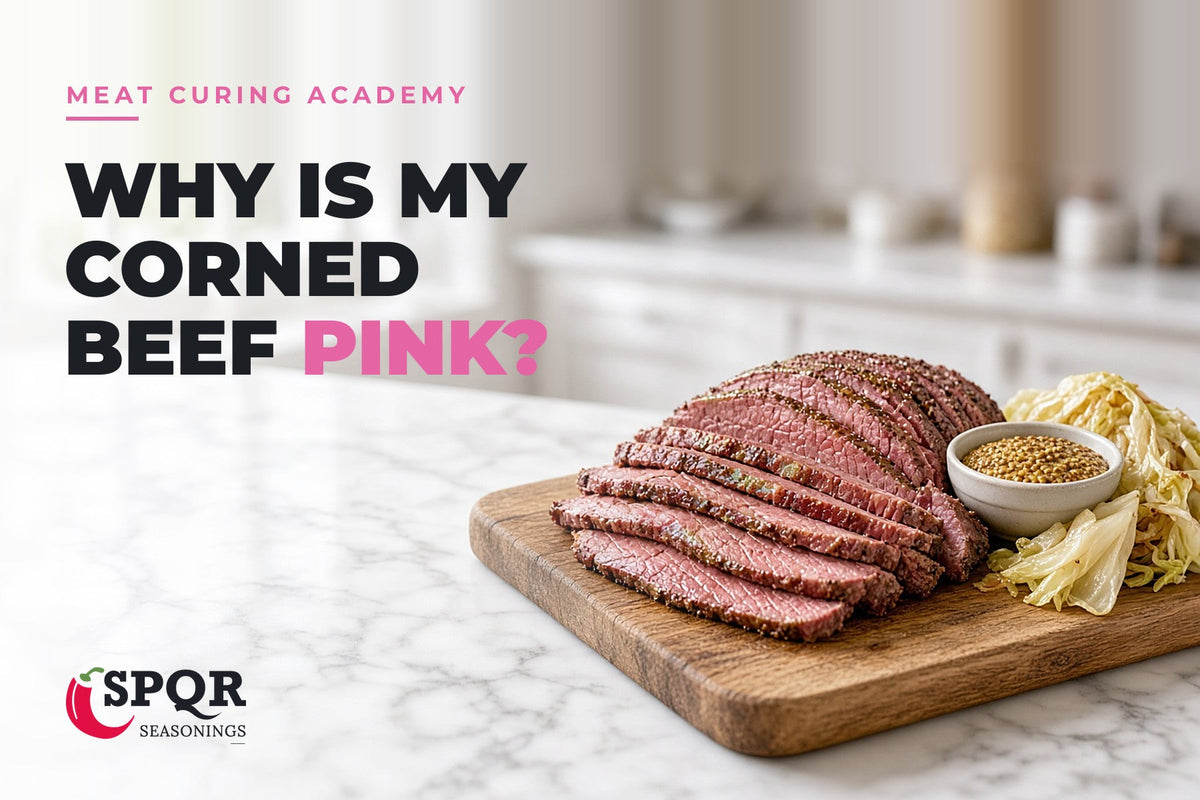
Corned beef is pink because it's cured with nitrite. The nitrite in the cure reacts with the meat's natural pigment and locks in a rosy red color that cooking doesn't turn gray. USDA FSIS says corned beef "may still be pink in color after cooking. This does not mean it is not done" (FSIS, Corned Beef and Food Safety). A rainbow or greenish shine on the slices is something else: light bouncing off the muscle fibers. It's harmless too.
Here's what makes corned beef, ham and pastrami pink, how to tell normal rainbow sheen from spoilage, and why corned beef sometimes comes out gray. Our homemade corned beef gets its color from Prague Curing Salt #1 from SPQR Seasonings.
Why Is Corned Beef Pink?
Raw beef is red because of myoglobin, the pigment in muscle. Cook a plain brisket and the myoglobin breaks down to gray-brown. That's pot roast.
Corned beef is cured first, in a brine with salt and sodium nitrite. The nitrite bonds to the myoglobin, and when the meat is cooked that cured pigment stays pink. USDA FSIS explains that nitrite "fixes pigment in the meat and affects the color." Kansas State University meat scientists note that by the early 1900s it was established that "the reddish-pink color of cured meat was due to nitrite" (K-State, Use of Nitrite to Cure Meat).
The same thing makes ham, bacon, pastrami and hot dogs pink. FSIS says the usual color for cured ham is "deep rose or pink," while fresh, uncured ham cooks up "the pale pink or beige color of a fresh pork roast" (FSIS, Ham and Food Safety).
Is the Color From the Curing Salt Dye?
No. Curing salt is tinted so nobody mistakes it for table salt, and the tint doesn't color the meat. SPQR Seasonings' Prague Curing Salt #1 is now yellow (annatto) instead of the old pink, and corned beef cured with it is just as rosy. The color comes from the nitrite. More in why is Curing Salt #1 yellow?
Is Pink Corned Beef Undercooked?
Not because it's pink. Cured meat stays pink at any temperature, so color tells you nothing about doneness. Use a thermometer:
- Safe: FSIS says to cook raw corned beef to at least 145 °F, then rest it at least 3 minutes (FSIS).
- Tender: brisket is tough at 145 °F. FSIS says "fork-tender" is a good sign of doneness and you can cook it higher for preference. Most cooks simmer it until a fork slides in easily, about 1 hour per pound.
Pastrami works the same way: it's pink because it's cured, not because it's rare. See what is pastrami?
Why Does My Corned Beef Have a Rainbow Sheen?
That shimmering green, gold or purple sheen on sliced corned beef, pastrami, roast beef or ham is called iridescence. It isn't mold or a chemical. It's light.
- USDA FSIS: "When light hits a slice of meat, it splits into colors like a rainbow," and iridescence "does not represent decreased quality or safety of the meat" (FSIS, The Color of Meat and Poultry).
- The University of Wisconsin-Madison meat science program says the muscle fiber structure diffracts light, that it shows up often on roast beef and pastrami because of their smooth cut surfaces, and that it "does not correlate with spoilage" (UW-Madison Meat Science).
- Ohio State University's meat science extension notes it's most common in the round, navel and brisket, usually green or orange-red, and stronger on cured meats because their color is brighter (OSU Meat Science, Iridescence in Raw and Cooked Meats).
Why It Shows Up on Corned Beef So Often
Brisket's long, parallel muscle fibers get sliced straight across, which leaves a smooth surface that catches light. Ohio State notes that smooth surfaces show iridescence more vividly than rough ones, and that it can't be removed once it's there. Slicing at a slight angle, and wrapping leftovers airtight away from light, can make it less noticeable. Tilt the slice: if the colors move and change as you turn it, it's iridescence.
When Pink or Green Is Not OK
| What you see | Normal or not? |
|---|---|
| Rosy pink all the way through, cooked to temperature | Normal. That's the cure. |
| Rainbow or metallic green sheen that shifts when you tilt the slice | Normal. Iridescence. |
| Gray or greenish fading on the cut surface of leftovers | Normal fading. FSIS says light and oxygen break down cured pigments. Wrap it airtight. |
| Dull green, gray or brown with slime, stickiness or a sour smell | Spoiled. Throw it out. |
| Fuzzy spots of any color | Mold. Throw out cooked corned beef with mold; FSIS says to discard moldy cooked meat (FSIS, Molds on Food). |
FSIS's rule of thumb: spoiled meat "will have an off odor, be sticky or tacky to the touch, or it may be slimy" (FSIS). Color alone doesn't mean spoilage. Cooked corned beef keeps 3 to 4 days in the fridge, per FSIS.
Why Is My Corned Beef Gray Instead of Pink?
Gray corned beef almost always means not enough nitrite reached the meat.
- All gray: the brine had no curing salt. Salt alone, or Himalayan pink salt, won't turn it pink. See Curing Salt #1 vs Himalayan Salt. Some cooks make an uncured "gray" corned beef on purpose; it tastes more like pot roast.
- Pink outside, gray center: the brine didn't reach the middle. Thick briskets need injecting or more days. See gray spots or gray center after curing.
- Pink when raw, brown after cooking: usually too little cure, or the cure was spread too thin over too much meat and water.
The fix is the right dose and enough time. Our corned beef recipe uses 18.8 g of Prague Curing Salt #1 for a 5-lb brisket in 1 gallon of water. That's 18.8 × 62,500 ÷ 6,053 g of meat and water = about 194 ppm nitrite, under the 200 ppm federal limit (21 CFR 172.175; 9 CFR 424.21). The brisket gets injected and cures 7 days. For a different size, use the curing salt calculator.
Ready to make corned beef that's rosy all the way through? Shop Prague Curing Salt #1 from SPQR Seasonings, then follow our how to cure your own corned beef recipe.
Keep Learning
- Meat Curing Troubleshooting Guide
- Ham or Corned Beef Too Salty?
- Homemade Pastrami Recipe
- What Is Curing Salt #1?
Frequently Asked Questions
Why is corned beef pink?
It's cured with sodium nitrite, which reacts with the meat's natural pigment and keeps it pink after cooking. Without nitrite, brisket cooks up gray like pot roast.
Is pink corned beef safe to eat?
Yes, if it reached at least 145 °F with a 3-minute rest. USDA FSIS says corned beef may still be pink after cooking and that doesn't mean it isn't done. Use a thermometer.
Why does my corned beef have a rainbow sheen?
Light hitting the cut muscle fibers splits into colors, called iridescence. USDA says it doesn't mean lower quality or safety.
Why is ham pink?
Cured ham is pink for the same reason as corned beef: nitrite in the cure. Fresh, uncured ham cooks up pale pink or beige like a pork roast.
Why is my corned beef gray?
Not enough nitrite reached the meat. Either the brine had no curing salt, or the center wasn't injected or cured long enough.
Does the color of curing salt make meat pink?
No. Curing salt is tinted so it isn't mistaken for table salt. The pink in cured meat comes from the nitrite, which is why corned beef cured with yellow Curing Salt #1 is just as pink.
When is green on corned beef a problem?
A shifting rainbow or green sheen is normal. Dull green or gray with slime, stickiness or a sour smell means it's spoiled; throw it out.


