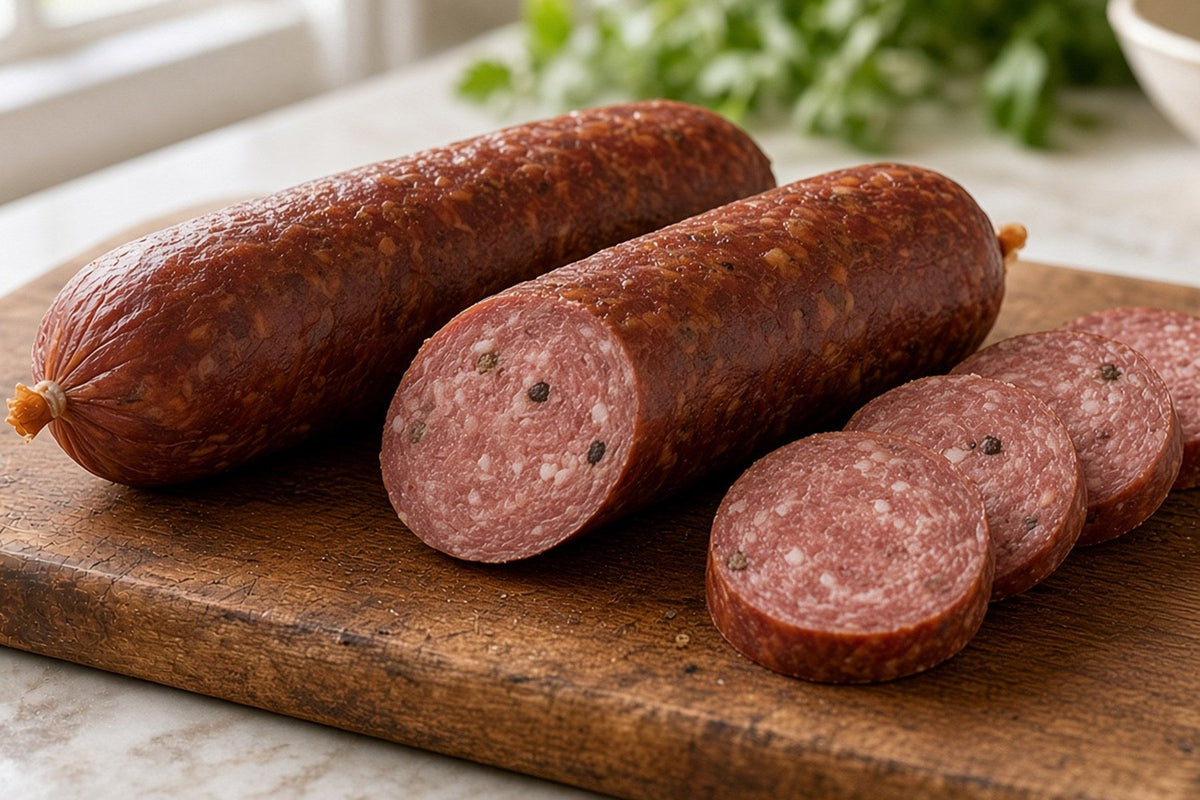
Summer sausage is a cured, semi-dry sausage, usually beef or beef and pork, with a tangy flavor, mustard seed and black pepper, that is smoked or cooked until it's fully done and then sliced cold. USDA puts it in the semi-dry family with Lebanon bologna, cervelat and thuringer: sausages that are "usually heated in the smokehouse to fully cook the product and partially dry it" (USDA FSIS, Sausages and Food Safety).
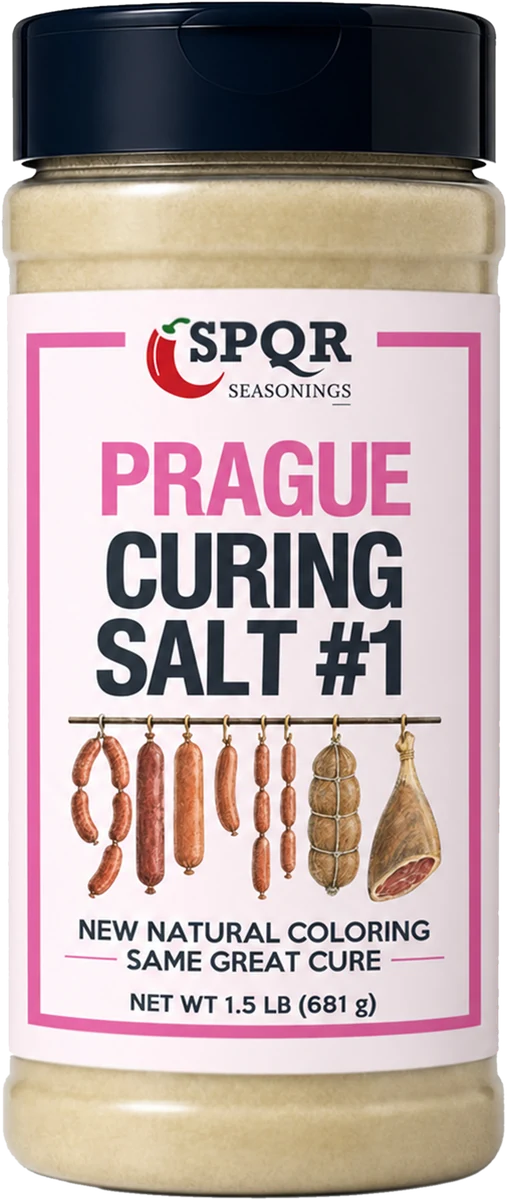
You can make it at home in an oven or a smoker with a temperature control. The one ingredient you can't skip is the cure. This recipe uses Prague Curing Salt #1 from SPQR Seasonings, weighed to stay under the 156 ppm federal limit for ground meat. That's less than the bottle's 1 teaspoon per 5 lb, and we explain why below.
What Is Summer Sausage?
Summer sausage is a ground, cured sausage stuffed into a wide casing, then smoked or cooked and chilled. Slices are firm, deep red from the cure, flecked with fat, mustard seed and pepper, and a little sour. It's a staple of holiday gift boxes, deer camp and charcuterie boards.
It sits between two other sausage types:
- Cooked sausages like hot dogs and bologna are soft, moist and kept cold.
- Dry sausages like pepperoni and Genoa salami are fermented and air-dried for weeks, and most are not cooked.
- Semi-dry sausages like summer sausage are fermented or acidified for tang, then fully cooked and partly dried. FSIS says semi-dry sausages have "good keeping qualities due to their lactic acid fermentation and sometimes heavy application of smoke."
Where does the tang come from?
Commercial summer sausage gets its sour edge from fermentation: a starter culture of lactic acid bacteria eats a little sugar and lowers the pH before the sausage is cooked. At home you have two choices, and Washington State University Extension describes both (WSU, EB1661):
- Encapsulated citric or lactic acid. The acid is coated so it stays locked up until the sausage heats. WSU says encapsulated acids "are recommended for home production of semi-dry sausages" for safety and convenience. This recipe offers it as an option.
- A starter culture. This gives the truest flavor but needs a warm fermentation step held at the right temperature. WSU warns that Staphylococcus aureus toxin can form if fermentation isn't tightly controlled. Save it for when you have a chamber and a pH meter.
Don't use plain citric acid powder in the meat. It acts right away, before cooking, and WSU notes early acid makes sausage "mushy and mealy." Our Citric Acid Powder is great for rubs and sauces, but for summer sausage you need the encapsulated kind from a sausage supplier.
Do You Need Curing Salt for Summer Sausage?
Yes. Summer sausage is cooked low and slow, often in smoke, which is exactly the warm, low-oxygen setting where Clostridium botulinum can grow. Nitrite is what protects it, and it also gives summer sausage its red color and cured taste. WSU explains that sausages made without nitrite turn brown instead of red when cooked and are "much more perishable."
Use a 6.25% nitrite cure like our Prague Curing Salt #1. Don't swap in a "complete" cure such as Tender Quick at the same amount; those contain far less nitrite and replace most of the salt, so the recipe has to change completely. See Can I Use Regular Salt Instead of Curing Salt?
Homemade Summer Sausage (Oven or Smoker)
- Total time
- About 1½ daysmostly hands-off
- Prep time
- 45 min
- Cure time
- 12 to 24 hoursstuffed, in the fridge
- Cook time
- 4 to 6 hoursto 160 °F inside
- Yield
- Two 2½-inch logsa little under 5 lb after cooking
- Difficulty
- Moderateneeds a scale and a probe thermometer
- Meat weight
- 5 lb (2,268 g)80% lean
You'll need
Written for a 5-lb (2,268 g) meat block. For a different size, use the scaling table below, or the curing salt calculator (choose sausage, ground meat).
The meat
- 4 lbs. (1,814 g) beef chuck, cubed (or venison, see the tips)
- 1 lb. (454 g) pork shoulder or pork back fat, cubed
The cure and seasoning
- 5.6 g (¾ level tsp) SPQR Seasonings Prague Curing Salt #1. Weigh it. Not 1 tsp: this is ground meat.
- 57 g fine non-iodized salt (2.5%), such as SPQR Seasonings Celtic Salt, Fine Ground. This is the plain salt, not the cure.
- 23 g sugar or dextrose (1%) or SPQR Seasonings Monk Fruit Sweetener (only if you skip the starter culture)
- 2 tablespoons yellow mustard seed, whole
- 1 tablespoon coarsely ground black pepper
- 2 teaspoons garlic powder
- 1 teaspoon ground coriander
- 1 teaspoon SPQR Seasonings Smoked Spanish Paprika (adds smoke flavor for oven cooks)
- ½ teaspoon ground nutmeg
- 60 g (¼ cup) ice water
- Optional: 68 g (about ⅔ cup) nonfat dry milk, helps lean or venison sausage hold together
- Optional: 5.6 g SPQR Seasonings MSG (0.25%) for deeper savory flavor
- Optional: encapsulated citric acid for tang, at the supplier's rate. Add it last. Plain powder such as SPQR Seasonings Citric Acid is uncoated and turns the meat mushy if mixed in, so save it for rubs and sauces.
Cure dose
Weigh it. Spoon users: ¾ level tsp, never heaped
- Prague Curing Salt #1
- 5.6 g for 5 lb of meat
- Nitrite level
- about 154 ppm (ground meat limit 156)
Storage: Keep the bottle sealed, labeled and out of reach of children and pets. Curing salt is not table salt. Store it away from your regular salt.
Equipment
- Digital scale that reads to 0.1 g (for the cure) and a kitchen scale for the meat
- Meat grinder with ⅜-inch and 3/16-inch plates, and a sausage stuffer
- Two 2½-inch fibrous casings sized for about 2½ lb each (check the package), soaked as directed
- Oven that holds 170 °F, or a smoker with a temperature control
- Leave-in probe thermometer
Steps
-
Chill everything
Cube the meat and fat and spread it on a tray. Put it and the grinder parts in the freezer for 30 to 45 minutes, until the edges are firm. Cold fat cuts cleanly; warm fat smears.
-
First grind
Grind the beef and pork through the ⅜-inch plate into a bowl set over ice.
-
Mix the cure in evenly
Stir the Curing Salt #1, salt, sugar, spices, MSG and dry milk (if using) into the ice water. Pour it over the meat and mix by hand or with a stand mixer paddle for 2 to 3 minutes. Even mixing is a safety step: it spreads the nitrite through every bite.
-
Second grind and bind
Regrind through the 3/16-inch plate. Mix 2 to 4 minutes more, until the meat turns sticky and holds to your palm when you turn your hand over. Fold in encapsulated citric acid now, if using, for no more than a minute.
-
Stuff tight
Stuff into the casings with no air pockets. Prick any bubbles with a clean pin and tie the ends. If you used encapsulated acid, skip the overnight rest and go straight to cooking.
-
Rest overnight
Refrigerate the logs 12 to 24 hours at 36 to 40 °F. The cure sets the color and the flavors blend.
-
Cook to 160 °F
Hang or lay the logs in a 150 °F smoker or your oven's lowest setting for 1 hour to dry the surface. Then raise it to 170 to 180 °F (add hickory smoke now in a smoker) and cook until the center reads 160 °F, about 3 to 5 more hours. USDA's minimum for sausage with ground beef or pork is 160 °F (FSIS).
-
Chill fast
Plunge the logs into ice water until the center drops to about 100 °F, about 15 to 30 minutes. Pat dry and hang or rack them at room temperature for 1 to 2 hours so the color deepens.
-
Refrigerate, then slice
Refrigerate overnight before slicing. It slices cleaner cold and the flavor settles.
Storage
- Refrigerator: up to 3 weeks, wrapped (Oregon State Extension). Homemade summer sausage is not shelf stable. Keep it cold.
- Freezer: vacuum-seal and freeze at 0 °F. FSIS gives 1 to 2 months for best quality; it stays safe longer.
- Gifting: ship or hand it over cold, with a "keep refrigerated" note.
Scaling the Cure to Your Meat
The cure is 2.45 g of Curing Salt #1 per kilogram of meat and fat (about 153 ppm), with 2.5% salt and 1% sugar. We count the meat block only, not the water or dry milk. Weigh the cure if you can. Spoon amounts are rounded down to the nearest ⅛ teaspoon at 7.07 g per level teaspoon, so they come in under the weighed dose.
| Meat block | g | Curing Salt #1 | Nitrite | Or level spoons | Salt | Sugar |
|---|---|---|---|---|---|---|
| 2 lb | 907 | 2.2 g | 152 ppm | ¼ tsp (122 ppm) | 23 g | 9 g |
| 3 lb | 1,361 | 3.3 g | 152 ppm | ⅜ tsp (122 ppm) | 34 g | 14 g |
| 5 lb | 2,268 | 5.6 g | 154 ppm | ¾ tsp (146 ppm) | 57 g | 23 g |
| 10 lb | 4,536 | 11.1 g | 153 ppm | 1½ tsp (146 ppm) | 113 g | 45 g |
| 25 lb | 11,340 | 27.8 g | 153 ppm | 3⅞ tsp (151 ppm) | 283 g | 113 g |
How Much Cure Is in This Summer Sausage?
- The math: 5.6 g of Curing Salt #1 × 6.25% sodium nitrite = 0.35 g of nitrite. 0.35 ÷ 2,268 g of meat = about 154 ppm.
- The limit: For chopped or ground meat, federal rules allow ¼ oz of sodium nitrite per 100 lb, which works out to 156 ppm (9 CFR 424.21(c); see also 21 CFR 172.175). Never go over 2.5 g of Curing Salt #1 per kilogram of ground meat.
- Why not the bottle's 1 tsp per 5 lb? One level teaspoon (7.07 g) in 5 lb of meat is about 195 ppm. That's right for whole cuts (whole muscle) like bacon or ham, where the limit is higher, but it's over the 156 ppm cap for sausage. For ground meat, use ¾ teaspoon per 5 lb, or weigh it.
- Why Curing Salt #1: summer sausage is cooked within a day or two. Curing Salt #1 is the right cure for anything cooked, smoked or eaten within weeks. See Curing Salt #1 vs #2.
Our Prague Curing Salt #1 is 6.25% sodium nitrite, the same strength as any Cure #1 or what most recipes call pink curing salt. Ours is tinted yellow with annatto, not dyed pink, and it's used at exactly the same rate.
How Other Recipes Compare
We checked the cure in published summer sausage recipes against the 156 ppm limit. Several popular versions go over it.
| Source | Cure as written | Nitrite on the meat block | Cook to |
|---|---|---|---|
| Washington State Univ. EB1661 | 31 g of 6.25% cure for 25 lb meat and fat (plus 3 lb water) | about 171 ppm on meat (153 ppm if you count the water) | 150 °F |
| Oregon State Univ. SP 50-735 | Tender Quick, 2 Tbsp per 5 lb | Complete cure; follow its own label | 160 °F |
| Bottle label rate | 1 level tsp per 5 lb | about 195 ppm (fine for whole cuts, over the limit for ground) | n/a |
| This recipe | 5.6 g per 5 lb | about 154 ppm | 160 °F |
We cook to 160 °F, USDA's number for ground beef and pork sausage, rather than the 150 to 152 °F some older extension recipes use.
Tips and Swaps
- Venison summer sausage: use 4 lb venison and 1 lb pork fat or fatty pork shoulder. Venison is very lean, so add the nonfat dry milk. Cooking to 160 °F handles parasites; CDC warns that freezing does not reliably kill the Trichinella found in wild game (CDC).
- Cheddar or jalapeño: fold in 1 cup high-temperature cheese cubes or ½ cup diced pickled jalapeños after the second grind.
- No casing? Oregon State shapes the mix into tight foil-wrapped rolls and bakes them on a rack until 160 °F inside.
- Fat smeared or greasy texture? The meat got too warm. Keep it near freezing through grinding and mixing.
- Crumbly slices? It wasn't mixed long enough to bind. Mix until it's tacky.
- Want to try fermenting? Use a commercial starter culture with dextrose and follow its time and temperature chart exactly, then cook to 160 °F. Don't guess at fermentation.
Also making fresh sausage? Our homemade smoked pork sausage uses the same grind-and-cure method in smaller links.
Frequently Asked Questions
What is summer sausage made of?
Usually beef, or beef and pork, with salt, curing salt, sugar, mustard seed, black pepper and garlic. It's stuffed into a wide casing and smoked or cooked until fully done. Venison is a popular swap for the beef.
Is summer sausage cooked?
Yes. Semi-dry sausages like summer sausage are heated in the smokehouse to fully cook them, according to USDA. Homemade summer sausage should reach 160 °F in the center.
Does summer sausage need to be refrigerated?
Homemade summer sausage does. Keep it in the fridge and use it within about 3 weeks, or freeze it. Store-bought summer sausage that says "Keep Refrigerated" lasts about 3 months unopened and 3 weeks once opened, per the FSIS chart. Only products labeled shelf stable can stay in the pantry.
How much curing salt do I use for summer sausage?
For ground meat, use 2.45 g of Curing Salt #1 per kilogram of meat, or 5.6 g per 5 lb. That's about 154 ppm nitrite, under the 156 ppm federal limit. By spoon, use ¾ level teaspoon per 5 lb, not a full teaspoon.
Can I make summer sausage without curing salt?
We don't recommend it. Without nitrite it won't have the red color or cured flavor, and it loses its protection against botulism during the long, low-temperature cook. Without cure, cook and treat it like fresh sausage.
What gives summer sausage its tangy flavor?
Lactic acid from fermentation in commercial sausage. At home, encapsulated citric acid added at the very end gives a similar tang without a fermentation step. Plain citric acid powder doesn't work in the meat; it turns the texture mushy.
Can I eat summer sausage while pregnant?
CDC lists fermented and dry sausages among foods pregnant people should heat to 165 °F or until steaming hot before eating.
Keep Learning
- Homemade Smoked Pork Sausage
- Homemade Beef Jerky
- How Much Curing Salt Per Pound?
- Used Too Much Curing Salt?
- Safe Meat Curing Temperatures
- Meat Curing Academy
Ready to make your first summer sausage? Grab a bottle of Prague Curing Salt #1 from SPQR Seasonings. At 5.6 g per 5 lb, one 1.5-lb bottle cures about 600 lb of sausage, with plenty left for bacon, ham and jerky.
Sources
- USDA FSIS, Sausages and Food Safety (semi-dry definition, 160 °F, storage chart)
- USDA, 9 CFR 424.21 Use of food ingredients and sources of radiation (eCFR)
- FDA, 21 CFR 172.175 Sodium nitrite (eCFR)
- Washington State University Extension, Homemade Meat, Poultry, and Game Sausages (EB1661)
- Oregon State University Extension, Summer Sausage and Deli Style Meats (SP 50-735)
- CDC, How to Prevent Trichinellosis
- CDC, Safer Food Choices for Pregnant Women
By SPQR Seasonings. Last reviewed November 2026. Regulations quoted are current as of November 24, 2026.