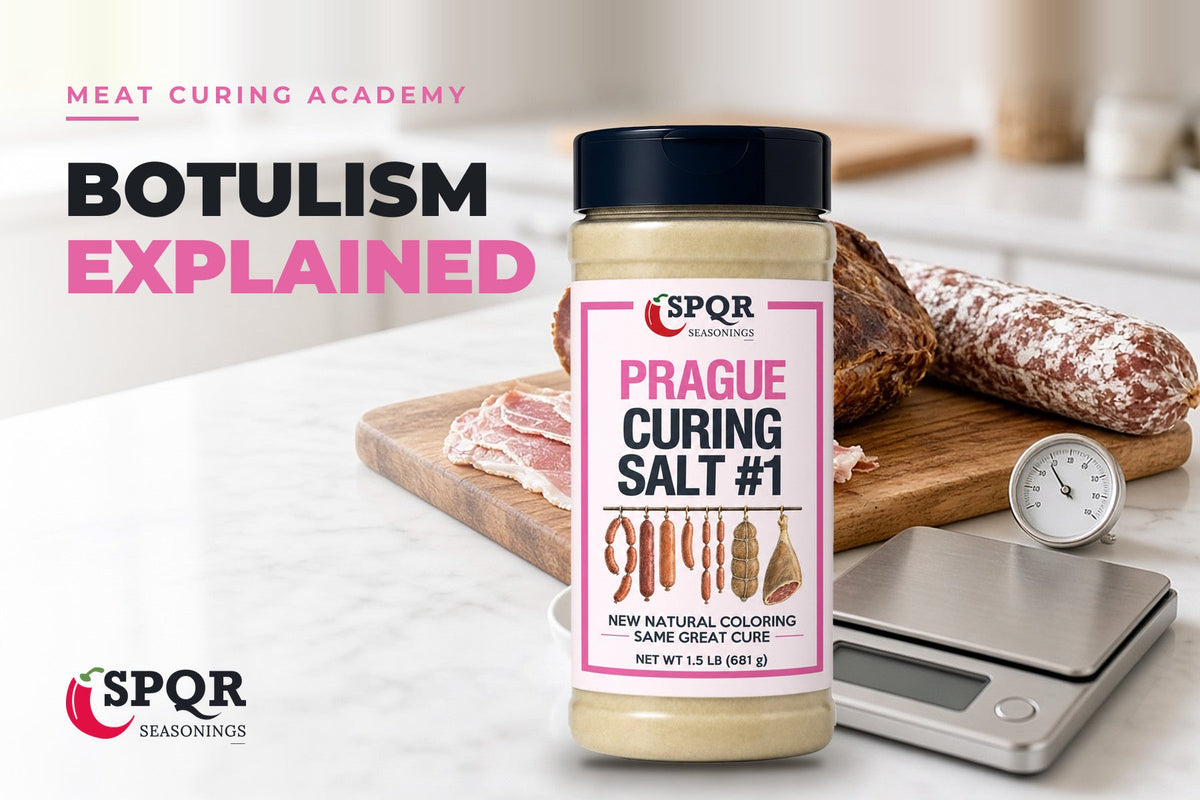
Botulism is a rare but serious illness caused by a toxin that some Clostridium bacteria make when their spores grow in low-oxygen, low-acid food. Cured meat, sausage and slow-smoked meat can offer those conditions, which is exactly why curing salt exists. The sodium nitrite in Curing Salt #1 (often called pink curing salt or Prague Powder #1), together with the right amount of salt and a cold fridge, stops the spores from growing. Weigh your cure, keep the meat at 34 to 40°F while it cures, and the risk of botulism in cured meat is very low.
This guide explains what botulism is, how meat gets it, how nitrite prevents it and the handful of habits that matter. It is written to be calm and accurate: no scare stories, and no shortcuts either. Every number links to the agency it came from.
Key Points
- CDC calls botulism "a rare but serious illness." The toxin attacks nerves, and every case is a medical emergency.
- The spores are everywhere, and eating them usually does no harm. The danger is spores that grow and make toxin inside food.
- Inside a ham, a stuffed sausage or a vacuum bag there is little oxygen, and meat is not acidic, so salt, nitrite and temperature do the protecting.
- Use a measured dose of Prague Curing Salt #1 from SPQR Seasonings: about 195 ppm nitrite for whole cuts, never over 200 ppm.
- Long dry cures (salami, prosciutto, coppa) need Curing Salt #2, a tested recipe and a controlled curing chamber.
- You cannot see, smell or taste botulinum toxin. If in doubt, throw it out.
What Is Botulism?
Botulism is an illness caused by botulinum toxin, which the CDC describes as "one of the most lethal toxins known." The toxin is made mainly by Clostridium botulinum and, less often, by two related bacteria. It blocks the signals between nerves and muscles, which is why the illness causes muscle weakness and, in severe cases, trouble breathing (CDC, About Botulism).
There are five main kinds of botulism. The one that matters for home curing is foodborne botulism, which happens when someone eats food in which the toxin has already formed. CDC lists the most common sources as "homemade foods that have been improperly canned, preserved, or fermented." The FDA notes that with fast treatment most people recover, but that the illness is fatal in about 5% to 10% of cases (FDA Bad Bug Book). That is why the habits below are worth taking seriously, even though the illness is rare.
How Does Meat Get Botulism?
C. botulinum forms spores, tough dormant cells that act like a protective coating. FDA says the spores are found in soil, in stream and lake sediments and in the intestinal tracts of fish and mammals, so a few can be on almost any raw meat. On their own they do nothing. CDC says the spores "usually do not cause people to become sick, even when they're eaten."
Trouble starts only when the spores find the right conditions to wake up, grow and make toxin. CDC lists those conditions as:
- Low oxygen or no oxygen
- Low acid
- Low sugar
- Low salt
- A certain temperature range
- A certain amount of water
Now picture the middle of a whole ham, a pork belly in a vacuum bag or a salami stuffed into a casing. There is very little oxygen in there. Meat is not acidic: FDA says almost any food above pH 4.6 can support the toxin. Fresh meat is moist and low in sugar. Without help, that is a good home for spores, especially when the meat sits for days or weeks. FDA's list of foods that have been linked to botulinum toxin includes ham, sausage and luncheon meats alongside home-canned vegetables (FDA Bad Bug Book).
That help is what curing provides. Canada's National Collaborating Centre for Environmental Health puts the history plainly: botulism "was commonly associated with the consumption of sausages containing botulinum toxin prior to the use of nitrites in their production" (NCCEH Ready-to-Eat Meats Field Guide).
How Curing Salt Prevents Botulism
Curing protects meat with several barriers working together. Food scientists call them hurdles. No single one does all the work, and each one makes the others stronger.
1. Nitrite
Sodium nitrite is the active ingredient in Curing Salt #1, which is salt with 6.25% sodium nitrite. USDA's Food Safety and Inspection Service says nitrite "greatly delays the development of the Clostridium botulinum toxin" (FSIS, Bacon and Food Safety). Research reviews describe two effects: nitrite keeps surviving spores from developing into growing cells, and it stops the cells that do develop from dividing. One well-known study found that nitric oxide from nitrite binds to iron-sulfur proteins that the bacteria need to grow (Reddy et al., Science, 1983; see also the PMC review, Nitrites in Cured Meats).
Kansas State University sums up why it matters at home: one of the most important reasons nitrite is used is to inhibit "the bacteria that causes botulism, in case cured meat is mishandled and stored at temperatures above 40F" (K-State, Use of Nitrite to Cure Meat). Nitrite is the safety margin for the day the fridge runs warm.
2. Salt
Salt pulls water out of the meat and makes it harder for bacteria to grow. FDA says a salt concentration of 4% to 5% in the water of a food is needed to inhibit the spores, especially the cold-tolerant types (FDA Bad Bug Book). A normal home cure does not reach that level on salt alone, which is why salt and nitrite are used together.
3. Cold
Temperature is the hurdle you control every day. FDA's growth tables show that the cold-tolerant strains of C. botulinum can grow, slowly, at temperatures as low as about 38°F, while the more common heat-resistant strains need about 50°F or more (FDA Hazards Guide, Appendix 4, Table A-1). That is why a curing fridge should hold 40°F or below, as FSIS recommends for all refrigerators (FSIS, Refrigeration and Food Safety), and why the nitrite still matters even in the fridge. Our guide to safe meat curing temperatures covers every stage, from the fridge to the smoker.
4. Drying, acid and time (for dry-cured meats)
Salami, prosciutto and other meats eaten without cooking add more hurdles: they lose water as they dry, and fermented sausages become more acidic. FSIS describes these products as relying on "multi-hurdle approaches" to be safe (FSIS Ready-to-Eat Fermented, Salt-Cured, and Dried Products Guideline). These are the cures that call for Curing Salt #2, as explained below.
How Much Nitrite Does It Take?
More cure is not more protection. FDA caps home curing mixes at 200 ppm sodium nitrite in the finished meat (21 CFR 172.175), and the right dose keeps you under that line while still protecting the meat.
- Whole cuts (whole muscle), a solid piece of meat like brisket, pork belly, ham, loin or a roast (not ground): about 195 ppm. That is 1 level teaspoon (7.07 g) of Prague Curing Salt #1 per 5 lb of meat. The math: 7.07 g x 62,500 / 2,268 g = about 195 ppm.
- Ground meat and sausage: 156 ppm or less, about 2.4 g of cure per kilogram of meat.
- Bacon: 120 ppm for brined or pumped bacon and 200 ppm for dry-cured bacon (9 CFR 424.22).
Weigh the cure on a scale that reads to 0.1 g, or let the SPQR Seasonings curing salt calculator do the math for your meat weight and method. For the full chart, see how much curing salt per pound. And if a batch got too much, our guide to using too much curing salt walks through what to do next.
Curing Salt #1, Curing Salt #2 and Long Dry Cures
Nitrite works fast, but it also gets used up over time. For bacon, ham, corned beef, pastrami and other meats that cure for days or a few weeks and are then cooked or hot-smoked, Curing Salt #1 is all you need.
Meats that hang for months and are eaten without cooking, like dry salami, prosciutto, coppa and bresaola, need protection that lasts. Curing Salt #2 adds sodium nitrate, which bacteria in the meat slowly turn into more nitrite. The BC Centre for Disease Control describes nitrate as a "reservoir" that keeps protecting against C. botulinum "after the 100-200 ppm nitrite reservoir becomes depleted" (BCCDC Fermented Foods Guidance). Read nitrites vs nitrates for the chemistry, and Curing Salt #1 vs #2 for which to use. Curing Salt #2 from SPQR Seasonings (coming soon) is on its way; until it launches, follow a tested dry-curing recipe and the label on the #2 you are using.
Where the Botulism Risk Is Highest in Home Curing
Most home curing is low risk when the basics are followed. These are the situations that deserve extra care:
- Sausage, salami and anything stuffed into a casing. Grinding spreads surface bacteria through the meat, and the casing shuts out oxygen. Mix the cure in evenly and keep ground meat cold.
- Dry curing at cellar temperatures. A curing chamber at 50 to 60°F is warm enough for the common strains to grow, so the cure must already be in the meat. Use Curing Salt #2 and a tested recipe.
- Fermenting salami. Fermentation is done warm on purpose. A starter culture and a measured cure make that step safe; guessing does not.
- Cold smoking. Cold smoke adds flavor but does not cook, and the meat sits in the 40 to 140°F "Danger Zone" (FSIS). Only cold smoke meat that is fully cured.
- Vacuum-packed or oil-covered meat stored warm. Packing removes oxygen. Keep it refrigerated or frozen unless it is a shelf-stable product made by a tested process.
- Skipping the cure. Smoking, drying or slow-cooking meat at low temperatures without curing salt removes the main safety net. Regular table salt or Himalayan salt cannot replace it; see curing salt vs Himalayan salt.
Signs of Botulism and What to Do
There is often no sign in the food itself. CDC is clear: "You cannot see, smell, or taste the toxin that causes botulism." A sour smell or slime usually points to spoilage bacteria rather than botulism, but either way the meat should go in the trash. See the meat curing troubleshooting guide for what is normal and what is not.
In people, CDC lists these common signs (CDC, Symptoms of Botulism):
- Difficulty swallowing, slurred speech
- Double or blurry vision, drooping eyelids, difficulty moving the eyes
- Muscle weakness and difficulty breathing
- With foodborne botulism, sometimes nausea, vomiting, stomach pain or diarrhea
FDA says symptoms usually start 18 to 36 hours after eating, but can begin anywhere from 4 hours to 8 days. CDC says botulism is a medical emergency: "immediately see your doctor or go to the emergency room. Do not wait." Call 911 for trouble breathing. For questions about something someone ate, Poison Help is free at 1-800-222-1222 (HRSA).
A Simple Botulism-Safe Curing Checklist
- Use real curing salt. Curing Salt #1 for meats you will cook or smoke; Curing Salt #2 only for long dry cures.
- Weigh the cure. Grams lead, spoons are a backup. Check the dose with the curing salt calculator.
- Mix it evenly. Rub it over every surface of whole cuts; blend it thoroughly into ground meat.
- Cure cold. Keep the fridge between 34 and 40°F with a thermometer inside.
- Give it time. Follow the recipe's cure time so the cure reaches the center. Thick cuts may need injecting.
- Cook to a safe temperature. 145°F with a 3-minute rest for whole cuts, 160°F for ground meat, 165°F for poultry (FSIS).
- Store it right. Refrigerate within 2 hours after smoking and use within the recipe's storage time, or freeze.
- Keep curing salt labeled and out of reach of children. It is not table salt.
Ready to start? Our tested recipes for homemade cured and smoked bacon, a home-cured holiday ham and corned beef all use weighed Prague Curing Salt #1 from SPQR Seasonings at safe levels. For the mistakes that trip up new curers, see common meat curing mistakes.
Keep Learning
- Is curing salt safe? Dosing, nitrite limits and storage
- Nitrites vs nitrates: Curing Salt #1 vs #2 chemistry
- Safe meat curing temperatures
- What is Curing Salt #1 (Prague Powder #1)?
- The SPQR Seasonings Meat Curing Academy
- Shop Prague Curing Salt #1 from SPQR Seasonings
Safety note: This article is general food safety information, not medical advice. If you think someone has botulism, get emergency care right away.
Frequently Asked Questions
Can you get botulism from cured meat?
It is possible but rare. Botulism has been linked to ham and sausage, mostly before nitrite was widely used or when meat was cured without a measured cure and kept warm. Using the right dose of curing salt, curing at 34 to 40°F and following a tested recipe make the risk very low.
Does curing salt prevent botulism?
Yes, that is its main job. The sodium nitrite in Curing Salt #1 keeps C. botulinum spores from growing and making toxin. USDA FSIS says nitrite "greatly delays the development of the Clostridium botulinum toxin." It works together with salt and cold temperatures, so it is not a license to skip refrigeration.
Does salt kill botulism spores?
No. Salt slows or stops the spores from growing, but it does not kill them. FDA says it takes about 4% to 5% salt in the water of a food to inhibit them, which is more than most home cures use. That is why curing salt adds nitrite.
What are the signs of botulism in cured meat?
Often there are none. CDC says you cannot see, smell or taste botulinum toxin. Swollen or leaking packages, off smells and slime are reasons to throw meat out, but meat that looks normal is not proof that it is safe. If a cure was skipped or the meat was kept warm, discard it.
Can you get botulism from salami?
Properly made salami has several protections: nitrite and nitrate from Curing Salt #2, salt, a fermentation step that lowers the pH and drying that removes water. Problems come from skipping the cure, guessing amounts or drying at the wrong temperature. Use a tested recipe written for Curing Salt #2.
Does cooking destroy botulinum toxin?
Heat can break down the toxin, and CDC advises boiling some home-canned foods for 10 minutes. But do not try to rescue meat you suspect. CDC's rule is simple: if in doubt, throw it out.
Can I cure meat without nitrite?
Some traditional products use salt alone, but they rely on carefully controlled salting, temperature and drying. For bacon, ham, sausage and smoked meats at home, use curing salt at the measured dose. It is the main protection against botulism.
Does refrigeration prevent botulism?
It helps a lot, but it is not enough by itself. FDA data show the cold-tolerant strains can still grow slowly at about 38°F. Keeping the fridge at 40°F or below and using curing salt together is what keeps cured meat safe.


