
Capicola is Italian dry-cured pork neck and shoulder: one whole muscle, salted, seasoned and hung to dry for months, then sliced paper thin. In Italy it goes by capocollo or coppa. In Italian-American New Jersey and New York, and on The Sopranos, it's "gabagool," a southern Italian way of saying the same word. Capicola, coppa, capocollo and gabagool are all the same cut and the same cure.
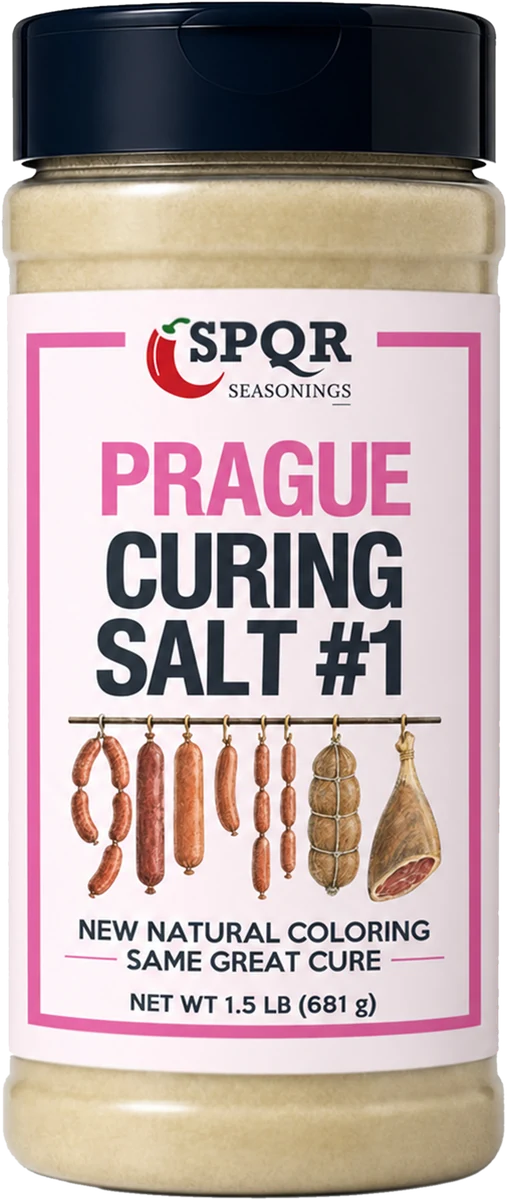
You can make real coppa at home with a gram scale, a refrigerator and a place to hang it at about 55 °F. This guide covers what capicola is, how it differs from prosciutto and salami, and a full recipe that uses Prague Curing Salt #2 from SPQR Seasonings at about 195 ppm nitrite, under the 200 ppm limit. Coppa is never cooked, so it needs Curing Salt #2, not #1. If you're curing something you'll cook, like bacon or pancetta, Prague Curing Salt #1 from SPQR Seasonings is the one you want.
What Is Capicola (Gabagool)?
Merriam-Webster defines capicola as a seasoned Italian pork "cut from the neck and top shoulder" that is cured in a casing, and lists capocollo and coppa as other names for it (Merriam-Webster). The name comes from Italian capo (head) and collo (neck). The cut is the long, round muscle that runs from the back of the pig's head into the top of the shoulder, the same place a pork butt (Boston butt) comes from. Butchers often call it the coppa or pork collar.
That muscle is the reason capicola tastes the way it does. It's well marbled, so the slices are rosy red with thin ribbons of white fat, and they stay tender even after months of drying. Classic capicola is rubbed with black pepper, garlic and warm spices. "Hot" capicola gets a coat of red pepper or paprika.
Why is capicola called gabagool?
Merriam-Webster's word history says "gabagool" reflects the southern Italian dialect habit of softening hard consonants (the c and p become g and b) and dropping the final vowel, and may come from the Neapolitan capecuollo. Italian immigrants from Naples and the south brought that pronunciation to New York and New Jersey. So gabagool isn't a different meat. It's capicola, said the way a lot of Italian-American grandparents said it.
Is capicola ham?
No. Ham is the hind leg. Capicola is the neck and shoulder. Some U.S. deli products sold as "capicola" or "cappy ham" are cooked and spiced rather than dry-cured, so read the label. True coppa is dry-cured and air-dried, never cooked. USDA's guideline for ready-to-eat salt-cured products lists coppa and capocolla alongside prosciutto, bresaola and pancetta as whole-muscle meats that are cured with salt and nitrite or nitrate and then air-dried (USDA FSIS, FSIS-GD-2023-0002).
Capicola vs Prosciutto vs Salami vs Pancetta
| Cured meat | Cut | Form | Eaten | Cure we'd use |
|---|---|---|---|---|
| Capicola (coppa) | Pork neck and upper shoulder | Whole muscle, cased and tied | Raw, sliced thin | Curing Salt #2 |
| Prosciutto | Pork hind leg (ham) | Whole leg, bone in or out | Raw, sliced thin | Salt only (traditional) or Curing Salt #2 |
| Bresaola | Beef eye of round | Whole muscle | Raw, sliced thin | Curing Salt #2 |
| Salami | Ground pork (sometimes beef) | Stuffed sausage, fermented and dried | Raw, sliced | Curing Salt #2 |
| Pancetta | Pork belly | Flat or rolled slab | Usually cooked | Curing Salt #1 if you'll cook it |
Capicola and prosciutto are both whole-muscle pork, but coppa is far easier at home. A coppa weighs 3 to 5 lb and is done in about 3 months. A whole prosciutto leg weighs 15 lb or more and takes a year or longer. If you've never dry-cured anything, coppa or bresaola is the place to start.
Before You Start: What Makes Home Coppa Safe
Coppa is never cooked. Everything that keeps it safe has to happen during curing and drying, so these points aren't optional:
- Weigh everything in grams. Salt and cure are figured as a percent of the meat's weight. A spoon isn't accurate enough for a product you'll eat raw. Our free curing salt calculator has a Curing Salt #2 whole-muscle mode that does the math for you.
- Use Curing Salt #2. It's 6.25% sodium nitrite plus 4% sodium nitrate. The nitrite works right away. The nitrate slowly turns into more nitrite over the weeks the coppa hangs (here's the chemistry). Federal rules cap nitrite at 200 ppm and nitrate at 500 ppm in the finished meat for home curing mixes (21 CFR 172.175, 21 CFR 172.170). This recipe uses 3.1 g of Curing Salt #2 per kilogram of meat: about 195 ppm nitrite and 124 ppm nitrate.
- Freeze the pork first. CDC says curing, drying and smoking alone don't reliably kill Trichinella, and that freezing pork less than 6 inches thick at 5 °F (-15 °C) for 20 days does (CDC). The risk from U.S. commercial pork is very low, but coppa is eaten raw, so we freeze it. Check your freezer with a thermometer. Never make a raw-eaten coppa from wild boar or bear; CDC warns some wild-game parasites survive freezing.
- Control the hang. 50 to 60 °F and 70 to 80% relative humidity, with gentle air movement. A kitchen or basement that swings with the weather won't work. A dedicated fridge with a temperature controller and humidifier will.
- Go by weight loss, not the calendar. Weigh the coppa when you hang it and dry it until it has lost at least 35% of that weight. Pathogens can't grow at a water activity of 0.85 or lower (Virginia Tech Extension, FST-485). Weight loss is the home cook's stand-in for that number. If you own a water activity meter, use it.
One honest note. USDA's guideline for commercial makers says there is limited published evidence that salt-curing and drying alone reliably kill Salmonella, E. coli and Listeria in whole-muscle products, which is why plants have to validate their process (FSIS-GD-2023-0002). Home coppa carries some risk. CDC advises people who are pregnant, 65 or older, or have a weakened immune system to heat dry-cured meats to 165 °F or until steaming hot before eating them (CDC).
Homemade Capicola (Coppa)
- Total time
- 3 to 4½ monthsmostly hanging
- Prep time
- 45 minplus 20 days frozen first
- Cure time
- About 4 weeksin the fridge, 7 days per inch
- Dry time
- 2 to 3 monthsat 50 to 60 °F, 70 to 80% RH
- Yield
- About 2½ lbfrom a 4-lb coppa
- Difficulty
- Advancedneeds a scale and a curing chamber
- Meat weight
- 1,800 g (about 4 lb)one boneless coppa
You'll need
Written for one 1,800 g coppa. For a different weight, use the scaling table below the recipe, or the curing salt calculator.
The meat
- 1,800 g (about 4 lb) boneless pork coppa (collar), in one piece, trimmed of loose flaps. Ask the butcher to cut it from the top of a pork butt.
The cure
- 5.6 g SPQR Seasonings Prague Curing Salt #2, weighed. Don't measure this one by spoon.
- 49.5 g fine non-iodized salt (2.75%), such as SPQR Seasonings Celtic Salt, Fine Ground. This is the plain salt, not the cure.
- 9 g sugar or dextrose (0.5%)
- 4 g (about 2 tsp) coarsely ground black pepper
- 2 g (about 1 tsp) fennel seed, toasted and cracked
- 2 g (about ½ tsp) garlic powder
- 2 bay leaves, ground
- Pinch freshly grated nutmeg
The coating (pick one)
- Classic: 2 tablespoons coarsely cracked black pepper
- Hot: 2 tablespoons sweet paprika or SPQR Seasonings Smoked Spanish Paprika, plus 1 to 2 teaspoons crushed red pepper
Cure dose
Weigh it. Never heaped, never "a little extra"
- Prague Curing Salt #2
- 5.6 g for 1,800 g (3.1 g per kg)
- Nitrite level
- about 194 ppm (limit 200)
- Nitrate level
- about 124 ppm (limit 500)
Storage: Keep the bottle sealed, labeled and out of reach of children and pets. Curing salt is not table salt. Store it away from your regular salt.
Equipment
- Digital scale that reads to 0.1 g (for the cure) and a kitchen scale for the meat
- Vacuum sealer and bags, or heavy zip-top bags
- Beef bung or collagen casing big enough for the coppa, plus butcher's twine or elastic netting
- A curing chamber: a fridge with a temperature controller, a small humidifier, a humidity controller and a thermometer/hygrometer
- A sterilized sausage pricker or needle
- A freezer that holds 5 °F (-15 °C) or colder, checked with a thermometer
Steps
-
Freeze it for 20 days
Wrap the coppa well and freeze it at 5 °F (-15 °C) or colder for at least 20 days. Thaw it in the refrigerator, which takes 1 to 2 days.
-
Trim and weigh
Trim off loose flaps and ragged bits so the surface is smooth, with no pockets where air can hide. Weigh the trimmed meat in grams and write it down. Every cure amount comes from this number.
-
Measure the cure
Multiply the meat weight by 0.0031 for Curing Salt #2, 0.0275 for salt and 0.005 for sugar. For 1,800 g that's 5.6 g, 49.5 g and 9 g. Weigh the Curing Salt #2 on the 0.1 g scale. Mix the cure, salt, sugar and cure spices in a bowl until the color is even.
-
Rub and bag
Rub the mix over every surface, working it into creases. Put the coppa and every grain of leftover mix in a vacuum bag and seal it, or use a zip-top bag with the air pressed out.
-
Cure in the fridge, 7 days per inch
Measure the coppa at its thickest point. Cure it at 36 to 40 °F for 7 days per inch of thickness, a rule from university extension guides for dry-cured meat (Mississippi State University Extension). A 4-inch coppa takes about 28 days. Flip the bag every other day to move the liquid around. Because the salt is measured, extra days won't make it saltier.
-
Rinse, dry and coat
Rinse off the cure, pat the coppa very dry, and press your chosen coating over the whole surface.
-
Case and tie
Soak the beef bung or collagen casing as the package directs, slide in the coppa, and tie it tightly with twine or netting. Prick the casing all over with the sterilized needle to release air pockets.
-
Weigh and tag
Weigh the cased coppa. Write the date, the hanging weight and the target weight (hanging weight × 0.65) on a tag, and tie it on.
-
Hang at 55 °F, 70 to 80% humidity
Hang it in the chamber at 50 to 60 °F (55 °F is the sweet spot) and 70 to 80% relative humidity, with a little air movement. Start around 80% for the first couple of weeks, then let it drift toward 70 to 75%.
-
Weigh it every week
Expect faster loss in the first weeks and slower loss later. A thin, even, powdery white mold is normal and safe. Small blue-green spots early in drying that wipe off completely can be wiped with a cloth dampened in vinegar; if they come back or spread, throw the coppa out. Throw it out right away for black mold of any amount, fuzzy patches that spread, yellow, orange or pink fuzz, mold under the casing, or a rotten or ammonia smell. Our mold guide has photos.
-
Done at 35% weight loss
The coppa is ready when it has lost at least 35% of its hanging weight and feels firm all the way through, with no soft center. That usually takes 2 to 3 months.
-
Rest, then slice thin
Peel off the casing, vacuum-seal the coppa and refrigerate it for 2 to 4 weeks so the moisture evens out from edge to center. Then slice it as thin as you can, across the grain.
Storage
- Whole, vacuum-sealed: keep it in the refrigerator. It keeps for months there, and you'll see the cut face darken a little as it ages.
- Sliced: refrigerate and eat within about a week. Slice only what you'll use.
- Freezer: vacuum-sealed slices or chunks freeze well for several months for best quality.
Scaling the Cure to Your Coppa
Every number below is 3.1 g of Curing Salt #2, 27.5 g of salt and 5 g of sugar per kilogram of meat, rounded to 0.1 g. That keeps nitrite at about 195 ppm and never over 200 ppm.
| Coppa | About | Curing Salt #2 | Nitrite | Nitrate | Salt | Sugar | Target weight (35% loss)* |
|---|---|---|---|---|---|---|---|
| 1,000 g | 2.2 lb | 3.1 g | 194 ppm | 124 ppm | 27.5 g | 5 g | 650 g |
| 1,500 g | 3.3 lb | 4.7 g | 196 ppm | 125 ppm | 41.2 g | 7.5 g | 975 g |
| 1,800 g | 4.0 lb | 5.6 g | 194 ppm | 124 ppm | 49.5 g | 9 g | 1,170 g |
| 2,000 g | 4.4 lb | 6.2 g | 194 ppm | 124 ppm | 55 g | 10 g | 1,300 g |
| 2,500 g | 5.5 lb | 7.8 g | 195 ppm | 125 ppm | 68.8 g | 12.5 g | 1,625 g |
*Figured on the trimmed raw weight for planning. Use the weight you write on the tag when you hang it, which will be a little lower after curing.
How Much Cure Is in This Coppa?
- Nitrite: 5.6 g of Curing Salt #2 × 6.25% = 0.35 g sodium nitrite. 0.35 ÷ 1,800 g = about 194 ppm. The limit is 200 ppm in the finished product (21 CFR 172.175; 9 CFR 424.21 says nitrite, nitrate or a combination may not result in more than 200 ppm nitrite).
- Nitrate: 5.6 g × 4% = 0.22 g sodium nitrate, about 124 ppm, far under the 500 ppm cap for home curing preparations (21 CFR 172.170).
- Why 3.1 g per kg and not 2.5? Many coppa recipes use 0.25% Cure #2 (about 156 ppm). Both are legal. SPQR Seasonings targets about 195 ppm for whole cuts (whole muscle), under the 200 ppm ceiling, and our calculator does the same. Never go over 3.2 g per kg.
- Never use Curing Salt #2 for anything you'll cook, like bacon or ham. Nitrate isn't allowed in bacon. For those, use SPQR Seasonings Prague Curing Salt #1. See Curing Salt #1 vs #2.
Prague Curing Salt #2 from SPQR Seasonings is currently sold out and coming soon. Any Cure #2 that's labeled 6.25% sodium nitrite and 4% sodium nitrate works at the same rate. Check your label.
Tips and Troubleshooting
- Hard outside, soft center (case hardening). The humidity was too low, so the surface dried shut. Raise the humidity to about 80%, or vacuum-seal the coppa in the fridge for a couple of weeks to let moisture even out. See case hardening.
- Gray ring or gray center when you slice it. The cure didn't make it all the way through, usually because the cure time was too short for the thickness. Don't eat a gray core raw. See Cure Didn't Penetrate.
- Too salty. Make sure you're using 2.75% salt by weight, not by cup. Different salts weigh very different amounts per spoon.
- No chamber? Make pancetta first. It cures in the fridge with Curing Salt #1 and gets cooked, so it doesn't need a chamber.
- Want more flavor? You can add about 0.25% SPQR Seasonings MSG (4.5 g for a 1,800 g coppa) to the cure mix for a rounder, savory taste. It doesn't change the cure.
Frequently Asked Questions
What is capicola?
Capicola is dry-cured pork neck and upper shoulder, cured with salt and spices, hung to dry for months, and sliced thin. It's also called coppa or capocollo.
What is gabagool?
Gabagool is capicola. It's the southern Italian and Italian-American pronunciation of capocollo, made famous by The Sopranos. It's the same meat.
Is capicola raw?
Traditional capicola is never cooked. It's made safe by salt, nitrite and nitrate, and by drying until it has lost about 35% of its weight. Some U.S. deli capicola is cooked, so check the label. CDC advises pregnant people, adults 65 and older and anyone with a weakened immune system to heat dry-cured meats to 165 °F or until steaming hot.
Is capicola spicy?
It can be either. Sweet or classic capicola is coated in black pepper. Hot capicola is coated in red pepper or paprika.
What's the difference between capicola and prosciutto?
Both are dry-cured whole-muscle pork, but prosciutto is the hind leg and takes a year or more, while capicola is the neck and shoulder and takes about 3 months. Capicola has more marbling and is usually more heavily spiced.
Do I need Curing Salt #2 for coppa?
Yes for a coppa you'll eat raw after months of drying. Curing Salt #2 adds nitrate, which keeps turning into nitrite as the meat hangs. Use 3.1 g per kilogram of meat for about 195 ppm nitrite.
How long does it take to make coppa?
About 3 to 4½ months: 20 days in the freezer, about 7 days per inch of thickness curing in the fridge, and 2 to 3 months hanging until it loses 35% of its weight.
Can I make coppa without a curing chamber?
Not safely in an ordinary room. You need to hold about 55 °F and 70 to 80% humidity for months. A spare fridge with a temperature controller and a humidifier is the usual home setup.
Keep Learning
- Homemade Bresaola
- Homemade Pancetta
- Curing Salt #1 vs #2
- Nitrites vs Nitrates
- White Mold on Salami: Good or Bad?
- Safe Meat Curing Temperatures
- Meat Curing Academy
Ready to cure? Pick up Prague Curing Salt #2 from SPQR Seasonings for coppa and other long dry cures, and Prague Curing Salt #1 from SPQR Seasonings for bacon, pancetta, ham and jerky. Our Curing Salt #1 is tinted yellow with annatto, not pink, so it's easy to tell from table salt.
Sources
- Merriam-Webster, capicola (definition and word history, including gabagool)
- USDA FSIS, Ready-to-Eat Fermented, Salt-Cured, and Dried Products Guideline (FSIS-GD-2023-0002)
- FDA, 21 CFR 172.175 Sodium nitrite (eCFR)
- FDA, 21 CFR 172.170 Sodium nitrate (eCFR)
- USDA, 9 CFR 424.21 Use of food ingredients and sources of radiation (eCFR)
- CDC, How to Prevent Trichinellosis
- CDC, Preventing Listeria Infection
- Mississippi State University Extension, Curing Pork Products at Home
- Virginia Tech Extension, Interpreting Water Activity Lab Results (FST-485)
By SPQR Seasonings. Last reviewed November 2026. Regulations quoted are current as of November 24, 2026.