
Pancetta is Italian cured pork belly: the same cut as bacon, rubbed with salt, black pepper and spices, cured, and air-dried instead of smoked. Merriam-Webster calls it simply "unsmoked bacon used especially in Italian cuisine," and USDA's bacon glossary describes it as Italian streaky bacon that is "usually cured in salt and spices and then air-dried." The name comes from pancia, Italian for belly.
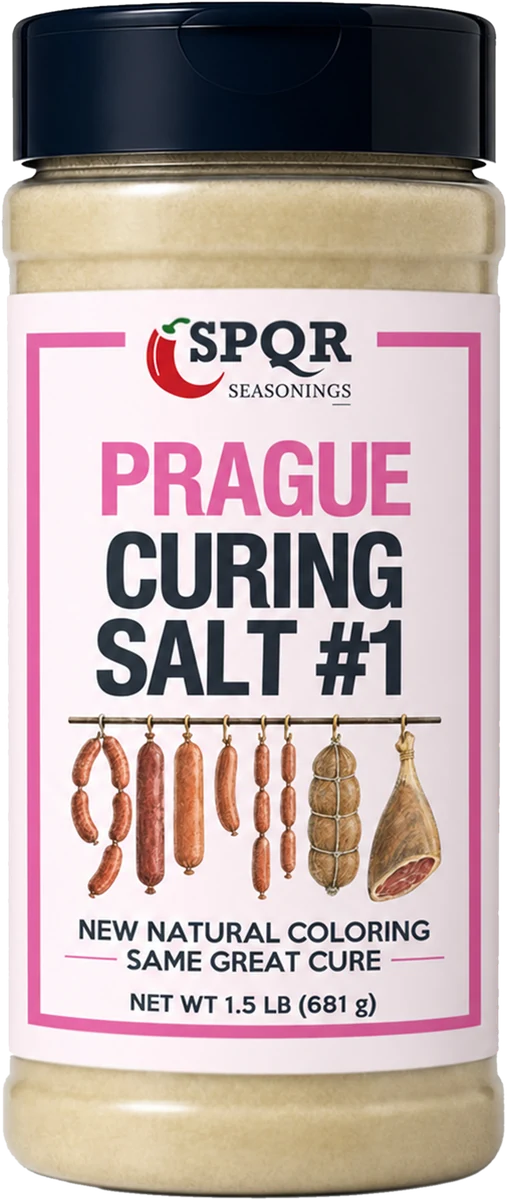
It's also one of the easiest cured meats to make at home. You need a pork belly, a scale, about two weeks and a refrigerator. No smoker, no curing chamber. This guide explains what pancetta is, how it differs from bacon and prosciutto, whether you can eat it raw, and how to make it with Prague Curing Salt #1 from SPQR Seasonings at about 195 ppm nitrite.
What Is Pancetta?
Pancetta starts as a slab of skinless pork belly. It's coated with a dry cure (salt, curing salt, a little sugar, black pepper, and aromatics such as garlic, bay, juniper and nutmeg), left in the fridge until the cure reaches the center, then rinsed and dried. It comes in two shapes:
- Pancetta tesa (flat): the belly is cured and dried as a slab. It's what this recipe makes, and it's the easiest at home.
- Pancetta arrotolata (rolled): the cured belly is rolled into a tight log, tied and hung. Sliced, it shows the spiral of fat and meat you see at the deli counter.
Most pancetta you buy, and every pancetta made with this recipe, is meant to be cooked. You dice it and render it for pasta alla carbonara or amatriciana, beans, soups and sauces, or you crisp thin slices like bacon.
Pancetta vs Bacon: What's the Difference?
Both are cured pork belly. USDA defines bacon as "the cured belly of a swine," and lists pancetta as the Italian word for it (USDA FSIS, Bacon and Food Safety). The differences are in the seasoning, the smoke and the drying.
| Pancetta | American bacon | |
|---|---|---|
| Cut | Pork belly | Pork belly |
| Cure | Dry cure: salt, nitrite, pepper, garlic, bay, juniper and other spices | Usually a wet cure (brine or injection) with salt, nitrite and sugar |
| Smoked? | Usually not | Usually yes |
| Dried? | Yes, air-dried after curing | No, smoked or cooked and sliced |
| Flavor | Pork, pepper and spice, salty, no smoke | Smoky and often sweet |
| Usual form | Slab, rolled log, or diced cubes | Thin strips |
Can you swap them? Yes, in most cooked dishes. Bacon adds smoke, so a carbonara made with bacon will taste smoky. If you want to take the smoke edge off store bacon, some cooks blanch it in simmering water for a minute or two before crisping it.
Pancetta vs prosciutto and guanciale
Prosciutto is the hind leg, dry-cured for a year or more and eaten raw in thin slices. Guanciale is cured pork jowl (cheek), richer and fattier than pancetta, and traditional in Roman carbonara. Pancetta is the belly. All three are Italian cured pork, but they're three different cuts.
Can You Eat Pancetta Raw?
Treat pancetta as something to cook unless the package clearly says it's ready to eat. USDA says pork bacon without other descriptors "is raw or uncooked, and must be cooked before eating," and that crisp-cooked bacon should have reached a safe temperature (FSIS). Some Italian rolled pancetta is fully dried for months and sold to eat raw, like coppa. That kind is made with a long dry cure, Curing Salt #2 and controlled drying. The pancetta in this recipe must be cooked. It's cured and dried for two weeks, not months, and it's made with Curing Salt #1.
Want a raw-eaten Italian cure? Start with homemade capicola (coppa) or bresaola.
Homemade Pancetta (Flat, Fridge-Cured)
- Total time
- About 2 to 3 weeksmostly hands-off
- Prep time
- 30 min
- Cure time
- 7 days per inchabout 10 days for a 1½-inch belly
- Dry time
- 7 to 14 daysuncovered, in the fridge
- Yield
- One slaba little lighter after drying
- Difficulty
- Easyneeds a scale
- Meat weight
- 5 lb (2,268 g)skinless pork belly
You'll need
Written for a 5-lb (2,268 g) skinless pork belly. For a different size, use the scaling table below, or the curing salt calculator (choose bacon, dry cure).
The meat
- 5 lbs. (2,268 g) skinless pork belly, squared off into a neat rectangle
The cure
- 7.07 g (1 level tsp) SPQR Seasonings Prague Curing Salt #1, measured level. Weigh it if you can.
- 57 g fine non-iodized salt (2.5%), such as SPQR Seasonings Celtic Salt, Fine Ground. This is the plain salt, not the cure.
- 23 g brown sugar (1%, about 2 tablespoons packed) or SPQR Seasonings Monk Fruit Sweetener
- 2 tablespoons coarsely cracked black pepper, divided
- 4 garlic cloves, minced
- 4 bay leaves, crumbled
- 1 tablespoon juniper berries, lightly crushed
- 1 teaspoon dried thyme
- ½ teaspoon freshly grated nutmeg
- Optional: ½ teaspoon crushed red pepper
Cure dose
Measure level, never heaped
- Prague Curing Salt #1
- 7.07 g (1 level tsp) for 5 lb
- Nitrite level
- about 195 ppm (dry-cured bacon limit 200)
Storage: Keep the bottle sealed, labeled and out of reach of children and pets. Curing salt is not table salt. Store it away from your regular salt.
Equipment
- Digital kitchen scale that reads in grams
- 2-gallon zip-top bag, or a glass or plastic dish that holds the belly flat
- A wire rack that fits on a sheet pan in your fridge
- Fridge thermometer (the fridge must hold 36 to 40 °F)
Steps
-
Weigh the belly
Trim it into a neat rectangle and weigh it in grams. If it isn't close to 5 lb, use the scaling table.
-
Mix the cure
Stir together the Curing Salt #1, salt, brown sugar, 1 tablespoon of the pepper, garlic, bay, juniper, thyme, nutmeg and red pepper until the cure is evenly spread through the mix.
-
Rub it on
Rub the mix over every surface of the belly, including the edges. Put the belly and any loose mix in the bag (or dish, covered), and press out the air.
-
Cure 7 days per inch
Refrigerate at 36 to 40 °F. Cure for 7 days per inch of thickness, and at least 7 days. Oklahoma State University Extension gives the same rule: a 2-inch belly cures in 14 days (OSU, ANSI-3994). Flip the bag every day or two and massage the liquid around.
-
Check that it's cured
The belly should feel firm all over, including the thickest part, like a flexed muscle rather than raw meat. If the center still feels soft, give it 1 to 2 more days.
-
Rinse and pepper
Rinse off the cure under cold water and pat the belly very dry. Press the remaining tablespoon of cracked pepper into the meat side.
-
Dry in the fridge
Set the belly on the rack over the sheet pan, uncovered, in the fridge for 7 to 14 days. USDA notes that dry-cured bacon "may be left to hang for up to 2 weeks to draw out moisture." The surface will darken and firm up.
-
Portion it
Cut it into 4 to 6 oz blocks. Keep one in the fridge and vacuum-seal or tightly wrap the rest for the freezer.
-
Always cook it
Dice it and render it over medium-low heat until the fat runs and the edges brown, or cook slices until crisp. Pork cooked to 145 °F with a 3-minute rest is safe (USDA FSIS). Cured pork stays pink when it's cooked, so go by the heat, not the color.
Storage
- Refrigerator: USDA's home storage chart gives pancetta 7 days in the fridge at 40 °F or below. Keep one block out at a time.
- Freezer: 4 months at 0 °F for best quality (same chart). It dices easily while still half frozen.
- Cooked leftovers: 4 to 5 days in the fridge.
Scaling the Cure to Your Pork Belly
The cure is 3.1 g of Curing Salt #1 per kilogram of belly (about 195 ppm), 2.5% salt and 1% sugar. Weigh it if you can. Spoon amounts are rounded down to the nearest ⅛ teaspoon at 7.07 g per level teaspoon, so they come in a little under 195 ppm.
| Belly | g | Curing Salt #1 | Nitrite | Or level spoons | Salt | Brown sugar |
|---|---|---|---|---|---|---|
| 2 lb | 907 | 2.8 g | 193 ppm | ⅜ tsp (183 ppm) | 23 g | 9 g |
| 3 lb | 1,361 | 4.2 g | 193 ppm | ½ tsp (162 ppm) | 34 g | 14 g |
| 4 lb | 1,814 | 5.6 g | 193 ppm | ¾ tsp (183 ppm) | 45 g | 18 g |
| 5 lb | 2,268 | 7.07 g | 195 ppm | 1 tsp (195 ppm) | 57 g | 23 g |
| 6 lb | 2,722 | 8.4 g | 193 ppm | 1⅛ tsp (183 ppm) | 68 g | 27 g |
| 8 lb | 3,629 | 11.2 g | 193 ppm | 1½ tsp (183 ppm) | 91 g | 36 g |
How Much Cure Is in This Pancetta?
- The math: 7.07 g of Curing Salt #1 × 6.25% sodium nitrite = 0.44 g of nitrite. 0.44 ÷ 2,268 g of belly = about 195 ppm.
- The limit: Pancetta is a dry-cured pork belly, which USDA treats as dry-cured bacon: no more than 200 ppm ingoing sodium nitrite (9 CFR 424.22(b); FSIS repeats the 200 ppm cap on its bacon page). That's also the general cap in 21 CFR 172.175. Never go over 3.2 g per kilogram.
- Why Curing Salt #1 and not #2: this pancetta is cured in about 10 days and then cooked. Nitrate (the extra ingredient in Curing Salt #2) isn't allowed in bacon, and it's meant for meats that hang for months. See Curing Salt #1 vs #2.
- Why not just salt? Without nitrite you get salted pork, not pancetta: grayer, without the cured flavor, and without nitrite's protection against Clostridium botulinum. See Can I Use Regular Salt Instead of Curing Salt?
Our Prague Curing Salt #1 is 6.25% sodium nitrite, the same strength as any Cure #1 or what most recipes call pink curing salt. Ours is tinted yellow with annatto instead of pink. It's used at exactly the same rate.
Tips and Swaps
- Want it rolled? After rinsing, pepper the meat side, roll the belly tightly lengthwise with the fat on the outside, and tie it every inch. Keep it in the fridge and cook it the same way. Air pockets in a roll can spoil, so roll it tight.
- Want it smoked? Then you're making bacon. Our homemade bacon recipe walks you through it.
- Too salty? Check that you weighed the salt. A cup of one brand of salt can weigh much more than a cup of another. You can also blanch diced pancetta for a minute before browning it. See Bacon Too Salty?
- Center still gray when you cook it? The cure didn't have enough time for the thickness. It's still safe to eat once cooked. Next time, go by 7 days per inch. See Cure Didn't Penetrate.
- More savory depth: add about 0.25% SPQR Seasonings MSG to the cure (5.6 g for a 5-lb belly). It adds flavor only and doesn't change the cure.
Frequently Asked Questions
What is pancetta?
Pancetta is Italian cured pork belly, seasoned with salt, black pepper and spices, then air-dried rather than smoked. It's sold flat or rolled and is usually diced and cooked.
Is pancetta the same as bacon?
They're the same cut, pork belly, and both are cured. Pancetta is usually dry-cured with pepper and spices and air-dried without smoke. American bacon is usually brined, smoked and sliced thin.
Is pancetta cooked?
Most pancetta is raw-cured, not cooked, and is meant to be cooked before eating. Some long-dried Italian rolled pancetta is sold ready to eat, and its label will say so. The pancetta in this recipe must be cooked.
Can you eat pancetta raw?
Only if the package says it's ready to eat. Homemade pancetta made with this recipe must be cooked, because it's dried for weeks, not months. Crisp it in a pan or cook it into a dish.
Can I substitute bacon for pancetta?
Yes, in most cooked dishes. Bacon adds a smoky flavor that pancetta doesn't have. Blanching bacon for a minute in simmering water takes some of the smoke and salt out.
Do I need curing salt to make pancetta?
Yes, if you want true pancetta. Curing Salt #1 gives it the cured color and flavor and helps protect against botulism. Use 7.07 g (1 level teaspoon) per 5 lb of belly, about 195 ppm nitrite.
How long does homemade pancetta last?
USDA's storage chart gives pancetta 7 days in the refrigerator and 4 months in the freezer for best quality. Portion it and freeze what you won't use in a week.
Can you freeze pancetta?
Yes. Wrap it tightly or vacuum-seal it and freeze it for up to 4 months for best quality. Diced pancetta can go straight from the freezer into the pan.
Keep Learning
- Homemade Cured and Smoked Bacon
- Homemade Capicola (Coppa)
- Cured vs Uncured Bacon
- How Much Curing Salt Per Pound?
- What Is Equilibrium Curing?
- Meat Curing Academy
Ready to make your first pancetta? One 1.5-lb bottle of Prague Curing Salt #1 from SPQR Seasonings holds about 96 level teaspoons, enough for roughly 480 lb of pork belly at this rate, plus your bacon, ham, corned beef and jerky.
Sources
- Merriam-Webster, pancetta
- USDA FSIS, Bacon and Food Safety (bacon definition, dry-cured bacon, glossary entry for pancetta, home storage chart)
- USDA, 9 CFR 424.22 Certain other permitted uses (bacon nitrite limits) (eCFR)
- FDA, 21 CFR 172.175 Sodium nitrite (eCFR)
- Oklahoma State University Extension, Meat Curing (ANSI-3994)
- USDA FSIS, Safe Minimum Internal Temperature Chart
By SPQR Seasonings. Last reviewed November 2026. Regulations quoted are current as of November 24, 2026.