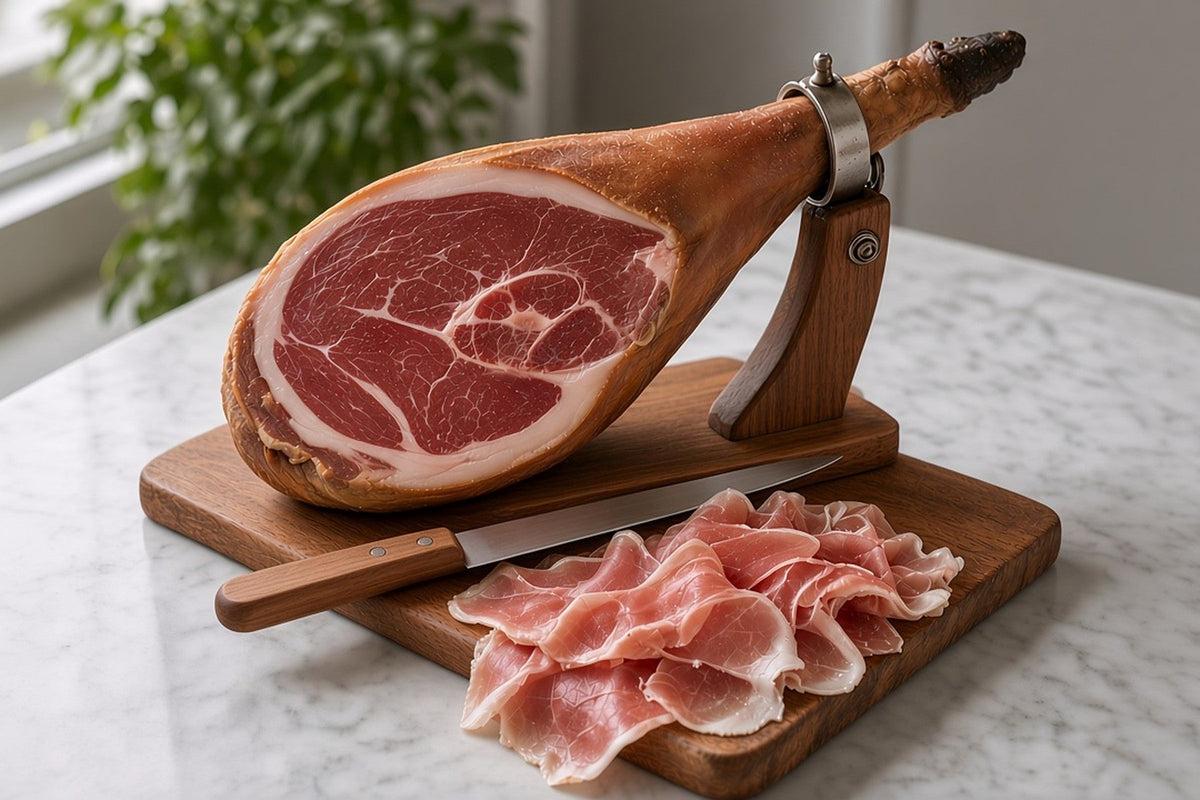
Prosciutto is Italian dry-cured ham: a pig's hind leg salted, rested and air-dried for a year or more, then sliced paper-thin and eaten without cooking. USDA describes it as "an Italian-style dry cured raw ham; not smoked," and explains that "prosciutto can be eaten raw because the low water content prevents bacterial growth" (USDA FSIS, Hams and Food Safety).
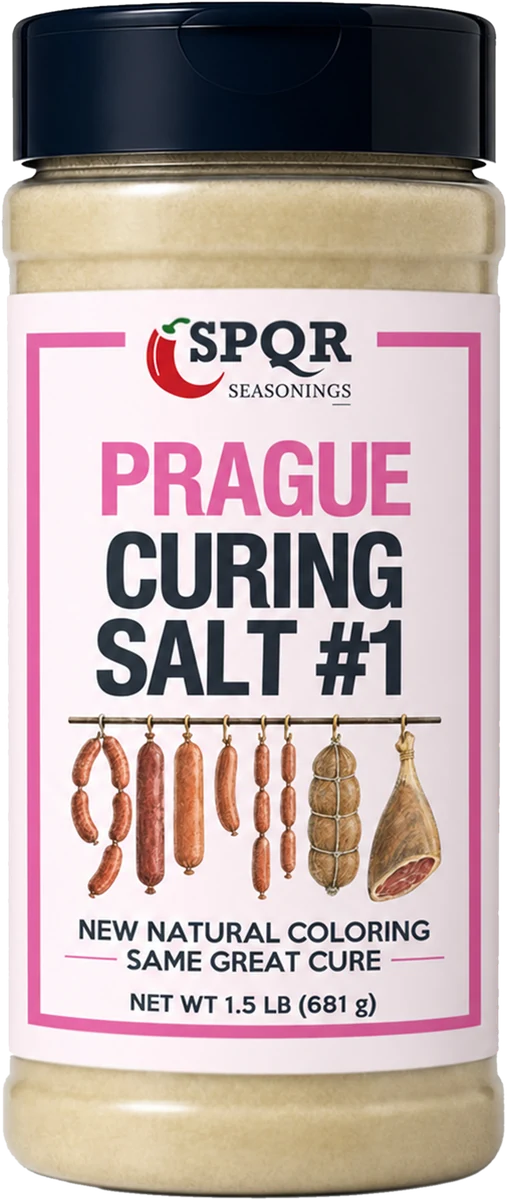
You can make a real whole-leg prosciutto at home, but it's a 12- to 18-month project that needs a curing chamber and careful sourcing. This guide covers what prosciutto is, whether it's raw, the safety rules, an honest whole-leg method using Prague Curing Salt #2 from SPQR Seasonings (currently sold out and coming soon), and a weeks-long pork loin version made with Prague Curing Salt #1 for anyone without a chamber.
Jump to the whole-leg prosciutto recipe · Jump to the easier pork loin version
What Is Prosciutto?
Prosciutto is the Italian word for ham. In the U.S. it almost always means prosciutto crudo, the raw, dry-cured kind. Cooked Italian ham is prosciutto cotto.
Here's how a classic prosciutto is made, following the Parma ham consortium's description (Making Parma Ham):
- Salting. The fresh leg is salted and held at 1 to 4 °C (about 34 to 39 °F) for about a week, then salted again for another 15 to 18 days, depending on weight.
- Resting. The hams rest 60 to 90 days in refrigerated rooms at about 75% humidity.
- Washing and drying. They're washed, dried, and hung in airy rooms for about three months.
- Greasing and aging. The exposed meat is coated with a paste of lard and salt so it doesn't dry too fast, and the hams finish aging in cellars until they're at least 14 months old.
The PDO Hams: Parma and San Daniele
Italy's best-known hams carry Protected Designation of Origin (PDO) rules, and both are cured with salt alone.
- Prosciutto di Parma: only two ingredients, pork leg and sea salt. The legs "do not undergo smoking," aging lasts at least 14 months, and finished hams test at 4.2% to 6.0% salt (Parma Specification).
- Prosciutto di San Daniele: sea salt only, with other additives and preservatives banned. It's aged at least 400 days from first salting and must test at 4.3% to 6.0% salt and a water activity no higher than 0.930 (San Daniele Specification).
The Parma consortium notes that this sets its ham apart from "other generic prosciuttos, normally containing nitrites and nitrates." Check the ingredients list on the package.
Salt Only, or Nitrite and Nitrate at Home?
The PDO plants use salt alone, but they also control the pigs, the salting rooms and the drying rooms, and independent inspectors check the hams before they are branded. At home we add Curing Salt #2 to a whole leg. Its nitrite guards against Clostridium botulinum deep in the meat early on. Its nitrate slowly turns into more nitrite over the long hang. For anything that hangs only a few weeks, Curing Salt #1 is the right choice. See Curing Salt #1 vs #2.
Is Prosciutto Raw?
It's uncooked, but it isn't raw meat the way a fresh pork chop is. Salt and months of drying pull out water until bacteria can't grow, which is why USDA lists prosciutto among the "ready-to-eat hams" that "can be eaten right out of the package" (FSIS). Commercial makers must also control Trichinella in their process.
- Higher-risk eaters: CDC advises people who are pregnant, 65 or older, or have a weakened immune system to heat deli meats, including sliced cured hams, to 165 °F or until steaming hot (CDC, Preventing Listeria Infection). Prosciutto crisped in a hot pan or baked on a pizza meets that.
- Once it's sliced, keep it cold. USDA's ham chart gives cut prosciutto 2 to 3 months in the fridge and 1 month in the freezer. Pre-sliced packs follow their use-by date.
Prosciutto vs Other Cured Meats
| Cured meat | Cut | Cured with | Aging | Eaten |
|---|---|---|---|---|
| Prosciutto (crudo) | Pork hind leg | Salt (Parma, San Daniele), or salt with nitrite or nitrate | At least 14 months (Parma) | Raw, sliced thin |
| Country ham | Pork hind leg | Dry salt rub, often with nitrate or nitrite; often smoked | Months | Usually soaked and cooked |
| Pancetta | Pork belly | Salt, nitrite, pepper and spices | Weeks | Usually cooked |
| Capicola (coppa) | Pork neck and shoulder | Salt with nitrite and nitrate | Months | Raw, sliced thin |
| Lonzino (cured loin) | Pork loin | Salt, nitrite (our version), spices | Weeks | Raw, sliced thin |
Prosciutto Food Safety: Read This Before You Start
A homemade prosciutto is eaten without cooking, so three hazards matter: Trichinella, Listeria and botulism.
Trichinella: Why Freezing Doesn't Cover a Whole Leg
Trichinella is a parasitic worm that can live in pork muscle. CDC says curing (salting), drying or smoking alone "does not consistently kill the worms." Its home freezing rule, 20 days at 5 °F, only covers pork less than 6 inches thick (CDC, How to Prevent Trichinellosis).
A whole bone-in leg is much thicker than that. USDA's guideline for inspected plants does list longer freezing times for pieces 6 to 27 inches thick: 30 days at 5 °F. But it assumes a dedicated freezer, monitored thermometers and air moving freely around each piece (FSIS Trichinella Compliance Guideline). A packed home freezer that cycles on and off isn't that, and nothing in the consumer advice covers a leg. Freezing also may not kill the freeze-resistant worms found in wild game, so never make prosciutto from wild boar.
That leaves two real controls for a home leg:
- Your pork source. FSIS says the drop in Trichinella in U.S. pigs is mostly due to raising them in confinement, and that the risk rises in pasture-raised pigs that can reach rodents and wildlife (FSIS). In 2024, USDA tested 3.2 million pigs raised under the industry's Pork Quality Assurance Plus (PQA+) program and found none infected (USDA ARS). Buy a USDA-inspected leg and ask your butcher whether it comes from PQA+ farms. The older USDA Trichinae Certification Program ended in 2021 (Federal Register), so you won't find "certified" on a label.
- The USDA dry-cure ham treatment, as a time and temperature guide. Before 2018, federal rules (9 CFR 318.10) spelled out ham curing methods that destroy Trichinella. They now live in the FSIS guideline. The one closest to prosciutto says to cure the ham to at least 6% brine concentration in the biceps femoris (a large thigh muscle), dry it at 55 °F or warmer for at least 150 days, and run the whole process at least 206 days (FSIS, Ham Method No. 4; 83 FR 25302). Our recipe meets the time and temperature parts. Plants confirm the 6% with lab tests, which you can't do in a kitchen, so the pork source is still your main protection.
Listeria, and Who Should Heat It First
USDA's guideline for commercial makers says there is limited published evidence that salt-curing and drying alone reliably kill Salmonella and Listeria in whole cuts (whole muscle); plants have to prove their process works (FSIS-GD-2023-0002). Start with a fresh, cold leg, sanitize your tools and keep the salting stage at 34 to 40 °F.
CDC advises people who are pregnant, 65 or older, or have a weakened immune system to avoid unheated deli and cured meats, and USDA adds very young children to its at-risk list for uncooked dry sausages (FSIS). For them, crisp homemade prosciutto until it's steaming hot.
Botulism and the Cure
Salt takes weeks to reach the center of a thick leg, and the deep meat around the bone is the riskiest spot until it does. That's where nitrite earns its place. Weigh the Curing Salt #2. Don't guess at it, and don't swap in Curing Salt #1 for a hang that lasts a year.
Homemade Prosciutto (Whole Bone-In Leg)
- Total time
- 12 to 18 monthsmostly hands-off
- Prep time
- 1 hour
- Salting
- About 14 days1.5 days per kg, 34 to 40 °F
- Resting
- 60 to 90 days34 to 40 °F, about 75% humidity
- Drying and aging
- 10 months or more55 to 60 °F, 65 to 75% humidity
- Yield
- About 14 lb (6.35 kg)bone-in, from a 20-lb fresh leg
- Difficulty
- Advancedneeds a curing chamber
You'll need
Written for one 20-lb (9,072 g) fresh, skin-on, bone-in hind leg. For other sizes, use the scaling table below or the curing salt calculator (choose whole cuts, dry cure).
The meat
- 20 lbs. (9,072 g) fresh hind leg, skin on, from a USDA-inspected source (ask for PQA+ pork), never wild boar
The cure
- 22.6 g (3⅛ level tsp) SPQR Seasonings Prague Curing Salt #2 (currently sold out and coming soon)
- 90 g fine non-iodized salt, such as SPQR Seasonings Celtic Salt, Fine Ground, to carry the cure
- About 3 kg (6½ lb) coarse non-iodized sea salt for packing
- For the face paste: lard, rice flour and coarse black pepper
Cure dose
Weigh it. Spoon users: 3⅛ level tsp, never heaped
- Prague Curing Salt #2
- 22.6 g for 20 lb (2.5 g per kg)
- Nitrite level
- about 156 ppm, at most (house cap 200)
- Nitrate level
- about 100 ppm, at most (USDA dry-cure limit about 2,188)
Storage: Keep the bottle sealed, labeled and out of reach of children and pets. Curing salt is not table salt.
Equipment
- A curing chamber that holds 55 to 60 °F and 65 to 75% humidity for a year, with room to hang a 20-lb leg
- Fridge space at 34 to 40 °F for the salting and resting stages, plus a food-safe tub
- Scale that reads to 0.1 g, a hanging scale, and a thermometer-hygrometer
- Cheesecloth or ham netting and strong cord
Steps
-
Trim, drain and weigh
Trim loose flaps and round off the cut face. Press along the large vein from the hoof end toward the hip to push out any leftover blood, and wipe it off. Weigh the leg in grams and write it down. Scale the cure to that number.
-
Rub in the cure
Mix the Curing Salt #2 with the 90 g of fine salt. Rub it into all the exposed meat, working it hard around the hip joint, the bone ends and the hock. Virginia Tech's ham guide stresses packing cure around the aitchbone (hip) to prevent bone sour.
-
First salting: 7 days
Set the leg in the tub on a bed of coarse salt, skin side down. Cover the cut face with a thick layer of coarse salt and give the skin a thin one. Refrigerate at 34 to 40 °F. Turn it and pour off the liquid every couple of days.
-
Second salting: to 1.5 days per kg
Brush off the wet salt and pack it again with fresh coarse salt only (no more cure). Keep it cold until the total salting time reaches 1.5 days per kg, or about 14 days for a 20-lb leg.
-
Rest 60 to 90 days
Brush off the salt, wipe the leg dry and keep it at 34 to 40 °F and about 75% humidity for 60 to 90 days, as Parma producers do. The meat darkens; that's normal.
-
Rinse, weigh and hang
Rinse briefly in cool water and pat dry. Weigh it, multiply the fresh weight by 0.70 for your target, and write both on a tag. Net or wrap it in cheesecloth and hang it at 55 to 60 °F and 65 to 75% humidity with gentle air movement. Don't let the chamber drop below 55 °F.
-
Coat the face
After about three months of drying, once the cut face feels firm, smear it with a paste of lard, rice flour and black pepper. That slows drying at the surface while the inside catches up.
-
Age to 30% loss and at least 12 months
Weigh it monthly. It's ready when it has lost at least 30% of its fresh weight and at least 12 months have passed since the first salting. We aim for 14, Parma's minimum.
-
Check it and slice
Scrub off the paste and any mold, and trim away the skin. Slice as thin as you can. A sour or rotten smell near the bone, or soft, slimy meat, means throw it out.
Storage
- Once cut: cover the cut face with plastic wrap or a thin coat of lard and keep it cold. USDA gives cut dry Italian ham 2 to 3 months in the fridge.
- Freezer: slice, layer with parchment, vacuum-seal and freeze. USDA gives it 1 month for best quality.
Scaling the Cure to Your Leg
The cure is 2.5 g of Curing Salt #2 per kilogram of fresh, bone-in leg. Grams are rounded down to the nearest 0.1 g. Spoon amounts are rounded down to the nearest ⅛ teaspoon at 7.07 g per level teaspoon, so they land under the weighed dose. Weigh it if you can.
| Fresh leg | g | Curing Salt #2 | Nitrite | Nitrate | Or level spoons | Salting days (1.5/kg) | Target weight (70%) |
|---|---|---|---|---|---|---|---|
| 16 lb | 7,257 | 18.1 g | 156 ppm | 100 ppm | 2½ tsp (152 ppm) | 11 | 11.2 lb (5,080 g) |
| 18 lb | 8,165 | 20.4 g | 156 ppm | 100 ppm | 2⅞ tsp (156 ppm) | 12 | 12.6 lb (5,715 g) |
| 20 lb | 9,072 | 22.6 g | 156 ppm | 100 ppm | 3⅛ tsp (152 ppm) | 14 | 14.0 lb (6,350 g) |
| 22 lb | 9,979 | 24.9 g | 156 ppm | 100 ppm | 3½ tsp (155 ppm) | 15 | 15.4 lb (6,985 g) |
| 25 lb | 11,340 | 28.3 g | 156 ppm | 100 ppm | 4 tsp (156 ppm) | 17 | 17.5 lb (7,938 g) |
How Much Cure Is in This Prosciutto?
- Nitrite: 22.6 g of Curing Salt #2 × 6.25% sodium nitrite = 1.41 g. 1.41 ÷ 9,072 g of leg = about 156 ppm.
- Nitrate: 22.6 g × 4% sodium nitrate = 0.90 g. 0.90 ÷ 9,072 g = about 100 ppm.
- Why 2.5 g per kg on a leg, not the 3.1 g we use on boneless cuts: the bone and skin don't take up the cure the way lean meat does. If bone and skin made up a fifth of the leg's weight and all the cure went into the lean, the lean would see about 195 ppm. That's still at or under our house cap of 200. Some cure also stays behind in the salt you brush off, so the real level is lower.
- The limit: Federal rules let dry-cured products start with up to 1 oz of sodium nitrite per 100 lb (625 ppm) and 3½ oz of sodium nitrate per 100 lb (about 2,188 ppm), with no more than 200 ppm nitrite in the finished product (9 CFR 424.21(c); 21 CFR 172.175; 21 CFR 172.170). Our house rule is stricter: never over 200 ppm nitrite going in.
Prague Curing Salt #2 from SPQR Seasonings is currently sold out and coming soon. Our Prague Curing Salt #1 is 6.25% sodium nitrite, the same strength as any Cure #1 or what many recipes call pink curing salt. Ours is tinted yellow with annatto, not dyed pink, and it's used at the same rate. Use it for the loin below, not the leg.
No Curing Chamber? Make a Prosciutto-Style Pork Loin (Lonzino)
A boneless pork loin gives you thin, sweet, prosciutto-like slices in weeks instead of a year. A pork loin is usually well under 6 inches thick (measure yours), so you can freeze it first by CDC's rule, cure it in the fridge, and dry it in the fridge in a humidity-controlling wrap.
For 2 lb (907 g) of trimmed, boneless pork loin:
- 2.8 g (⅜ level tsp) SPQR Seasonings Prague Curing Salt #1 (3.1 g per kg)
- 27 g fine non-iodized salt (3%)
- 4.5 g sugar (0.5%), or SPQR Seasonings Monk Fruit Sweetener
- 9 g coarse black pepper (1%), plus fennel seed or orange zest if you like
- Freeze first. Freeze the loin at 5 °F or colder for 20 days (CDC's rule for pork under 6 inches thick). Check your freezer with a thermometer. Thaw it in the fridge.
- Weigh and cure. Trim it into an even log, weigh it, and scale the cure with the table below. Rub it on, vacuum-seal, and refrigerate at 36 to 40 °F for 10 to 14 days, flipping daily. This is an equilibrium cure, so an extra day or two won't make it saltier.
- Rinse and weigh. Rinse, pat dry, and weigh it. Multiply by 0.65: that's your target.
- Wrap and dry. Wrap it in a humidity-controlling charcuterie wrap or dry-aging membrane bag, set it on a rack in the fridge with air around it, and weigh it weekly. Or hang it unwrapped at 50 to 60 °F and 65 to 80% humidity if you have the space.
- Done at 35% loss. Practical Self Reliance reached 35% in 3 weeks in a 58 °F basement using a wrap. A fridge may be slower or faster, so go by weight and feel: firm all the way through.
If you expect the drying to run past about 4 weeks, use Curing Salt #2 at the same 2.8 g instead (about 193 ppm nitrite plus 124 ppm nitrate; currently sold out and coming soon).
| Loin | g | Curing Salt #1 | Nitrite | Or level spoons | Salt (3%) | Sugar (0.5%) | Target weight (65%) |
|---|---|---|---|---|---|---|---|
| 1½ lb | 680 | 2.1 g | 193 ppm | ¼ tsp (162 ppm) | 20 g | 3.4 g | 442 g |
| 2 lb | 907 | 2.8 g | 193 ppm | ⅜ tsp (183 ppm) | 27 g | 4.5 g | 590 g |
| 3 lb | 1,361 | 4.2 g | 193 ppm | ½ tsp (162 ppm) | 41 g | 6.8 g | 885 g |
| 4 lb | 1,814 | 5.6 g | 193 ppm | ¾ tsp (183 ppm) | 54 g | 9.1 g | 1,179 g |
The math: 2.8 g × 6.25% = 0.175 g nitrite ÷ 907 g = about 193 ppm, under our 200 ppm cap.
How Other Prosciutto Recipes Compare
| Source | Cure | Nitrite (calculated) | Salting | Drying |
|---|---|---|---|---|
| Prosciutto di Parma (PDO) | Sea salt only | None | About 1 week + 15 to 18 days at 1 to 4 °C, then 60 to 90 days resting | At least 14 months total |
| Gastrochemist (home leg) | Sea salt first, then an equilibrium cure with nitrate (amounts not stated); or excess salt 1 day per kg | Not calculable from the page | 1 week + 3 weeks or more at 40 °F | 55 °F, 65% humidity, 12 months, about 30% loss |
| Matthew Evans, SBS Food (home leg) | 2 to 3 kg salt for a 10 kg leg, no cure | None | 1½ to 2 days per kg at 12 °C or below | 12 °C or below, 6 to 12 months |
| CuringChamber.com (home bone-in leg) | 0.25% Cure #2 mixed into the covering salt | about 156 ppm nitrite, 100 ppm nitrate at most | About 1 day per kg at 1 to 4 °C, then 1 to 3 weeks resting | 12 to 15 °C, 70 to 80% humidity, 12 to 18 months, to 30% loss |
| This recipe | Weighed Curing Salt #2 (2.5 g/kg) + excess sea salt | about 156 ppm nitrite, 100 ppm nitrate at most | 1.5 days per kg at 34 to 40 °F, then 60 to 90 days resting | 55 to 60 °F, 65 to 75% humidity, at least 12 months and 30% loss |
Matthew Evans salts at up to 12 °C (about 54 °F). We keep salting at 34 to 40 °F, like Parma, because that's where bacteria grow slowest while the salt works in. We weigh the cure separately from the packing salt, so the most nitrite that can go in is fixed by the scale, not by how long the leg sits in salt.
Prosciutto Troubleshooting
- Hard, dark outer layer: the outside is drying faster than the inside. Raise the humidity and coat the face sooner. See Case Hardening.
- Mold: white, powdery mold is normal on long-aged meat. Black, fuzzy or colored patches need a vinegar wipe, and widespread colored mold means stop. See White Mold on Salami: Good or Bad?
- Insects and mites: Virginia Tech warns that cheese skippers, larder beetles, red-legged ham beetles and mites go after aging hams. Keep the chamber sealed and clean, and wrap the leg in cheesecloth.
- Sour smell near the bone: that's bone sour, spoilage deep in the leg. Discard it. Prevent it by packing cure around the hip and keeping the salting stage cold.
Frequently Asked Questions
What is prosciutto?
Prosciutto is Italian dry-cured ham made from a pig's hind leg. It's salted, rested and air-dried for many months, then sliced very thin and eaten without cooking. Prosciutto di Parma uses only pork leg and sea salt and is aged at least 14 months.
Is prosciutto raw?
It's uncooked, but it isn't raw meat in the usual sense. Salt and long drying remove enough water that bacteria can't grow, and USDA treats prosciutto as ready to eat. Higher-risk groups should still heat it until steaming hot.
Is prosciutto cooked?
Prosciutto crudo, the kind sold as prosciutto in the U.S., is not cooked. It's cured and dried. Prosciutto cotto is the cooked Italian ham.
Can you eat prosciutto while pregnant?
CDC advises pregnant people to heat deli and cured meats to 165 °F or until steaming hot. Crisped prosciutto or prosciutto baked on a pizza meets that. Cold, unheated slices are the riskier choice.
How long does it take to make prosciutto?
A whole leg takes at least 12 months, and Parma requires 14. San Daniele requires 400 days. A prosciutto-style pork loin takes weeks: 20 days in the freezer, 10 to 14 days curing, then drying to 35% loss, which took 3 weeks in Practical Self Reliance's test.
Can you make prosciutto without nitrates?
Parma and San Daniele do, using salt alone under tightly controlled conditions. For a home leg we recommend Curing Salt #2 at 2.5 g per kg, because salt takes weeks to reach the deep meat around the bone.
How long does prosciutto last?
USDA's ham chart gives cut prosciutto 2 to 3 months in the refrigerator and 1 month in the freezer. Pre-sliced packages should follow their use-by date.
What's the difference between prosciutto and pancetta?
Prosciutto is the hind leg, aged for many months and eaten raw. Pancetta is the belly, cured for a few weeks and usually cooked. See our pancetta guide.
Keep Learning
- Homemade Capicola (Coppa)
- Homemade Bresaola
- Country Ham: What It Is and How to Cook It
- Curing Salt #1 vs #2
- Curing Salt Calculator
- Meat Curing Academy
Ready to start? Begin with the loin and a bottle of Prague Curing Salt #1 from SPQR Seasonings. When you're ready for a whole leg, watch for Prague Curing Salt #2, currently sold out and coming soon. At 2.5 g per kilogram, one 1.5-lb bottle (680 g) is enough for about 272 kg of leg.
Sources
- USDA FSIS, Hams and Food Safety (prosciutto definition, ready-to-eat hams, storage chart)
- Consorzio del Prosciutto di Parma, Product Specification (May 17, 2025)
- Consorzio del Prosciutto di Parma, Making Parma Ham
- Consorzio del Prosciutto di San Daniele, Disciplinare di Produzione (PDO specification)
- CDC, How to Prevent Trichinellosis
- USDA FSIS, Compliance Guideline for the Prevention and Control of Trichinella and Other Parasitic Hazards in Pork Products
- Federal Register, 83 FR 25302 (May 31, 2018), Elimination of Trichinae Control Regulations
- Federal Register, 86 FR 52954 (Sept. 24, 2021), Elimination of the Voluntary Trichinae Certification Program
- USDA ARS, Absence of Trichinella Infection in Commercial Pigs (Aug. 2, 2024)
- USDA FSIS, Ready-to-Eat Fermented, Salt-Cured, and Dried Products Guideline (FSIS-GD-2023-0002)
- USDA FSIS, Sausages and Food Safety (at-risk groups)
- CDC, Preventing Listeria Infection
- USDA, 9 CFR 424.21 (eCFR)
- FDA, 21 CFR 172.175 Sodium nitrite (eCFR)
- FDA, 21 CFR 172.170 Sodium nitrate (eCFR)
- Virginia Tech Cooperative Extension, Country Ham Curing and Aging (FST-513)
- Gastrochemist, Prosciutto
- Matthew Evans, Prosciutto (SBS Food)
- CuringChamber.com, Curing a Whole Ham at Home: Bone-In Method
- Practical Self Reliance, How to Make Lonzino
By SPQR Seasonings. Last reviewed November 2026. Regulations quoted are current as of November 24, 2026.